








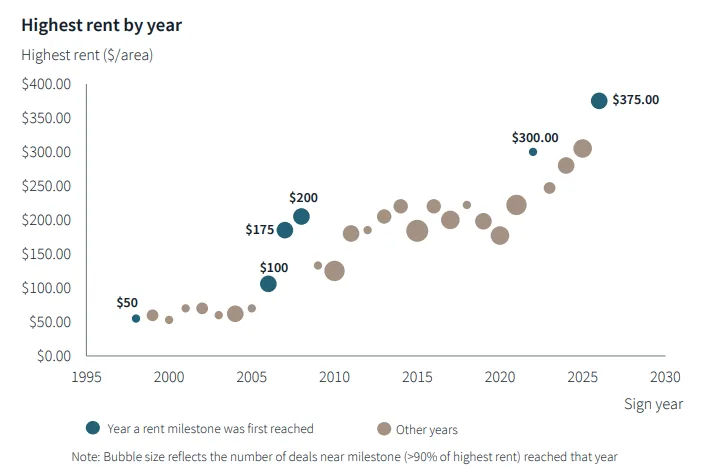
- JLL says $300 PSF Manhattan office rents are normalizing in about four years, versus 14 for $200 PSF, with repeat deals at that level showing sustained demand.
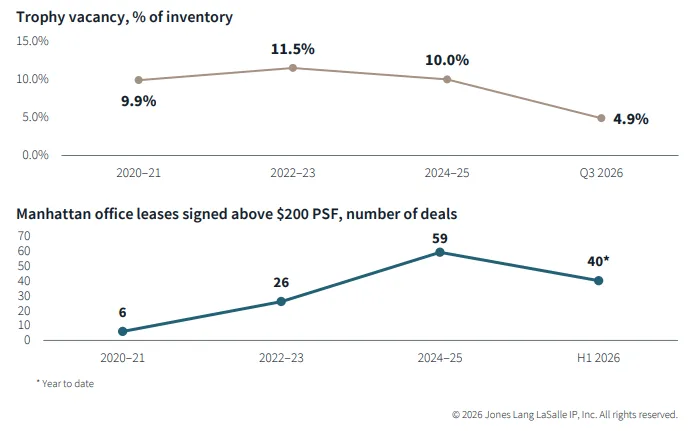
- Trophy vacancy is a cycle-low 4.9%, deals above $200 PSF hit 40 in the first half of 2026, and new supply drops from 7.8M SF a year to 1.5M.
- Capital, not lenders, is the constraint: equity has rotated to data centers and private credit, so record rents still haven’t unlocked new construction at scale.
$300 PSF rents are becoming a feature of Manhattan’s premium office market rather than a one-off, according to JLL’s October report, “NYC Office: A Market Waiting on Capital.”
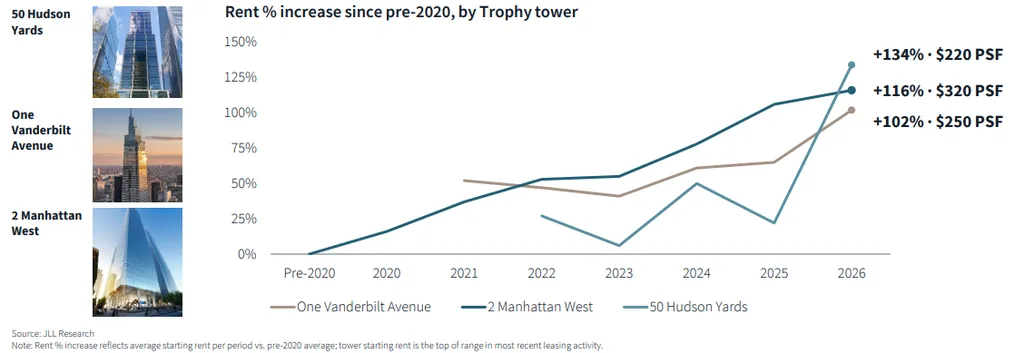
JLL counts 14 years for $200 PSF to become standard, versus four for $300, which first appeared in 2022.
Get Smarter About What Matters in New York
Subscribe to our free newsletter covering the biggest commercial real estate stories across the five boroughs — delivered in just 5 minutes.
Faster Than $200 Did
The 2008 downturn slowed the climb to $200. This time, repeat deals at $300 point to sustained demand, JLL says, helped by stronger leasing and elevated inflation.
Leases above $200 PSF are speeding up, too. Manhattan logged 40 such deals in the first half of 2026, against 59 across all of 2024 and 2025.
Asking starts at three Trophy towers, One Vanderbilt, 2 Manhattan West and 50 Hudson Yards, now sit above $200 PSF, more than double pre-2020 levels.
Trophy Vacancy Hits a Cycle Low
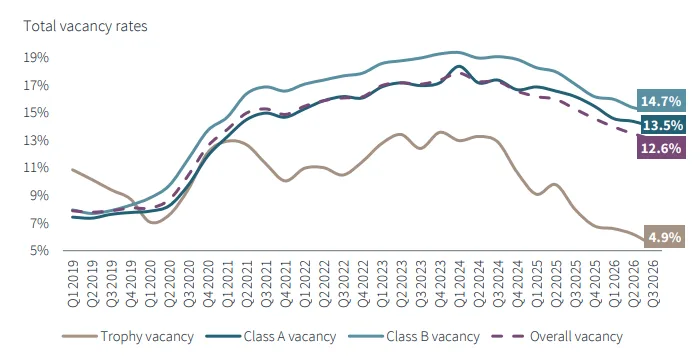
Trophy vacancy has fallen to 4.9%, down from an 11.5% peak in 2023 and below pre-pandemic levels. JLL says Midtown’s newer towers have no vacant large blocks left.
Class A+, Trophy, Super Trophy and new-build space combined accounted for over 52% of leasing volume this year versus 36% in 2025. New construction alone took 32%.
Class A and B vacancy dropped nearly two points year over year, yet it remains roughly triple Trophy’s.
CRE Daily reported the top of that market in October, when Castle Hook Partners signed a $375 PSF lease at 625 Madison, the highest-rent office lease in city history per JLL.
Demand Has Real Support
Manhattan in-office employment reached an all-time high of 1.31 million in 2026, and NYC’s labor participation rate was 62.1% in August. JLL’s 2026 occupancy benchmark has 70% of global workers in the office at least three days a week.
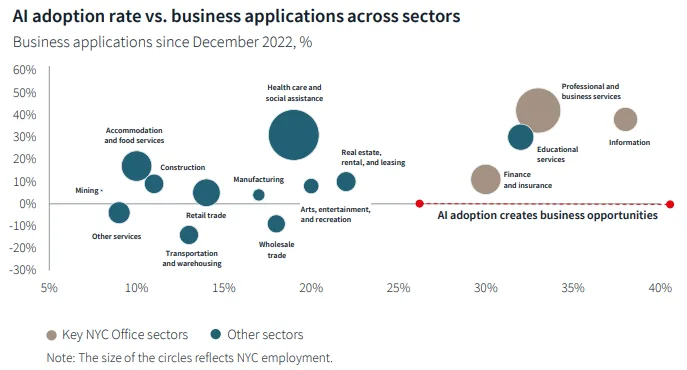
Firm formation tied to AI adoption is adding to occupier demand in the city’s office-using sectors, the report says.
Not a Peak by History
Manhattan asking rents have dipped just 1% this cycle. After the 2000 peak they fell 22%, and after 2008 they fell 27%, a slide that took seven years to recover.
Past cycles ran eight to 11 years peak to peak. The current one is seven years in, and JLL says the market hasn’t behaved like one that has topped out.
The Supply Cliff
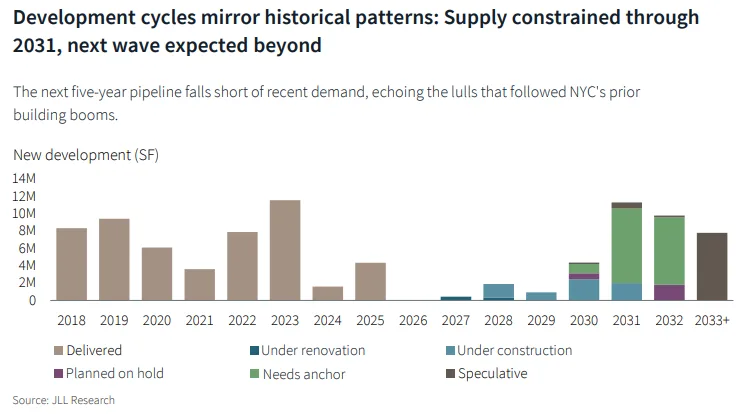
New development averaged 7.8M SF a year from 2018 through 2023. JLL projects just 1.5M SF a year through 2029.
Development has held at 0.9% to 1.7% of inventory since 2023 even as employment grows, and the next wave doesn’t show up until after 2031.
Why Nothing Gets Built
The money that’s missing is equity, not debt, JLL says. Lenders are confident, as CRE Daily saw when Griffin and Vornado landed a $3.3B loan for 350 Park, but investors have put their capital elsewhere.
Institutional office deal volume in Manhattan, Brooklyn and Queens dropped to $4.8B in 2025, down from $17.0B a decade earlier, per Real Capital Analytics. Late 2025 marked the first time data center building outspent office nationally, with roughly $700B of hyperscaler capex behind it.
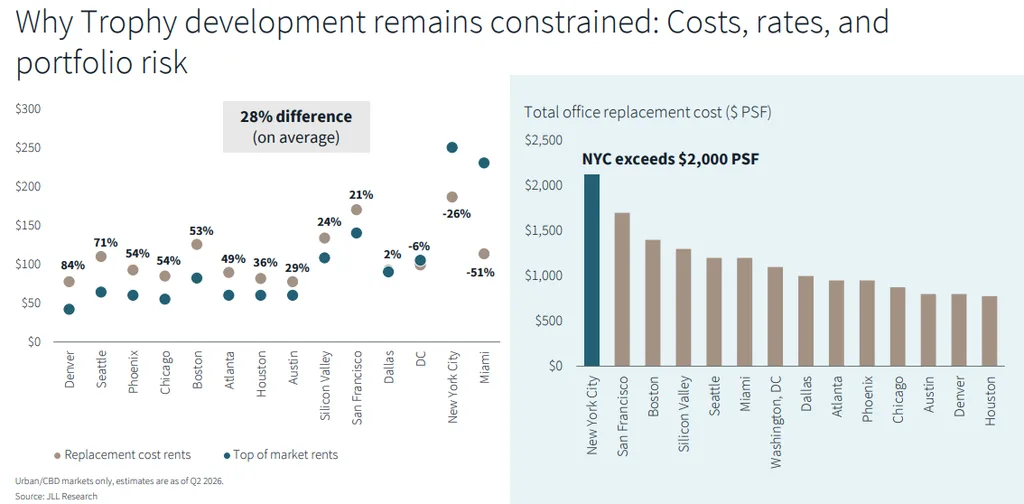
Replacement cost tops $2,000 PSF, and borrowing to build still costs more than a finished office building yields. JLL argues $300 is no record once adjusted for inflation and could still fall below the cost of building.
Investors also doubt that $300-plus rents would survive a downturn. Norway’s sovereign wealth fund bought into an existing Manhattan tower in 2025, which JLL cites as the kind of selective capital that does return.
Why It Matters
Tenants that can’t absorb top-of-market rents will move to cheaper submarkets or avenues. JLL’s watch item is that if Trophy rents climb faster than reallocation can offset, occupiers may redirect growth to other markets.
The report says that without new supply, New York risks becoming a hub for finance, tech and law while losing other industries.
What’s Next
JLL’s view is that supply waits on capital. Getting there takes cheaper construction debt, a return of sovereign and institutional equity from data centers and credit, or proof that rents hold through a slowdown.
The report lays out four scenarios, from a long squeeze to a full market recovery, depending on how fast capital returns and how much tenant saturation spreads beyond Trophy.