







- A total of $3.04B across 130 performing floating-rate Agency apartment loans in Texas reports an NCF DSCR below 1.0x, a balance-weighted 0.77x, even though they are still paying.
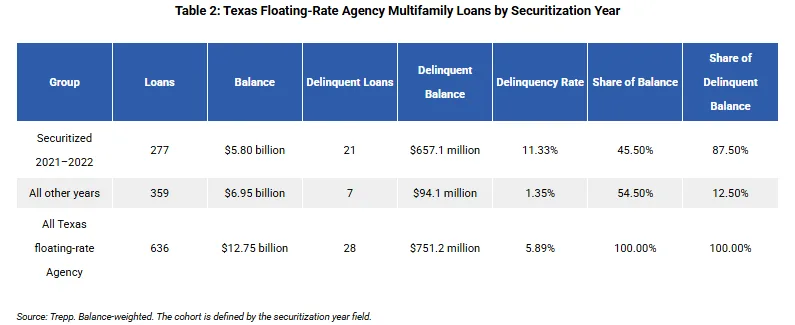
- Loans securitized in 2021 and 2022 hold 87.5% of the delinquent floating-rate balance, with an 11.33% delinquency rate against 1.35% for every other vintage.
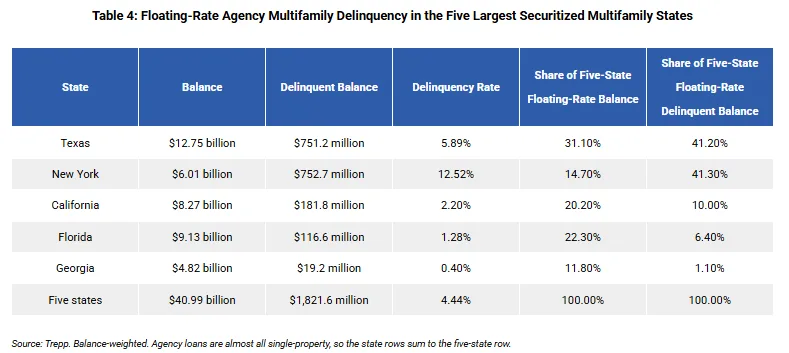
- Texas has the most floating-rate Agency apartment balance among the five biggest securitized states, and its delinquent loans are far larger, averaging $26.8M each.
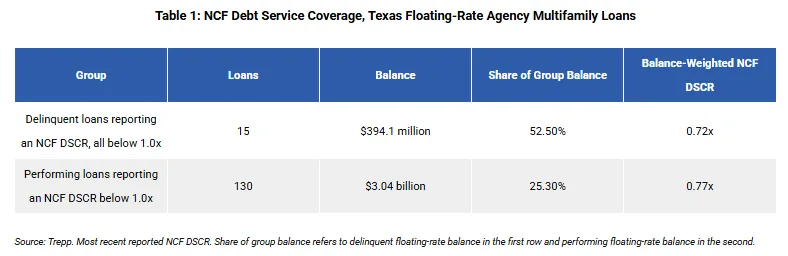
Roughly one in four performing floating-rate Agency apartment loans in Texas reports a DSCR below 1.0x, according to Trepp Research.
That is $3.04B across 130 loans, which is 25.3% of what’s performing, at a 0.77x weighted average. The loans are current, but reported cash flow doesn’t cover their debt service.
Get Smarter About What Matters in Texas
Subscribe to our free newsletter covering the biggest commercial real estate stories across Texas — delivered in just 5 minutes.
The Big Picture
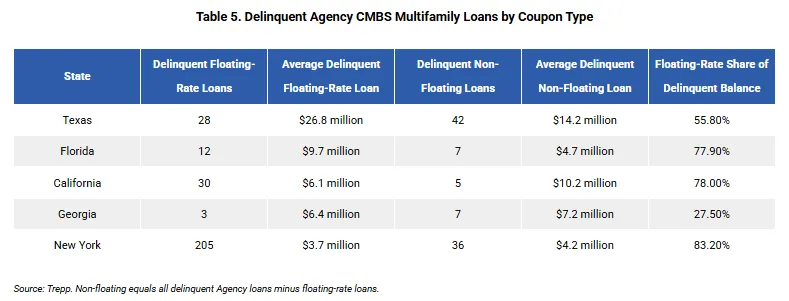
Texas holds $150.10B of securitized apartment debt, second only to California. Floating-rate loans are 21.3% of its Agency apartment balance yet 55.8% of the $1.35B that’s delinquent.
Only 15 of the 28 delinquent floaters report coverage, and all 15 land under 1.0x at a weighted 0.72x. The other 13, nearly half (47.5%) of delinquent dollars, report none.
The 2021-22 Vintage Problem
Deals packaged in 2021 and 2022 carry 87.5% of the delinquent floater dollars. Their delinquency rate is 11.33%, about 8.4 times the 1.35% for other years.
Floaters carry a 5.74% average coupon compared with 4.66% on fixed-rate paper, and the delinquent ones pay 5.99%.
CRED iQ found the same vintage effect, as CRE Daily reported in its piece on the multifamily refinance gap: 2021 and 2022 loans had the worst shortfall, with 57% of balance unable to refinance without new equity.
How Texas Compares
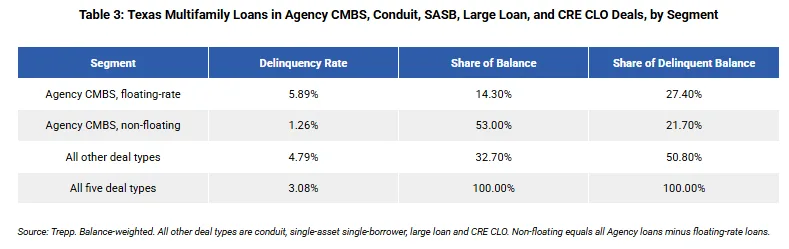
Texas floating-rate Agency loans show a 5.89% delinquency rate, versus 1.26% across the state’s other Agency loans and 3.08% across all its securitized apartment loans.
Across the five largest securitized states, Texas accounts for 31.1% of the five-state Agency floater total and 41.2% of its delinquencies. New York’s rate is higher at 12.52% on a smaller balance, and the other three come in lower: 2.20% for California, 1.28% for Florida and 0.40% for Georgia.
Large Loans Drive the Dollars
The typical delinquent Texas floater is $26.8M, about 2.8 times Florida’s, the next largest. New York’s, by contrast, average just $3.7M.
The two biggest delinquent loans in the state are floaters. The Kace, a Grand Prairie community of 720 units, carries $92.2M and slid into special servicing during April ahead of an expected payment default. Its 2025 cash flow works out to a 4.4% debt yield, under its 5.61% coupon.
Weston Medical Center Apartments, a 1972-built Houston asset with 793 units, owes $83.8M and entered special servicing the same month. Occupancy was 83% in July, coverage is 0.57x, and the annualized debt yield of 4.4% trails a 6.40% coupon.
Why It Matters
Delinquency shows where loans already broke. Coverage shows where they could, and $3.04B of current Texas loans sit below 1.0x. Trepp calls them a group worth watching for early signs of credit trouble.
Distress is spreading beyond bank-style lenders. Trepp’s earlier count, in CRE Daily’s report that private-label CMBS holds half of delinquent securitized apartment debt, showed a 7.69% rate in that segment against 0.80% at Freddie Mac.
What’s Next
Watch the 2021-22 floaters as they hit maturity and rate caps. Loans below 1.0x that still pay are the likeliest next entries on the special servicing list.