








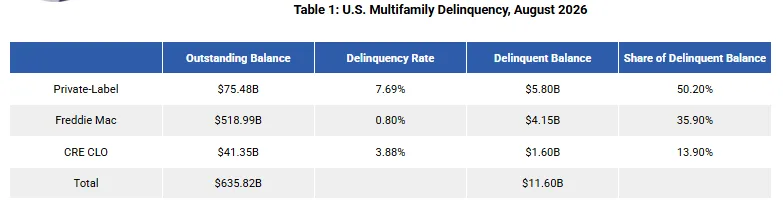
- Trepp counted $11.6B of delinquent loans among $635.82B of securitized multifamily debt in August, and private-label CMBS holds $5.8B of it at a 7.69% delinquency rate.
- Freddie Mac has 82% of the balance but a 0.80% rate and 35.9% of delinquent debt, while CRE CLOs have a 3.88% rate and 13.9% of the total.
- CRE CLO delinquency may understate distress because managers can pull impaired loans from pools, so the shift partly reflects loans leaving, not just who is struggling.
Private-label CMBS holds half of the delinquent multifamily debt in securitized markets, Trepp reported, even though it makes up just 12% of the outstanding balance.
Trepp counted $11.6 billion of delinquent loans in August across $635.82 billion of securitized multifamily debt.
Get Smarter about what matters in CRE
Stay ahead of trends in commercial real estate with CRE Daily – the free newsletter delivering everything you need to start your day in just 5-minutes
Who Holds the Distress
Private-label deals carry $75.48 billion of apartment loans at a 7.69% delinquency rate, which works out to $5.8 billion past due. Freddie Mac holds $518.99 billion, 82% of the tracked total, at a 0.80% rate and about $4.2 billion delinquent.
CRE CLOs hold $41.3 billion, mostly floating-rate transitional loans, and run a 3.88% delinquency rate, or $1.6 billion, per Trepp.
A Two-Year Shift
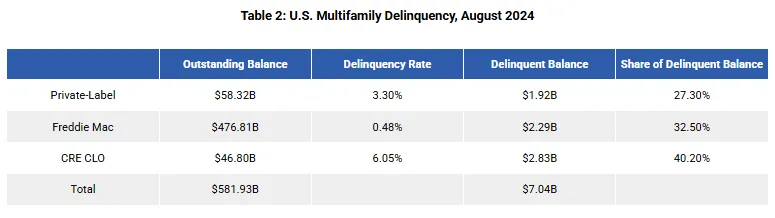
In August 2024, CRE CLOs held the largest slice of past-due apartment debt at about 40%, Trepp found, with Freddie Mac at 32% and private-label at 27%.
Total delinquent debt rose from $7.04 billion to $11.6 billion over the period, and private-label’s rate more than doubled, from 3.30% to 7.69%.
Portfolios Changed
Trepp says the CRE CLO universe shrank by about $5.5 billion to $41.3 billion over two years, and exposure to pre-1980 buildings fell by more than half, to $6.8 billion from $16.2 billion. Debt tied to post-2000 construction climbed to $28.5 billion from $19.2 billion.
Private-label exposure to pre-1980 buildings moved the opposite way, rising to $29.1 billion from $20.4 billion.
CRE CLO Numbers May Understate Stress
Trepp noted that CRE CLO managers can pull defaulted or impaired loans out of pools and have an incentive to do so. A deal that fails its overcollateralization test can see cash diverted from equity and subordinate noteholders to pay down senior notes.
Trepp walked through the math. A deal backed by $1 billion of loans against $800 million of notes starts at a 125% ratio, and marking one $100 million loan at half of par drops it to 118.75%, below a 120% trigger.
Rates and Dollars Moved
Freddie Mac delinquency rose from 0.48% to 0.80%, lifting past-due balances from $2.29 billion to about $4.2 billion, Trepp reported. CRE CLO delinquency moved the other way, from 6.05% to 3.88%, and past-due balances fell from $2.83 billion to $1.6 billion.
Trepp cautions that the CRE CLO drop is not all improvement, since loans can leave the pool.
Why It Matters
Reported delinquency now points at private-label CMBS, but Trepp cautions the change reflects loans leaving pools as well as who is struggling. Lenders should compare structures with care, since CRE CLO managers can drop troubled loans and private-label trusts generally cannot. That adds to the multifamily distress CRE Daily has been tracking.
What’s Next
Watch how CRE CLOs behave as Castlelake enters the CRE CLO market. Cleaner pools could keep headline delinquency low while stress shifts into other structures.