



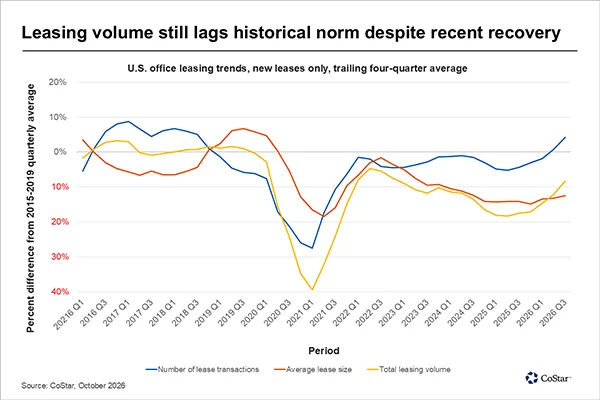
- New office leasing averaged 105M SF over the past four quarters through Q3, an improvement on the prior period but roughly 10M SF below the 2015-19 average.
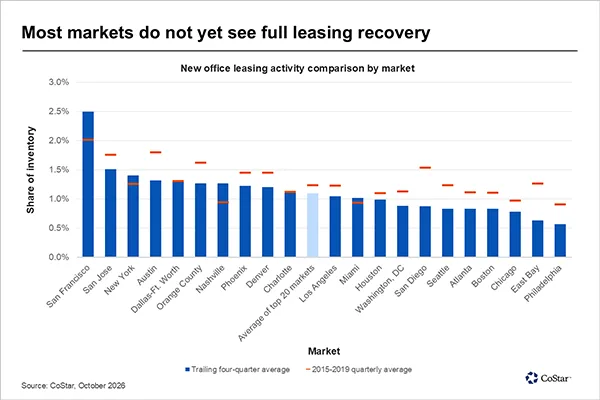
- San Francisco’s AI-driven leasing pushed quarterly volume past its pre-pandemic level of 2% of inventory, while New York, Nashville and Miami are also elevated.
- CoStar says stabilized space needs, high construction and financing costs, and slow renovations leave large occupiers few updated options, capping a full recovery.
U.S. office tenants signed new leases for an average of 105M SF over the past four quarters, according to CoStar data. That is an improvement on the prior four-quarter period.
Volume is still roughly 10M SF below the 2015-19 average.
Get Smarter about what matters in CRE
Stay ahead of trends in commercial real estate with CRE Daily – the free newsletter delivering everything you need to start your day in just 5-minutes
Why Volume Has Not Fully Recovered
Phil Mobley, CoStar’s national director of office analytics, said many large occupiers consolidated into smaller footprints earlier in the decade. He said that may have been the dominant factor in bringing down average lease transaction sizes.
Per-worker space requirements have since stabilized. The constraint now is supply of updated space.
Few Options for Relocating Occupiers
Mobley said elevated construction and financing costs have stifled new construction, and renovations remain unusually slow. Major occupiers seeking to relocate to updated space therefore have relatively few options.
That limits how many large deals can get done, even as demand improves.
San Francisco Leads the Markets
At the market level, San Francisco has seen quarterly leasing volume rebound past its pre-pandemic level of 2% of inventory. CoStar attributes the surge to AI-driven leasing by tech companies.
Volume is also elevated in New York, Nashville and Miami. Charlotte and Dallas have recently seen historically typical leasing activity, and CoStar says most markets do not yet see a full recovery.
Why It Matters
The recovery is real but selective. Demand is concentrated in markets with a clear driver, such as AI in San Francisco, while trophy offices in AI growth hubs draw institutional buyers.
Other markets are seeing strong activity as well, including Los Angeles office leasing, which hit its highest level since 2019. A shortage of updated space could shape where large tenants can actually move.
What’s Next
CoStar’s figures cover new leases executed through the end of Q3 and exclude renewals, which have little effect on overall occupancy. Watch whether construction and renovation activity picks up enough to give large occupiers more modern options.