





- Exchange-traded funds holding U.S. mortgage-backed securities posted $2.4B of net outflows in September 2026, the largest monthly total since March 2020.
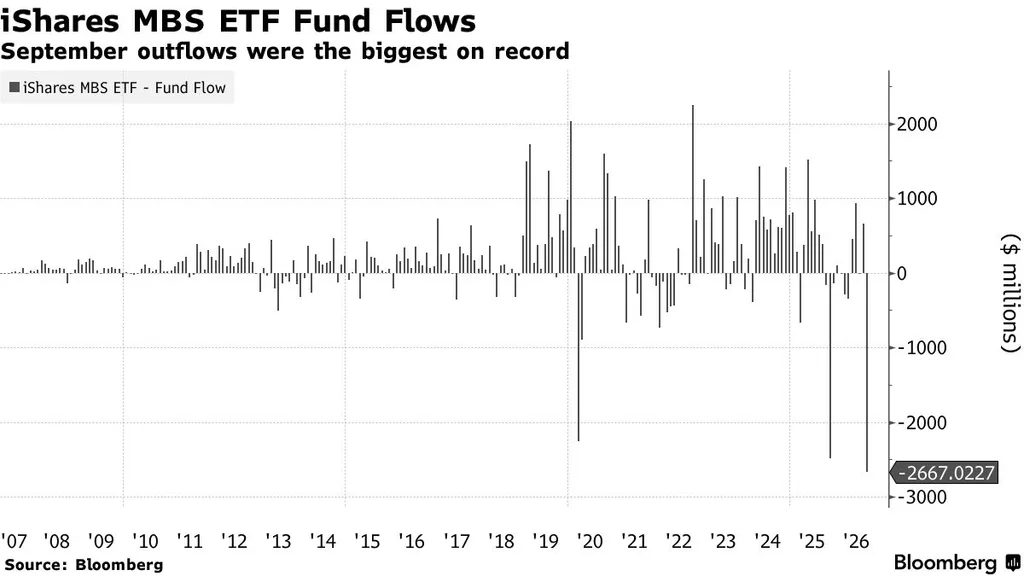
- BlackRock’s iShares MBS ETF lost roughly 3% in September and saw $2.7B in outflows, partly from an internal shift into an actively managed BlackRock fund.
- Weaker MBS demand and volatile rates can pressure mortgage spreads and borrowing costs, adding another headwind for housing and real estate finance.
Investors are pulling out of mortgage bond ETFs at the fastest pace in more than six years, according to Bloomberg. Exchange-traded funds that own U.S. mortgage-backed securities recorded $2.4B of net outflows in September 2026, the most since March 2020.
The selling follows a surge in Treasury yields to multi-decade highs on expectations that the Federal Reserve will raise rates to fight inflation.
Get Smarter about what matters in CRE
Stay ahead of trends in commercial real estate with CRE Daily – the free newsletter delivering everything you need to start your day in just 5-minutes
Why MBS Struggle When Rates Swing
Mortgage-backed securities tend to underperform when yields jump or drop unexpectedly. When rates rise, homeowners refinance less, locking investors into lower-yielding mortgage bonds for longer than expected.
A gauge of bond market volatility has climbed in recent weeks and sits near its April highs. Bloomberg Intelligence ETF analyst James Seyffart said rate volatility hurts MBS in particular because of that prepayment behavior, and noted that investors can now earn 5%-plus yields from Treasuries without the added complexity.
The Details
BlackRock’s iShares MBS ETF (MBB), which tracks the U.S. MBS market, fell roughly 3% on a total return basis in September, lagging a broad U.S. bond market ETF that was down 2.4%. MBB saw about $2.7B of outflows, its largest month since launch.
Part of that came from BlackRock itself: its model allocation team sold more than $1B of the passive MBB and moved into a BlackRock actively managed MBS ETF, which took in about $560M in September.
The Simplify MBS ETF and Schwab Mortgage-Backed Securities ETF also posted record outflows of $342M and $245.8M, respectively.
Mortgage Bond ETFs Feel the Rate Shock
The retreat comes as Treasury yields above 5% reset borrowing costs across real estate. For mortgage bond ETFs, competing with simpler, higher-yielding Treasuries has made the case for MBS harder to sell.
Why It Matters
MBS demand helps set mortgage spreads, so sustained selling can feed through to higher borrowing costs for homebuyers and housing finance more broadly. It adds to the refinancing pressure already building as the Fed tightens.
What’s Next
Watch whether bond market volatility eases from its near-April highs and whether Fed rate expectations shift. Until then, investors may keep favoring Treasuries over the prepayment risk that comes with mortgage bonds.