






- Florida and Texas hold 88 of the 100 highest-ranked snowbird destinations for the 2026-2027 winter, with Winter Haven and Lakeland, Florida, taking the top two spots.
- Texas claimed 14 of the 15 most affordable spots, while seasonal units make up as much as 65% of rentals in markets like Vero Beach.
- Snowbird demand underpins seasonal rentals, short-term rental income, retail and self storage across Sun Belt markets, with inland and Rio Grande Valley cities gaining appeal.
Florida and Texas account for 88 of the country’s 100 top snowbird destinations for the 2026-2027 winter, according to a new StorageCafe ranking. Central Florida’s Winter Haven took the No. 1 spot, followed by nearby Lakeland, while Texas swept the affordability rankings.
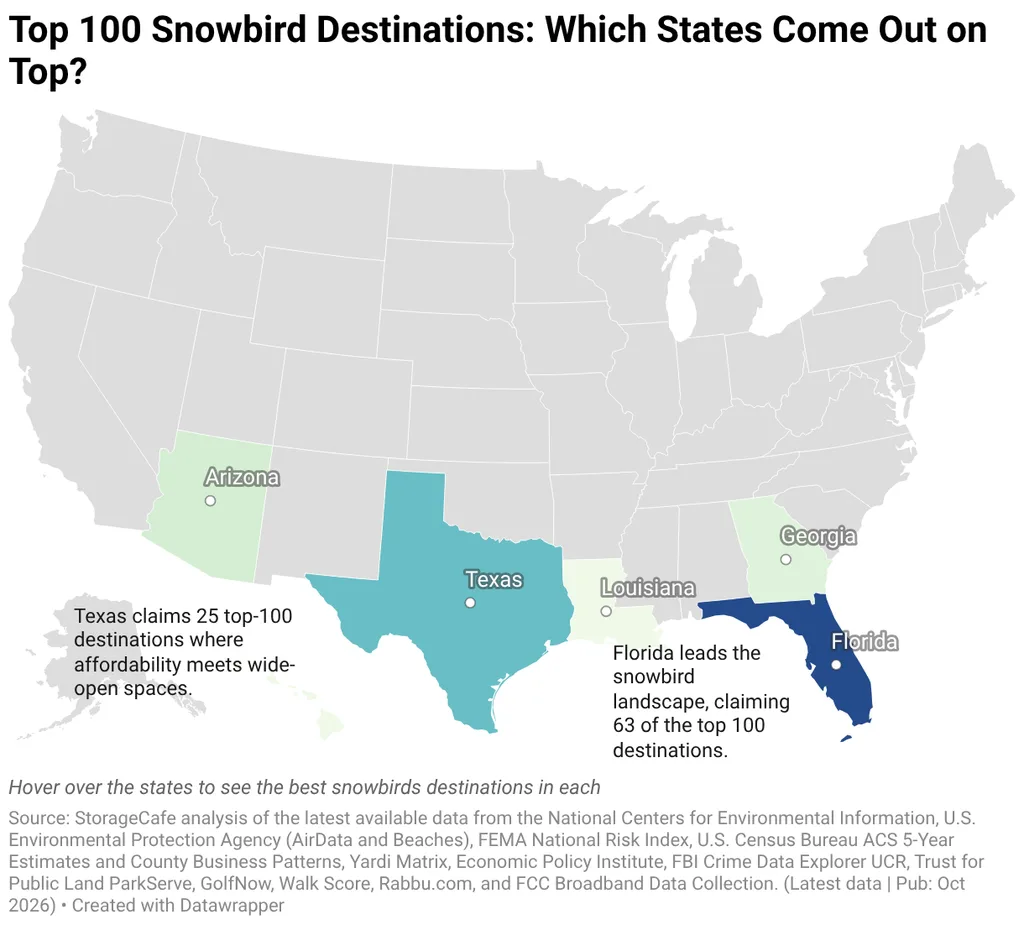
Florida led on volume with 63 cities in the top 100 snowbird destinations, while Texas placed 25.
Get Smarter about what matters in CRE
Stay ahead of trends in commercial real estate with CRE Daily – the free newsletter delivering everything you need to start your day in just 5-minutes
Seasonal Residents Drive Local Economies
Snowbirds are a real economic force in Sun Belt markets. A University of Texas Rio Grande Valley study cited by StorageCafe estimated roughly 57,000 Winter Texan households generated $761M in local spending in a single season.
StorageCafe sizes the potential snowbird pool, retirees and remote workers in colder northern states, at more than 40 million people. That’s not a count of who actually migrates, but of those with the flexibility to do so.
The Details
StorageCafe scored close to 500 cities on October-to-March climate, beach access, parks and golf, seasonal housing availability, rents and home prices, short-term rental revenue, groceries, walkability, healthcare, safety and self-storage costs.
Rounding out the top 10 after Winter Haven and Lakeland were McAllen, Mission, Vero Beach, Hollywood, Brownsville, Harlingen, Clearwater and Lake Wales. Three Polk County cities made the top 10, positioning inland Central Florida as an alternative to traditional coastal hubs.
Affordability anchors the Texas pitch. Monthly groceries for a family of four run about $680 in McAllen, Brownsville rents average around $1,000 a month, and more than half of Mission’s rental units are earmarked for seasonal use.
Florida’s coastal picks lean on lifestyle. Hollywood averages 71 degrees from October to March with a 2.5-mile beachfront Broadwalk, and its seasonal rentals generate more than $63K a year per unit, while Clearwater offers more than 20 miles of beaches.
Seasonal housing runs deep in these markets. Seasonal units make up 65% of rentals in Vero Beach, 60% in Hollywood, 58% in Yuma, Arizona, and 57% in Clearwater, and a Lakeland vacation property brings in close to $32K a year, per short-term rental data platform Rabbu.
Affordability Splits the Map
Texas claimed 14 of the 15 most affordable spots, led by Port Lavaca, Del Rio and Brownsville. The least affordable destinations were all in South Florida, including Boca Raton, Miami Beach and Fort Lauderdale.
Arizona ranked as the strongest alternative with six cities in the top 100, including Yuma and Lake Havasu City, where 75% of rentals are seasonal. Georgia placed four cities, led by Savannah, while Louisiana and Hawaii each placed one.
Not every seasonal buyer pool is expanding, though, as some Canadian snowbirds have been selling U.S. vacation homes.
Why It Matters
For CRE, snowbird demand supports seasonal rentals, short-term rental revenue, retail and self storage across the Sun Belt. Among top-10 cities, monthly storage rates ranged from $96 in Harlingen to $183 in Hollywood, against a $130 national average, per StorageCafe.
That seasonality makes off-season strategy a real consideration for storage operators in these markets. Experts consulted by StorageCafe, including Arizona State’s Kelly Bricker and Purdue’s SooCheong Jang, said snowbirds increasingly weigh healthcare, walkability and community alongside weather.
What’s Next
Heading into the 2026-2027 season, inland Central Florida and the Rio Grande Valley stand out as value plays against pricier coastal hubs.
Watch for seasonal rental and storage demand to hold up best in markets that pair warm winters with lower living costs. As UCF’s Xiaoxiao Fu told StorageCafe, snowbirds are now weighing economic, lifestyle and practical factors, not just warmth.