






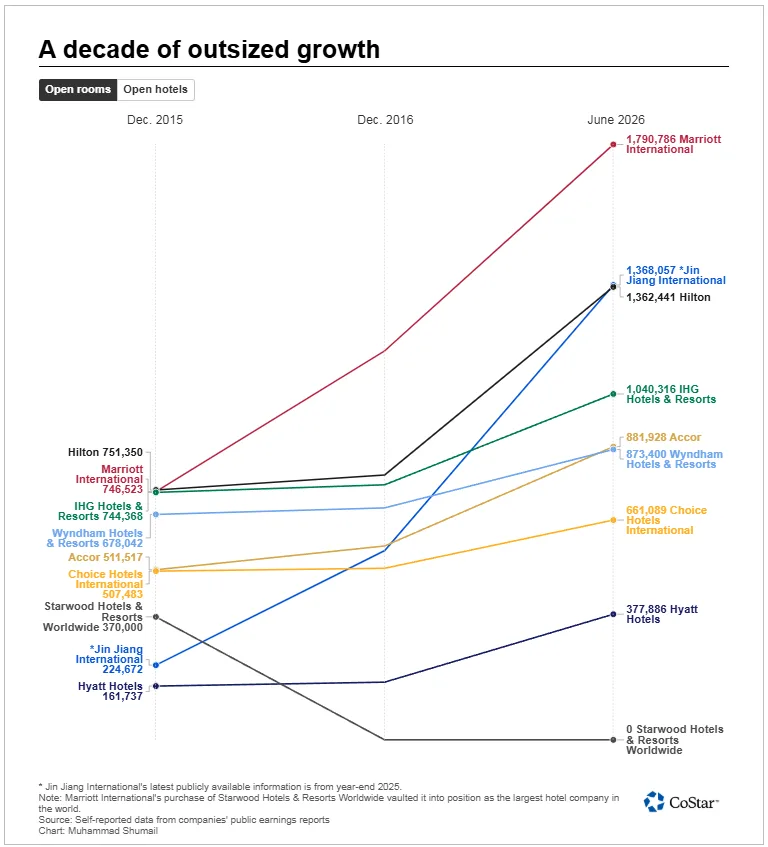
- Marriott’s $13.3 billion Starwood acquisition, closed in September 2016, vaulted it past Hilton in open rooms and set off a decade-long race for scale among hotel franchisors.
- The deal lifted Marriott to more than 5,700 hotels, 1.1 million rooms and 30 brands; today it has nearly 40 brands and Bonvoy counts over 300 million members.
- Analysts expect growth through $100 million to $500 million tuck-in deals, partnerships and international conversions rather than another megamerger, given regulatory and valuation hurdles.
A decade after Marriott International closed its $13.3 billion acquisition of Starwood in September 2016, the Marriott-Starwood deal stands as the defining transaction behind hotel franchising’s race for scale, according to CoStar News Hotels.
The retrospective opens a CoStar series on how the deal changed the way major hotel companies and their stakeholders think about growth.
Get Smarter about what matters in CRE
Stay ahead of trends in commercial real estate with CRE Daily – the free newsletter delivering everything you need to start your day in just 5-minutes
The Mount Rushmore of Hotel Deals
Before Marriott-Starwood, the landmark hotel company acquisition was Hilton’s 1999 purchase of Promus Hotel Corp. for $3.1 billion, which brought Hampton, Embassy Suites, Homewood Suites and DoubleTree into the fold. Marriott-Starwood dwarfed it, putting so many recognizable brands under one parent that it earned the Mount Rushmore nickname.
Marriott CEO Tony Capuano, then the company’s chief development officer, said the deal illustrated the power of broad brand portfolios. Simon Turner, Starwood’s former president of global development and founder of Alpha Lodging, said the business has consolidated and will likely keep consolidating because global scale matters.
The Details
Before the deal, Marriott reported 4,494 open properties with 764,513 rooms, 19 brands and more than 57 million loyalty members in Q2 2016. On closing day, Sept. 23, 2016, it reported more than 5,700 properties, 1.1 million rooms and 30 brands, and its Q3 2016 pipeline reached 2,454 properties and nearly 420,000 rooms.
Its combined loyalty programs totaled 85 million members. By comparison, Hilton reported 4,774 hotels, 781,272 rooms and about 58 million loyalty members in Q3 2016.
Marriott has led in open rooms ever since, despite a major data breach tied to Starwood, the COVID-19 pandemic and the February 2021 death of the deal’s architect, CEO Arne Sorenson.
The Brand Grab Era
Patrick Scholes of Truist Securities called the deal a brand grab that set the tone that bigger is better. Rivals followed with Accor’s 2016 purchase of FRHI, Wyndham’s 2018 deal for La Quinta and Hyatt’s 2021 acquisition of Apple Leisure Group, though none matched Marriott-Starwood’s scope.
Baird’s Mike Bellisario said the move had a defensive side too, since Hyatt was also in the running for Starwood. He now ranks Marriott 1A and Hilton 1B, making the U.S. effectively a two-horse race.
Because the major brands have largely shed owned real estate, their scale is the main way they deliver value to owners, even as hotel REIT activity climbs on improving fundamentals.
Why It Matters
Scale powers distribution, revenue management and loyalty, which is what brings owners and developers to a flag. Last year, 68% of Marriott’s room nights came from loyalty members, and Bonvoy, launched in 2017 by combining the legacy programs, now counts more than 300 million members.
Branded credit cards have become a big earnings driver, Scholes said, and owners want a bigger cut. In March, 51 owners with more than 1,000 Marriott-branded hotels wrote to executives seeking a larger share of fee revenue; Capuano declined to give an official response on the company’s Q2 call.
For owners weighing flags, that tension sits alongside a deeper bidding pool, with private equity bidders competing harder for U.S. hotels.
What’s Next
Capuano pointed to midscale as a growth lane, citing the City Express acquisition, the new StudioRes brand and more than 500 midscale hotels open or in the pipeline. Another megamerger looks harder: Choice Hotels abandoned its $7.8 billion bid for Wyndham in March 2024 amid likely regulatory scrutiny.
Bellisario expects $100 million to $500 million tuck-in deals, partnerships like Hilton’s with AutoCamp and Small Luxury Hotels of the World, and conversions of independent hotels abroad. Turner still expects a third dominant global player to emerge eventually.