



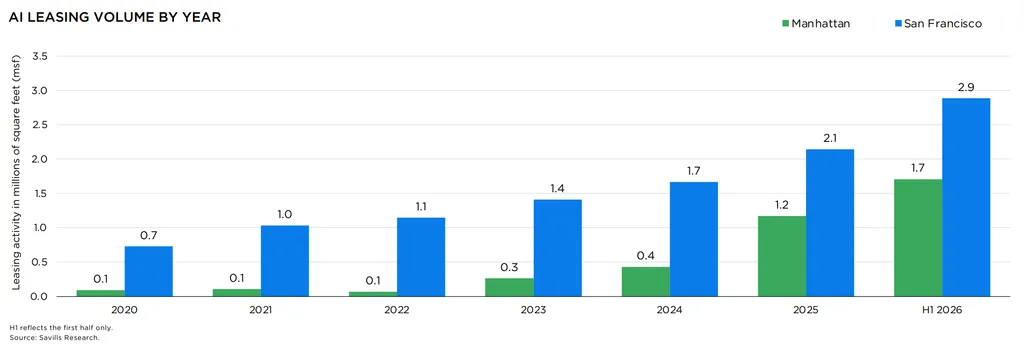
- AI firms leased 2.9M SF in San Francisco and 1.7M SF in Manhattan during the first half of 2026.
- Sublease share fell to 23.0% in San Francisco and 17.5% in Manhattan for 2025 through H1 2026.
- AI tenants are taking more Class A space, accepting smaller concessions, and signing substantially longer leases as their businesses scale.
A Savills and CompStak partnership report on AI office leasing shows AI tenants moving from opportunistic subleases into more institutional office commitments. In H1 2026, AI companies leased 2.9M SF in San Francisco and 1.7M SF in Manhattan. San Francisco’s total exceeded every prior full year. Manhattan recorded more AI leasing in six months than during 2024 and 2025 combined. The scale of demand is changing how these companies choose buildings and structure leases.
Get Smarter about what matters in CRE
Stay ahead of trends in commercial real estate with CRE Daily – the free newsletter delivering everything you need to start your day in just 5-minutes
AI Demand Concentrates in Key Submarkets
AI accounted for 31.3% of new San Francisco leasing in H1 2026. That was close to its 2023 peak, but on much larger volume. Manhattan’s share reached 8.2%, up from 0.7% in 2020.
Demand is heavily concentrated within both cities. Availability in San Francisco’s Mission Bay and Showplace Square fell 1,920 basis points from Q4 2023 to Q2 2026. Park Avenue South in Manhattan fell 1,120 basis points over the same period. Both declines were roughly twice those of the broader markets.
Mission Bay and Showplace Square availability fell from 36.8% to 17.6%. That puts the submarket more than 10 percentage points below the San Francisco average. Park Avenue South declined from 26.4% to 15.2%.
Much of the absorption reflects AI companies taking space returned during the previous cycle. Major deals have backfilled blocks vacated by earlier technology tenants in San Francisco. In Manhattan, AI companies have also absorbed space previously occupied by professional services and financial firms.
The Details
The leasing mix has shifted sharply toward direct space. Subleases represented 44.9% of San Francisco AI volume from 2020 through 2024. That share fell to 23.0% for 2025 through H1 2026. Manhattan moved from 42.3% to 17.5%.
The high point came in 2023, when more than three-quarters of AI volume in both cities was sublease space. Since 2024, direct deals have represented roughly three-quarters or more of annual volume. Manhattan reached 89.9% direct activity in 2025.
The transition reflects both company growth and changing market conditions. Scaling AI firms increasingly need offices that can support larger workforces and longer occupancy periods. At the same time, much of the discounted space that made subleases attractive earlier in the cycle has already been absorbed.
Sublease Discounts Keep Shrinking
The bargain that drew many early AI tenants is also fading. From 2020 through 2024, AI tenants subleased space at starting rents 15.9% below market in Manhattan. The discount narrowed to 7.1% in the latest period. San Francisco’s discount moved from 6.2% to 4.9%.
That means AI tenants are finding both less sublease inventory and smaller savings when they do use it. The discounted, pre-built space that supported the sector’s early expansion has largely been absorbed.
The change reduces the economic advantage of short-term subleases just as growing companies need larger footprints and more control over their workplaces. Direct leasing increasingly offers a better fit for tenants planning around longer hiring and expansion cycles.
Why It Matters
AI companies are behaving more like established office occupiers as they scale. Class A captured 63.7% of Manhattan AI leasing in 2025 through H1 2026, up from 48.6% during 2020 through 2024. San Francisco rose from 57.7% to 62.4%.
Manhattan AI lease terms increased from 49.0 months in 2020 to 90.9 months in H1 2026. That is approaching the 108.7-month average for non-AI tenants. San Francisco reached 58.6 months in 2026.
The pattern reinforces AI-driven office demand in major technology markets. Five tracked AI tenants expanded footprints by roughly three to six times. Most also doubled lease duration while moving into higher-quality buildings.
All five followed a similar progression from their earliest leases. Companies took more space, made longer commitments, and upgraded building quality as they matured. Four relocated during the process, while one expanded in place. Several ultimately moved into trophy, renovated Class A, or Class A properties.
Lease Economics Move Toward Market
Concessions declined as lease terms lengthened. Manhattan’s AI concession ratio fell 460 basis points from 20.8% to 16.2%. San Francisco’s declined 190 basis points from 18.5% to 16.6%.
Starting rents moved higher. Manhattan increased 9.1% from $86.02 PSF to $93.85 PSF. San Francisco rose 4.9% from $72.61 PSF to $76.17 PSF.
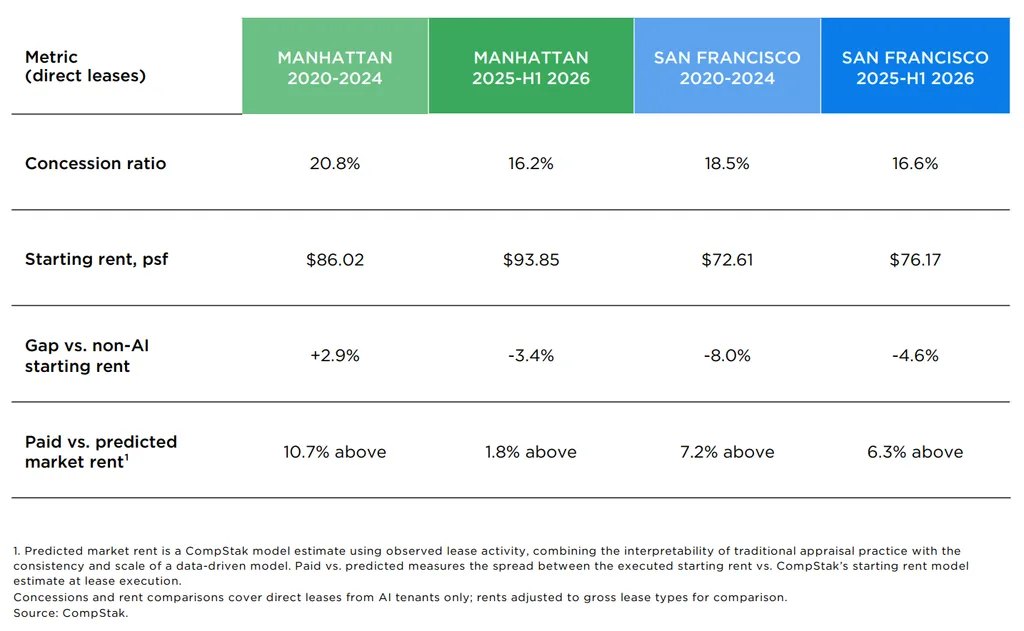
The gap with non-AI tenants is also narrowing. San Francisco AI tenants previously paid starting rents about 8.0% below non-AI tenants. That gap narrowed to 4.6%. In Manhattan, AI tenants moved from paying 2.9% more than non-AI tenants to paying about 3.4% less.
AI tenants are also transacting closer to CompStak’s predicted market rent. Manhattan deals went from 10.7% above predicted market rent in 2020 through 2024 to 1.8% above in the latest period. San Francisco narrowed from 7.2% above to 6.3% above.
Taken together, the report says the discounts and flexibility that defined the sector’s first leasing phase have largely disappeared.
What’s Next
Hiring and venture funding suggest the demand pool could continue growing. AI job postings increased 216.2% year-over-year in New York and 116.0% in San Francisco through August 2026. Over five years, postings rose 899.2% and 815.4%, respectively.
Capital formation provides another potential source of expansion. San Francisco AI companies raised $303.3B in H1 2026, including $209.7B during a single quarter. New York firms raised $39.2B. That was already more than they raised during all of 2025, with funding spread across hundreds of rounds.
AI adoption is also expanding beyond AI-native companies. As of August, 46.0% of information businesses reported using AI in a business function. The share reached 41.9% for professional, scientific, and technical services and 40.0% for finance and insurance.
Savills cautions that funding indicates capacity rather than committed office demand. Still, hiring, capital, and leasing activity are increasingly concentrated in the same markets.
The near-term question is whether quality supply in AI-heavy submarkets can keep pace. Discounted, pre-built sublease inventory has largely been absorbed, particularly in the locations AI companies favor. That could make the availability of high-quality space a defining issue for San Francisco and Manhattan over the next two years.