






- REIT implied cap rates exceeded comparable private real estate appraisal cap rates across all four major property types in Q2 2026.
- Office and apartments posted the widest public-private cap rate spreads at 194 and 172 basis points, respectively.
- REIT occupancy matched or exceeded private-market levels in every sector except industrial, supporting the value case highlighted by Nareit.
Public REITs continue to trade at wider implied yields than comparable private real estate across major property types. Nareit highlighted the Q2 2026 public-private valuation comparison using its REIT Industry Tracker and NCREIF ODCE property data. The analysis covered apartments, industrial, office, and retail. In every sector, REIT implied cap rates exceeded private appraisal cap rates.
Get Smarter about what matters in CRE
Stay ahead of trends in commercial real estate with CRE Daily – the free newsletter delivering everything you need to start your day in just 5-minutes
The Details
The largest spread appeared in office, where the public-private cap rate gap reached 194 basis points. Apartments followed at 172 basis points, while industrial posted a 117-basis-point spread. Retail had the narrowest difference at 46 basis points. Nareit argues that, all else equal, higher implied cap rates indicate more attractive pricing for public REITs compared with private real estate. The gap is especially pronounced in office and apartments.
Occupancy Holds Up
The valuation discount is not paired with broadly weaker occupancy. REIT occupancy exceeded comparable ODCE metrics in office, retail, and apartments. Office showed the largest advantage at 6.9 percentage points, followed by retail at 3.9 points.
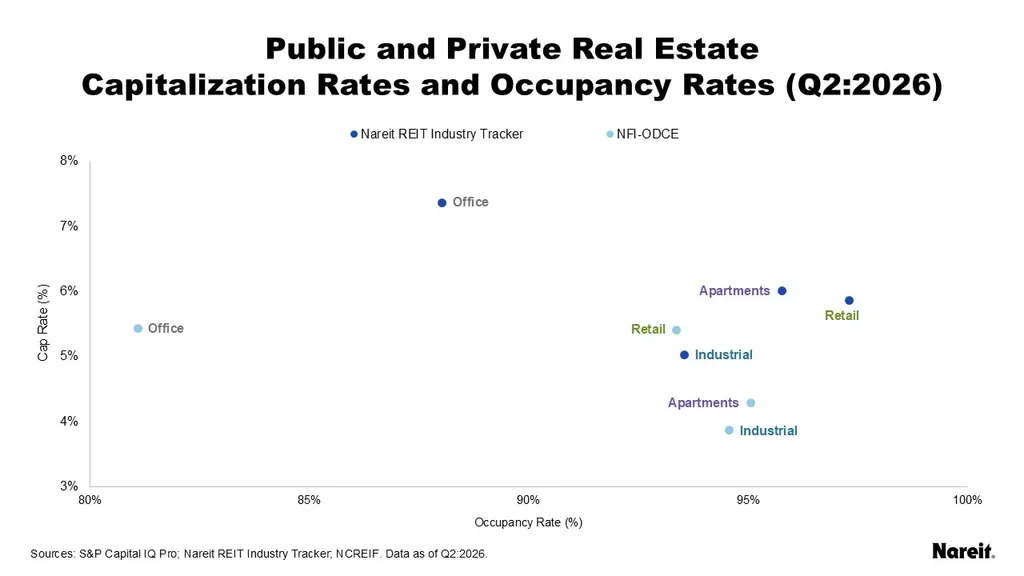
Apartment REIT occupancy was 0.7 points higher. Industrial was the exception, with REIT occupancy 1.0 percentage point below the private-market measure. Nareit said the public companies’ occupancy performance may reflect operational focus and property selection.
Why It Matters
The combination of wider implied cap rates and comparable occupancy supports Nareit’s value argument. Investors get institutional-grade real estate through public companies while pricing remains below private appraisal-based valuations. The public-private valuation gap is widest in office and apartments.