



- JLL’s Northern Virginia and Maryland SCIF inventory increased 430% over the past five years as secure-space demand accelerated.
- JLL secure-environment project volume rose from 907K SF in 2023 to 1.6M SF in 2025 alongside higher defense contract spending.
- Landlords with SCIF experience hold an advantage because each secure facility requires specialized construction and tenants tend to stay longer.
Bisnow reports that secure government and contractor requirements are creating a strong niche for SCIF office space across Greater DC. Additionally, defense spending, contracting activity, and security upgrades are driving more sensitive compartmented information facilities in Northern Virginia and Maryland.
Get Smarter about what matters in CRE
Stay ahead of trends in commercial real estate with CRE Daily – the free newsletter delivering everything you need to start your day in just 5-minutes
Secure Space Becomes a Growth Niche
JLL’s secure environments group said its SCIF inventory in Northern Virginia and Maryland grew 430% over five years. Project volume rose from 907K SF in 2023 to 1.3M SF in 2024. And 1.6M SF in 2025.
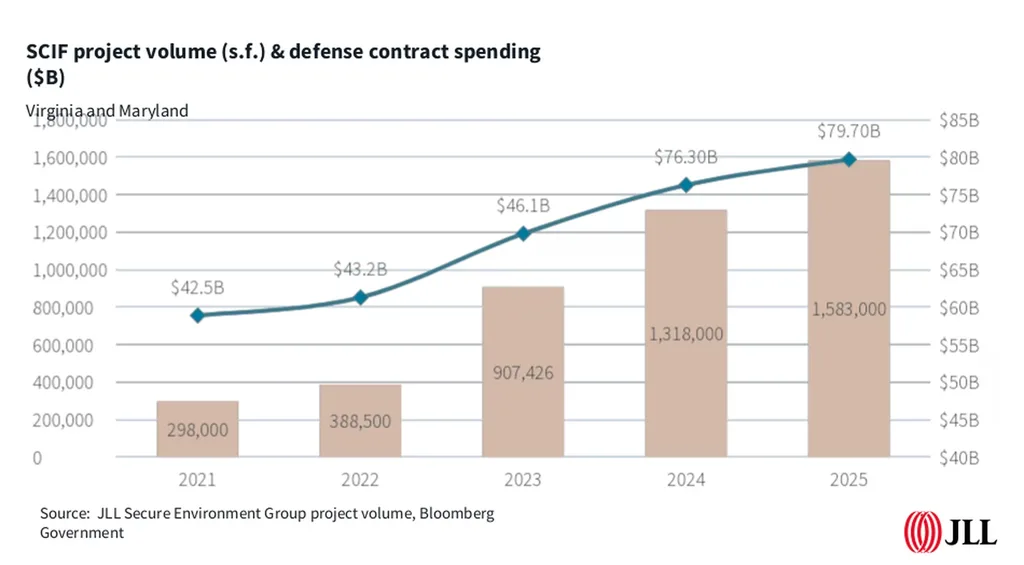
The expansion coincided with higher defense contract spending across the two states. Spending increased from $46.1B in 2023 to $76.3B in 2024 and $79.7B in 2025.
JLL’s secure environments group accredited 35 SCIFs in 2025. And expects to handle 45 spaces totaling about 1.3M SF this year. The growth is particularly significant because the wider regional office market has been pressured by reductions in federal contracting, employment, and leases.
The Details
SCIFs are built to block radio waves, sound, and other technology for sensitive national security work. Because facilities are tailored to specific requirements, space usually cannot transfer to another tenant in a completed state. Most new requirements therefore need a full build-out.
A 2025 federal directive also pushed upgrades toward stronger radio-frequency protection. The original 2028 deadline was rescinded in May, leaving the final rules and schedule unclear. But contractors said many tenants are still renovating or relocating into new secure space.
HITT Contracting said private-sector SCIF work has expanded 20% to 30% over roughly two years. Davis Construction is working on 10 to 20 SCIFs at various sizes. And is turning down some work because of demand.
Savills Managing Director Nicholas DiChiara said demand is high while available completed SCIF supply is limited. Because each secure environment must meet specific requirements, a new tenant generally builds its own facility rather than taking over existing improvements. That makes the construction process a recurring source of work for contractors and brokers.
Davis Construction began building secure-space expertise three or four years ago and now says demand exceeds its capacity. Clune Construction also invested in staff and technology ahead of expected security upgrades. And it is now seeing a sharp increase in opportunities.
Why It Matters
The growth creates a defensive leasing advantage inside a Greater DC office market pressured by federal cuts. Landlords that know how to deliver secure space can compete for mission-critical tenants with high build-out costs and fewer relocation options.
JBG Smith said 92% of its National Landing GSA tenancy has a SCIF, calling that capability difficult to replicate. The niche adds another layer to the Greater DC office leasing market even as conventional federal occupancy faces pressure.
Mission-critical tenancy can also help landlords offset some of the federal downsizing hitting conventional office space. JBG Smith said it backfilled space returned by the Department of Labor at National Landing with a secure government user, while most remaining GSA tenancy in its portfolio is mission critical.
What’s Next
More landlords are trying to enter the sector, while contractors are adding staff and technology. Clune Construction said it received 10 SCIF opportunities in roughly six weeks, and competitors are preparing for more demand.
The unresolved federal security standard remains a major variable. Even without a final deadline, contractors said tenants are moving forward with upgrades. And new facilities rather than waiting for complete regulatory clarity.
Landlords without a long secure-space track record are trying to build one. Because tenants can be difficult to dislodge after investing heavily in a SCIF. Contractors and brokers expect that stickiness, combined with defense spending, to keep competition for secure-capable buildings elevated.