






- Trepp identified $12.73B of securitized industrial loans where a sole or major tenant lease expires before loan maturity.
- About $3.68B, or 28.9%, has a key lease expiring within six months of maturity, creating the tightest refinancing window.
- The exposed loans remain stronger than the broader industrial book on current payment status, DSCR, debt yield, and special servicing.
Trepp identified $12.73B of industrial securitized loans with lease rollover exposure. The risk comes from significant or sole tenants whose leases expire before the associated loan matures, even though the loans currently look healthy on traditional credit measures.
Get Smarter about what matters in CRE
Stay ahead of trends in commercial real estate with CRE Daily – the free newsletter delivering everything you need to start your day in just 5-minutes
Strong Credit, Uneven Timing Risk
The $12.73B exposure equals 16.7% of securitized industrial loans where the anchor tenant is identified. Of that group, $7.24B is backed by single-tenant properties. While $5.49B is backed by multitenant assets whose largest tenant occupies at least 30% of rentable area.
The group is 98.2% current, compared with 97% for the broader industrial-loan universe. Only 0.40% is in special servicing. Median DSCR is 1.58x and median debt yield is 9.45%, both stronger than the overall industrial book.
Trepp tracks $76.06B of securitized industrial loans where an anchor tenant is identified. Equal to 96.5% of the industrial loans securitized through CMBS or CLO structures. The broader book is 97% current, with only 0.93% in special servicing, a 1.25x median DSCR. And an 8.9% median debt yield.
Servicers use a 30% occupancy threshold when evaluating major tenant exposure. A loan can be placed on the watchlist when a tenant occupying more than 30% of a property faces a lease expiration within 12 months.
The Details
$3.68B, or 28.9% of the exposed balance, has a key lease expiring within six months of loan maturity. Another $2.52B expires between six and 12 months before maturity. The remaining $6.53B has more than 12 months of runway.
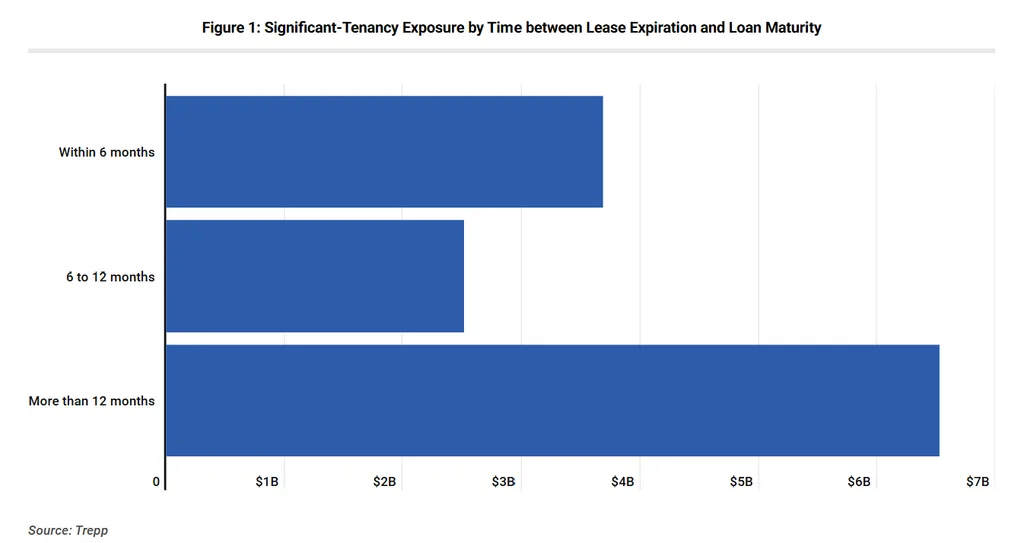
The shortest-window loans carry a median DSCR of 1.29x and a 9.4% debt yield. Loans with more than 12 months between lease expiration. And maturity have a much stronger 1.92x median DSCR and 9.99% debt yield.
Examples include GM Logistics Center 1 in Wentzville, Missouri, Ford Logistics Center in Monroe, Michigan. And 1040 40th Street SE in Grand Rapids. Each shows a different gap between anchor-tenant expiration and loan maturity.
CRE CLO collateral represents $4.92B, or 6.5%, of the identified-anchor industrial universe. Those loans are entirely floating-rate and carry an 11.62% median debt yield. Compared with 9.40% for CMBS loans. The CLO balance is also much newer, with 62.7% securitized in 2026 and 98.4% since 2025.
GM Logistics Center 1 is fully leased to General Motors through year-end. While its $37.8M loan matures next April. Ford Logistics Center is fully leased to Ford through March 2034, seven months before its $76.7M loan matures. The Grand Rapids example has a 13-month gap between its largest tenant’s lease expiration and loan maturity.
Why It Matters
The issue is not current distress. It is the possibility that borrowers reach maturity before resolving a major tenant rollover. Less time can reduce flexibility to negotiate a renewal, backfill the space. Or refinance with certainty about future cash flow.
Only 14.3% of the $3.68B near-term group is currently flagged on servicer watchlists. That makes lease timing an important supplement to standard surveillance metrics across the industrial CMBS market.
The lead-time buckets also show why lease timing can matter before a loan becomes delinquent. A 1.29x median DSCR in the shortest bucket implies materially less cash-flow cushion than the 1.92x median DSCR for loans with more than a year of runway. Current credit metrics can therefore look sound even as refinancing flexibility narrows.
What’s Next
The $3.68B of loans with leases expiring within six months of maturity warrants the closest attention. Those assets combine the shortest resolution window with the weakest median coverage among the three timing groups.
As maturity dates approach, renewal outcomes will become more important to refinancing prospects. Borrowers that secure extensions or replacement tenants early will have more options than owners carrying unresolved anchor exposure into the final months before loan maturity.