




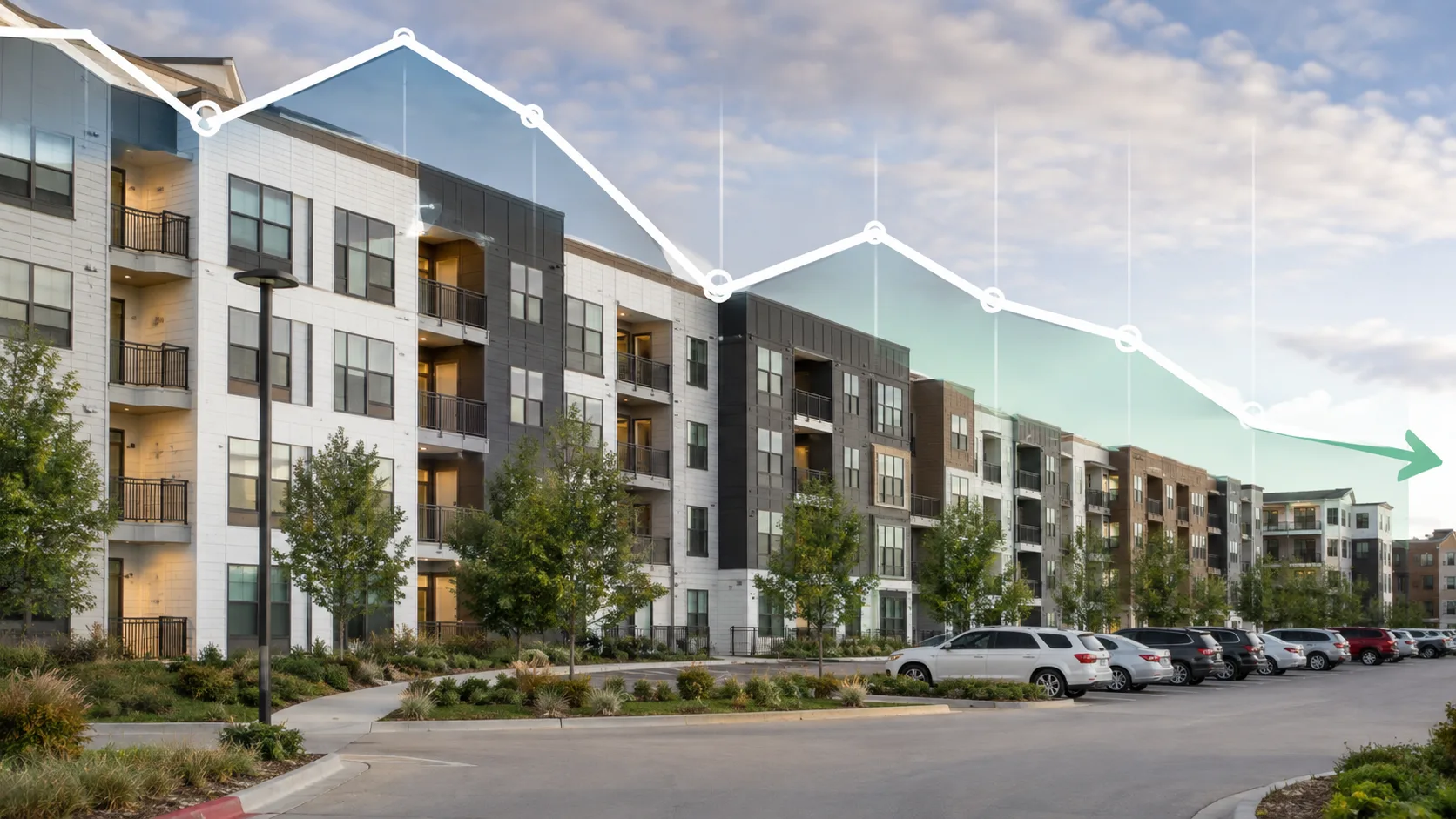



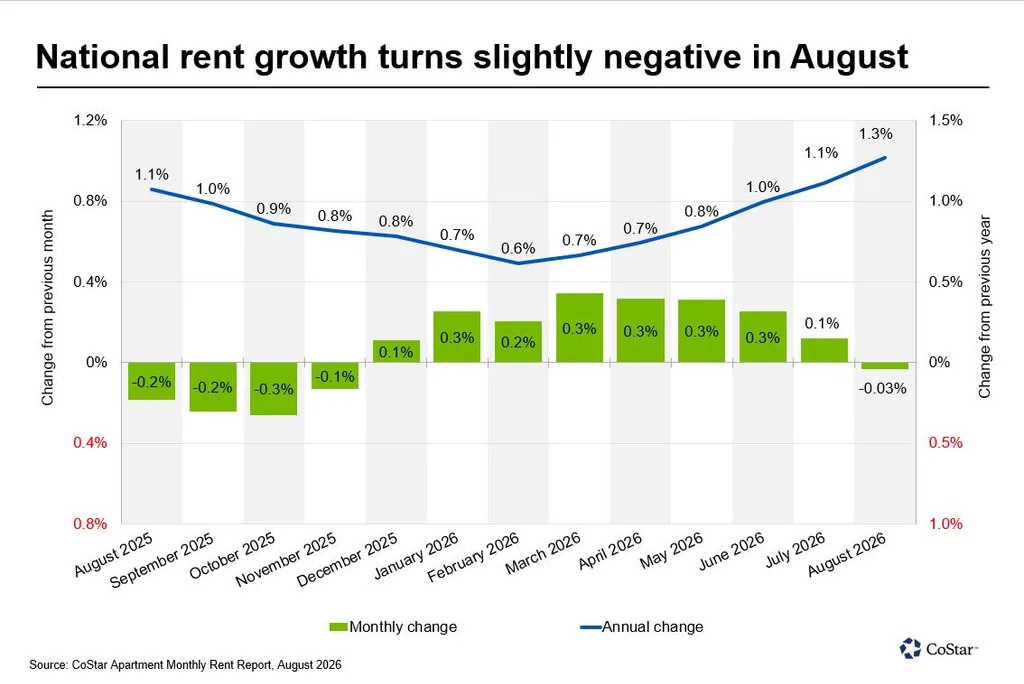
- US apartment rents fell 0.03% to $1,751 in August, ending eight consecutive months of gains, according to Apartments.com.
- San Francisco led major markets with 11.9% annual growth, while supply-heavy markets like San Antonio and Denver remained negative.
- August’s decline trailed the drops recorded in 2024 and 2025, suggesting pricing conditions are improving as supply pressures ease.
BusinessWire reports that US apartment rent growth slipped into negative territory in August. Still, underlying multifamily fundamentals continued to improve.
National apartment rents declined 0.03% from July to $1,751, according to Apartments.com’s August 2026 multifamily rent report. Meanwhile, annual rent growth accelerated to 1.3%. That marked an improvement from the revised 1.1% annual rate in July.
Get Smarter about what matters in CRE
Stay ahead of trends in commercial real estate with CRE Daily – the free newsletter delivering everything you need to start your day in just 5-minutes
An Eight-Month Streak Ends
August ended eight consecutive months of positive monthly rent growth. That streak followed softer conditions during the second half of 2025. The latest decline also follows a seasonal pattern that has emerged over the past three years.
Apartments.com also revised July’s monthly increase to 0.1% from its initial 0.03% estimate. July’s national average rent reached $1,752. Despite August’s reversal, annual growth remained stronger than the 1.1% rate recorded in August 2025.
The Details
The August pullback looks modest compared with the previous two late-summer leasing seasons. Apartments.com reported a 0.1% decline in August 2024. Rents then fell 0.2% in August 2025. By comparison, rents declined only 0.03% this August.
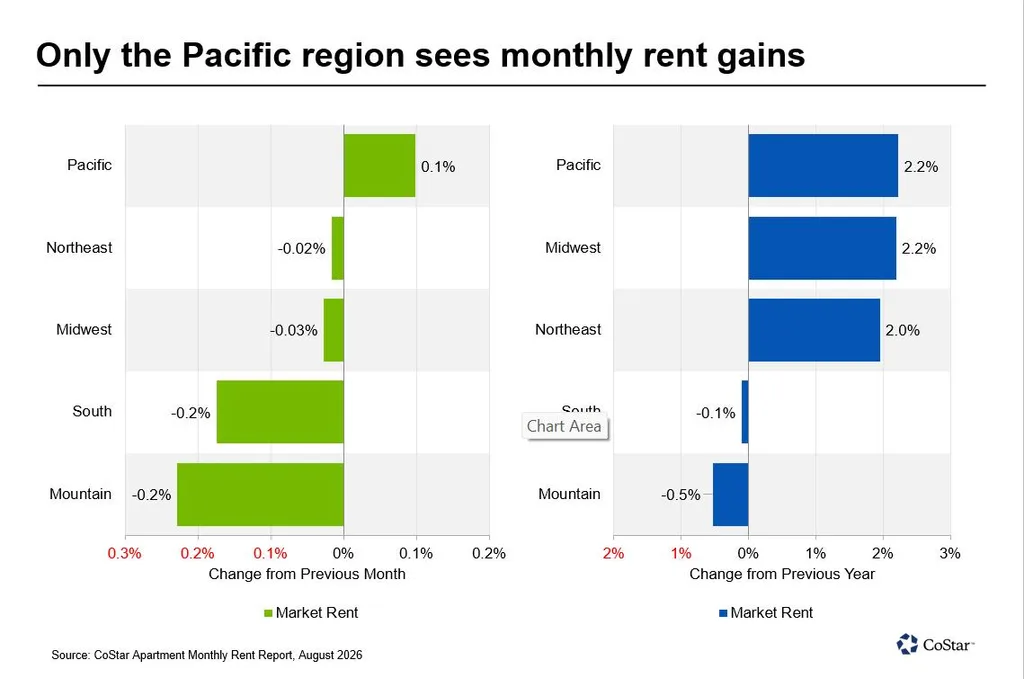
Regional results remained uneven. The Pacific posted the only monthly increase at 0.1%, according to Apartments.com’s 2026 report. The Northeast declined 0.02%, while the Midwest fell 0.03%. The South and Mountain regions each dropped 0.2%.
Annual results showed a similar divide. The Pacific and Midwest led with 2.2% growth, while the Northeast reached 2.0%. Meanwhile, the South recorded a 0.1% annual decline. Mountain region rents fell 0.5%, according to Apartments.com. Both regions narrowed their annual losses during the summer.
Bay Area Apartment Rents Break Away
Metro results highlight a widening gap between supply-constrained markets and cities still absorbing new inventory. Only 12 top-50 markets recorded monthly gains.
Seven stayed flat, while 31 posted declines, according to Apartments.com’s 2026 report. San Francisco rents have also reached their strongest growth pace in decades.
Orange County led monthly growth at 0.6%. San Francisco followed at 0.4%, while East Bay gained 0.3%. San Jose and Chicago each increased 0.2%. Annual results showed a sharper divide. San Francisco led with 11.9%, followed by San Jose at 7.7%. Norfolk reached 5.8%, while East Bay posted 5.1%.
Supply-heavy markets remained under pressure. San Antonio recorded the steepest annual decline at 2.2%, according to Apartments.com. Denver rents fell 1.9%. Phoenix, Houston, and Las Vegas each declined 1.2%. Orlando and Denver also posted August’s steepest monthly declines at 0.7%. Nashville followed with a 0.5% monthly drop.
Why It Matters
Multifamily rent performance increasingly depends on local supply conditions rather than one national cycle. Apartments.com’s 2026 data illustrate that split. Supply-constrained Pacific markets continue to produce some of the nation’s strongest gains. Conversely, high-construction markets still struggle to regain pricing power.
Still, national conditions are improving for apartment owners. August’s 0.03% decline came below the drops recorded in August 2024 and 2025. At the same time, annual growth climbed to 1.3%. Together, those trends suggest excess inventory is becoming less disruptive.
That shift matters for owners facing higher operating and financing costs. Stronger rent growth could support property income as new deliveries moderate. However, regional differences will continue shaping asset performance and underwriting assumptions.
What’s Next
Owners and investors should watch whether annual US apartment rent growth continues accelerating through the slower fall and winter seasons. Apartments.com says a substantial inventory overhang remains, although excess supply continues to ease.
Peak construction activity has also passed in most markets, according to Apartments.com’s 2026 report. That slowdown could reduce competitive pressure as existing properties absorb available renters.
As a result, local absorption will remain a key indicator through late 2026. Faster absorption could help more markets regain pricing power. Supply-heavy metros may need more time before rents return to sustained growth.