








- Global real estate investment volumes have increased for nine consecutive quarters since bottoming in early 2024, according to MSCI’s 2026 analysis.
- Higher bond yields are squeezing property spreads and liquidity, while Central London office transaction yields have climbed above 6%.
- Private investors now represent 38% of income-producing property acquisitions, while institutional participation has fallen to a record-low share.
Global commercial real estate has sustained a nine-quarter recovery, but bond markets now threaten that progress. Rising long-term government yields are pressuring property pricing, transaction liquidity, and institutional capital flows.
MSCI’s September 2026 analysis shows the recovery remains uneven across countries and investor groups. Some markets continue attracting capital, while major gateway cities face renewed pricing pressure.
Get Smarter about what matters in CRE
Stay ahead of trends in commercial real estate with CRE Daily – the free newsletter delivering everything you need to start your day in just 5-minutes
A Fragile Commercial Real Estate Recovery
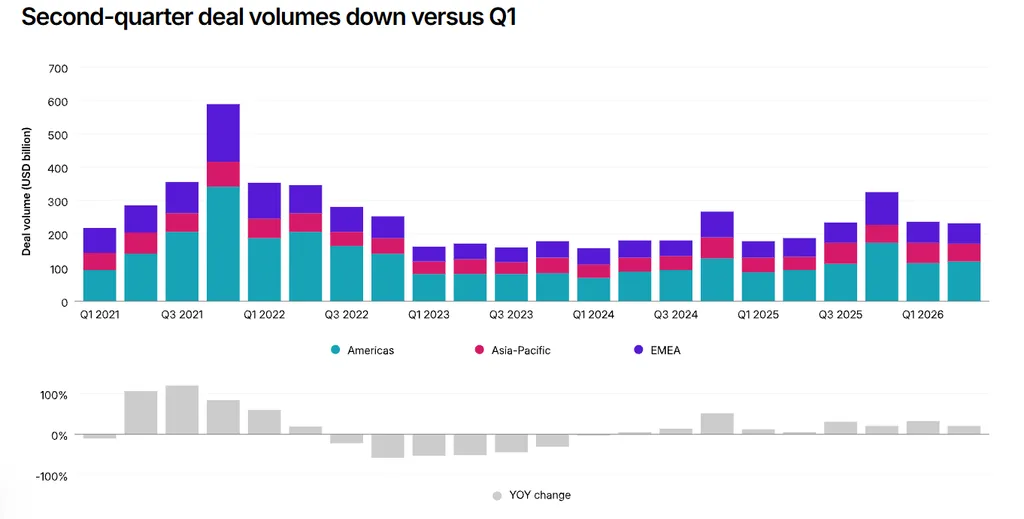
Global investment activity bottomed in early 2024 before starting a slow recovery, according to MSCI’s September 2026 analysis. Stabilizing interest rates helped property values find firmer footing and encouraged investors to return.
Source: MSCI’s September 2026 analysis
However, Q2 2026 transaction volumes fell below Q1 levels across the US, U.K., Germany, and France. That pattern matters because Q1 typically produces the year’s lowest transaction activity.
The reversal suggests momentum from the second half of 2025 has started fading. Continued geopolitical volatility has also weakened investor confidence, according to MSCI.
The Details
Sovereign debt markets sit at the center of the renewed pressure. US 30-year Treasury yields topped 5.3% for the first time since 2007, according to MSCI’s September 2026 analysis.
Meanwhile, U.K. 10-year gilt yields reached their highest level since 2009. German 10-year bund yields also climbed to their highest level since 2011.
MSCI links the increases to geopolitical risks, inflation concerns, government deficits, and heavy corporate borrowing. AI infrastructure investment has also increased corporate bond issuance and competition for available capital.
Gateway Markets Feel the Squeeze
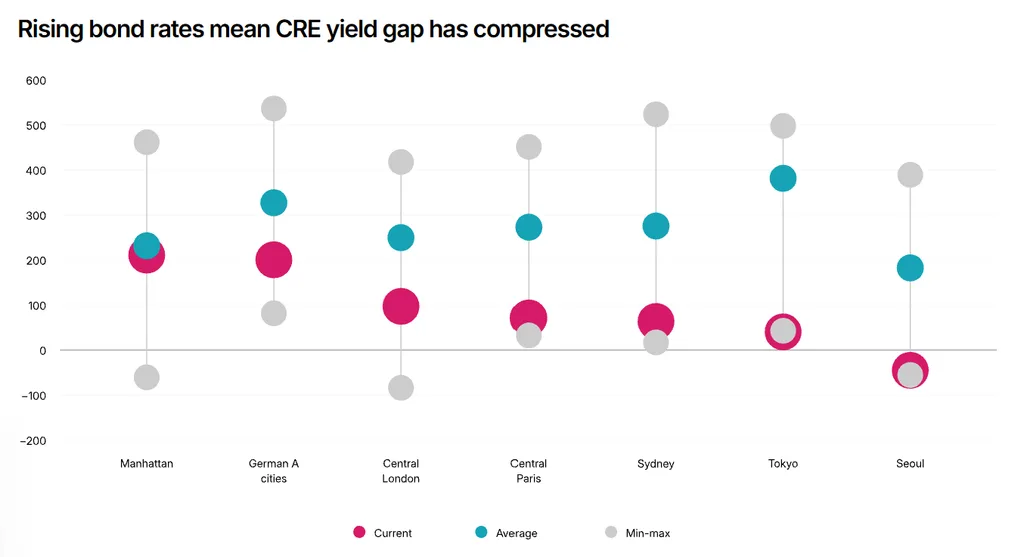
Higher risk-free rates make property yields less attractive unless prices decline or investors expect stronger income growth. Central London offers a clear example of that pressure.
Office transaction yields fell below 5.5% during H2 2025, according to MSCI’s September 2026 analysis. They climbed above 6% by the end of June 2026.
MSCI’s Capital Liquidity Scores also show Central London liquidity at its lowest recorded level. Tokyo and Seoul face similarly narrow spreads between property yields and government bonds.
Source: MSCI’s September 2026 analysis
Seoul Flashes a Warning Sign
Seoul currently has a negative yield gap, according to MSCI’s September 2026 analysis. Investors there accept property yields below the risk-free government bond rate.
Strong rental-growth expectations can temporarily support that pricing. However, MSCI notes that similar conditions have historically preceded property-market corrections elsewhere.
Manhattan looks better positioned. Its office yield gap remains near its long-term average, while office yields have returned to levels last recorded in 2004.
Some Global Markets Keep Accelerating
Not every market faces the same liquidity squeeze. Spain’s transaction volumes have returned to their pre-inflation peak, according to MSCI’s September 2026 analysis.
Spanish office and residential investment also sits above long-term averages. China recorded even stronger growth during H1 2026.
Chinese transaction volumes doubled from H1 2025 and reached roughly 25% above their 10-year average. MSCI notes that growth started from a relatively low base.
Singapore Sets a New Investment Record
Singapore has already established a new annual investment record in 2026. H1 transaction volume reached $10.3B, according to MSCI’s September 2026 analysis.
Investors completed another $3.5B during H2 through MSCI’s reporting date. That pushed the 2026 running total to $13.8B.
The figure already exceeds Singapore’s previous $12.5B record from 2019. China and Singapore also face less pressure from rising interest rates than many developed markets.
Private Capital Fills the Institutional Gap
Private investors continue gaining market share as institutional buyers struggle with liquidity constraints. They represented 38% of global income-producing real estate acquisitions, according to MSCI’s September 2026 analysis.
That share stands well above the 30% long-term average. Institutional buyers accounted for only 37% of H1 2026 acquisitions.
MSCI says that institutional share trails every full calendar year in its historical record. Many institutions have become net sellers while reshaping portfolios and returning capital to investors.
Large Private Buyers Keep Deploying Capital
Private investors often face fewer performance and liquidity constraints than third-party investment managers. That flexibility allows wealthy buyers to capitalize on institutional retrenchment.
Pontegadea provides one example. Zara founder Amancio Ortega’s investment vehicle acquired nearly $2B across Europe and North America during 2026, according to MSCI.
The firm invested another $2.7B during 2025. Its activity illustrates how private wealth can fill part of the gap left by institutions.
Why It Matters
Commercial real estate competes directly with government bonds for investor capital. Meanwhile, higher borrowing costs reduce the prices leveraged buyers can justify.
Recent property prices have already weakened as Treasury yields climbed. If bond yields remain elevated, property yields may need to rise further. That adjustment would place renewed downward pressure on commercial property values.
Lower values can also reduce transaction activity and prevent managers from selling assets. That delays investor distributions and restricts capital recycling into new funds.
What’s Next
Bond markets could determine whether the commercial real estate recovery continues through late 2026. Several forces supporting higher yields show few signs of disappearing.
MSCI highlights fiscal deficits, geopolitical risks, and AI-related borrowing as persistent pressures in its September 2026 analysis. These forces could keep long-term rates above earlier investor expectations.
If yields remain high, more property markets may require additional repricing. Falling sovereign yields, however, could relieve pressure on property spreads and transaction liquidity.