






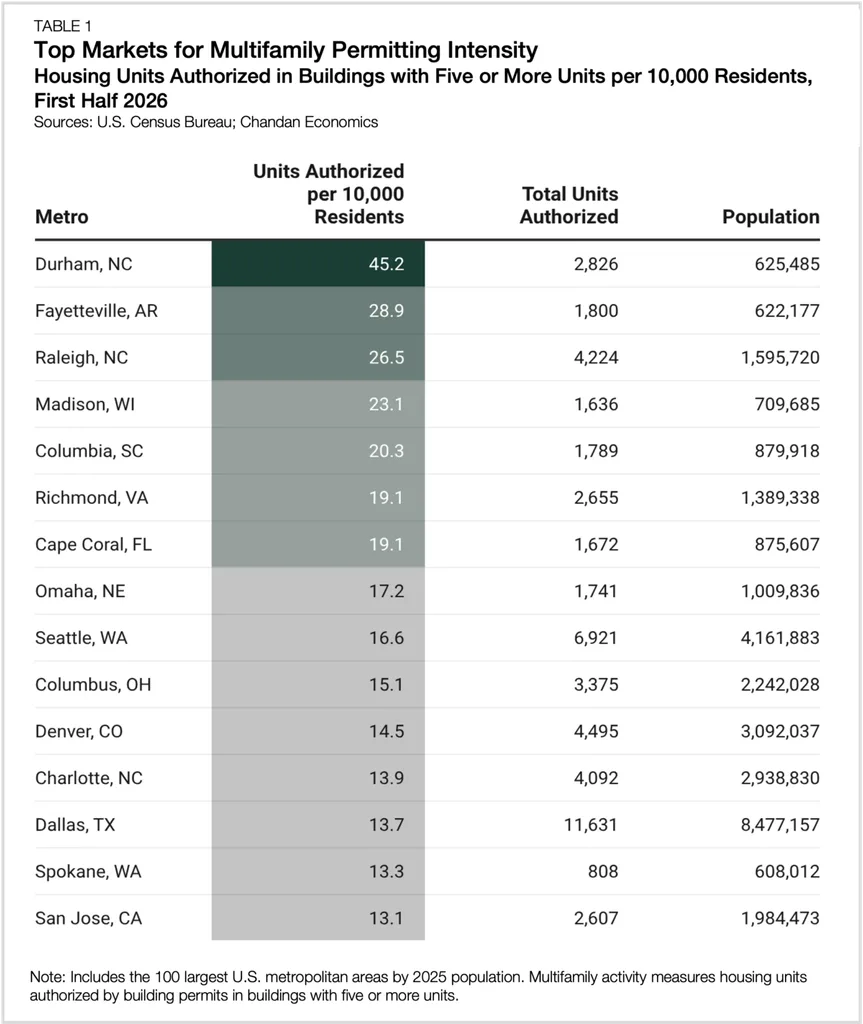
- Durham authorized 2,826 multifamily units in H1 2026, reaching 45.2 units per 10,000 residents and leading the 100 largest metros.
- Columbia recorded 468% annual permitting growth, while San Jose followed at 366% and Virginia Beach reached 342%, according to Chandan Economics.
- Northeast and Midwest markets gained momentum as much of the South slowed, highlighting increasingly local drivers behind new apartment development.
According to Arbor, multifamily permitting increasingly favors smaller, fast-growing US metros as national activity stabilizes. Durham, NC, led the 100 largest metros during H1 2026.
Chandan Economics analyzed US Census Bureau data for apartment buildings with at least five units. The August 2026 report also found significant differences between regions and individual markets.
Get Smarter about what matters in CRE
Stay ahead of trends in commercial real estate with CRE Daily – the free newsletter delivering everything you need to start your day in just 5-minutes
Smaller Metros Move to the Front
Smaller markets dominated the national rankings for permitting intensity. Seven of the top eight metros have fewer than 1.5M residents, according to Chandan Economics.
Durham and Fayetteville, AR, each have roughly 625,000 residents. They rank 93rd and 94th by population, respectively. Yet both placed near the top for multifamily construction relative to population.
The Details
Durham authorized 2,826 multifamily units during H1 2026. That total equaled 45.2 units per 10,000 residents, according to Chandan Economics.
Fayetteville ranked second with 1,800 units, or 28.9 per 10,000 residents. Its rate nearly doubled from 14.9 units per 10,000 residents one year earlier. Raleigh followed with 26.5 units per 10,000 residents. Durham’s per-capita rate exceeded Fayetteville’s by 56%.
Durham’s Fundamentals Support Development
Durham’s permitting surge coincides with strong demographic and economic fundamentals. The metro sits less than 10 miles from Research Triangle Park.
The employment hub supports engineering, scientific research, biomedical science, and other STEM industries. Duke, UNC-Chapel Hill, and NC State also support the region’s talent base. Chandan Economics reports local population, employment, and wage growth exceed national averages.
Carolina Multifamily Permitting Stands Out
The Carolinas placed several markets near the top of the national rankings. Durham, Raleigh, Columbia, and Charlotte all ranked among the top 12.
Population growth helps explain that concentration. US Census Bureau data published in 2026 show South Carolina’s population grew 1.5% during 2025. North Carolina ranked third nationally with 1.3% growth.
Fayetteville Brings Another Growth Story
Fayetteville’s development pipeline also reflects strong local population growth. The northwest Arkansas metro’s population increased 2.4% during 2025, according to Chandan Economics.
Annual population growth has remained above 1.9% since 2011. Meanwhile, the University of Arkansas reported record enrollment above 34,000 students. That expanding university presence adds depth to the area’s labor market.
Permitting Momentum Broadens
Columbia recorded the country’s largest annual increase in authorized multifamily units at 468%, according to Chandan Economics. San Jose followed at 366%, while Virginia Beach reached 342%.
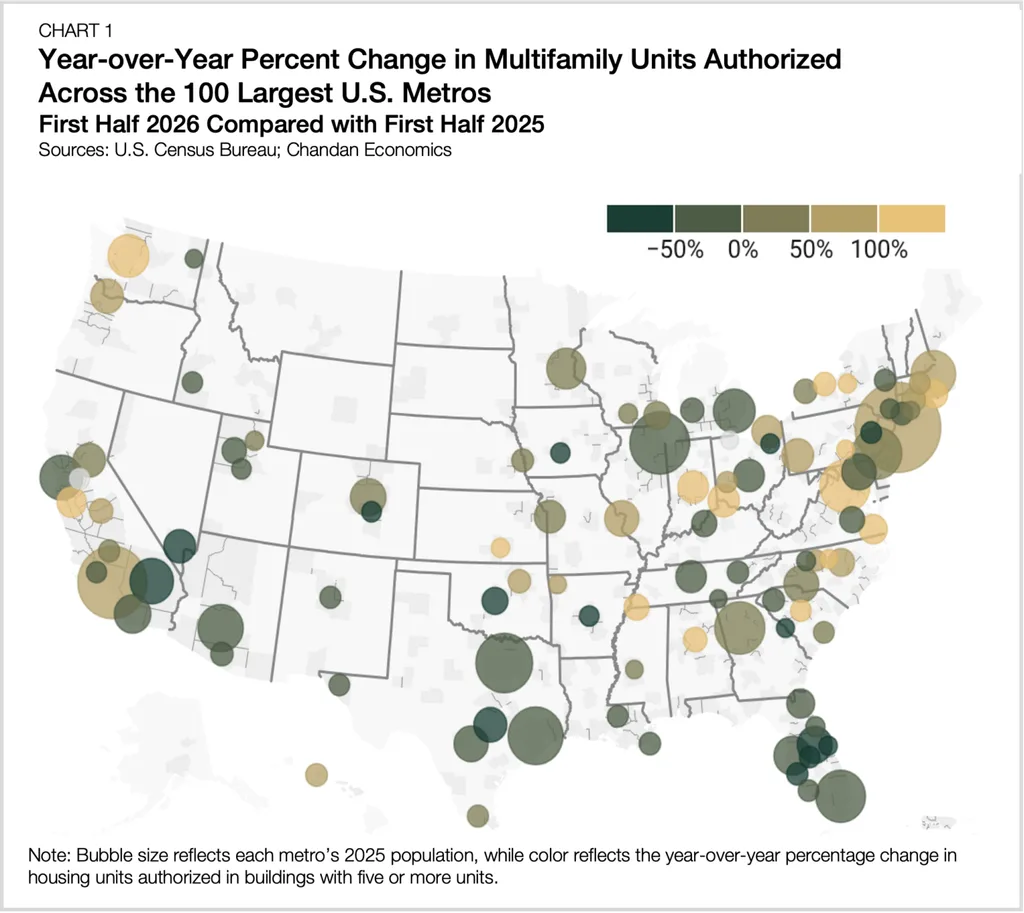
Syracuse and Providence completed the top five with gains of 287% and 243%, respectively. Smaller markets have also captured more multifamily permits as development expands beyond traditional growth hubs. These leaders span several regions, reinforcing the local nature of today’s apartment development cycle.
San Jose Adds Another Growth Signal
San Jose’s acceleration comes as local officials work to unlock more housing development. The city offers development incentives that include fee reductions and tax programs.
Demand conditions also remain favorable. Multifamily rents climbed 6.2% year-over-year in June 2026, according to Chandan Economics’ analysis of Zillow data. That pace ranked fourth among the 100 largest US metros.
Northeast Multifamily Permitting Gains Ground
The Northeast showed much broader momentum than the South. Twelve of its 16 top-100 metros authorized more multifamily units than one year earlier.
Syracuse and Providence ranked among the five fastest-growing permitting markets. Meanwhile, the South recorded the lowest share of metros with year-over-year permitting gains, according to Chandan Economics.
Why It Matters
The geographic split challenges the familiar Southern growth narrative for multifamily construction. Local conditions increasingly determine where developers pursue new projects.
The Carolinas offer a notable exception within the weaker South. Six of the region’s 14 markets with positive annual growth sit in the Carolinas. Demographics, employment growth, housing demand, and development conditions continue to shape permitting patterns.
What’s Next
Investors should watch whether current permitting momentum continues across smaller growth markets. National permitting has settled into a steady range, but local patterns continue shifting.
The H1 2026 data point toward an increasingly metro-specific supply cycle. Markets with favorable demographics and development conditions could continue separating from broader regional trends.