







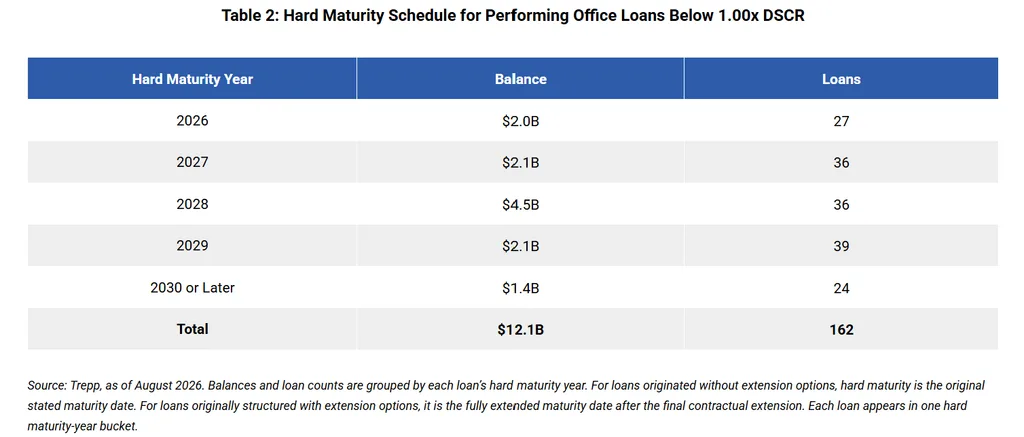
- $10.7B, or 88.1%, of $12.1B in performing office loans below 1.00x DSCR reaches hard maturity by the end of 2029.
- The largest annual maturity cohort is 2028, when about $4.5B across 36 loans becomes contractually due in full.
- The loans remain current, but weak property cash flow could make repayment or refinancing more difficult as final maturity dates approach.
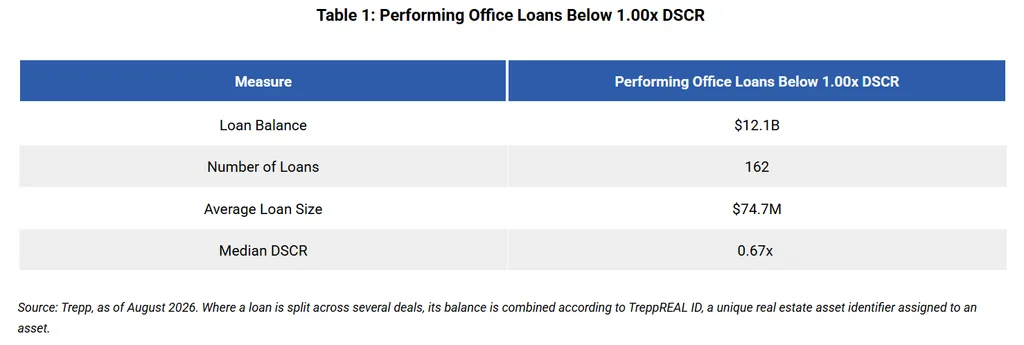
A large group of performing office loans is approaching a refinancing test despite property cash flow that already falls below debt service. Trepp identified $12.1B across 162 urban and suburban office loans with DSCRs below 1.00x. Of that balance, $10.7B reaches hard maturity by the end of 2029.
Get Smarter about what matters in CRE
Stay ahead of trends in commercial real estate with CRE Daily – the free newsletter delivering everything you need to start your day in just 5-minutes
Office Loan Maturities Build Through 2029
Trepp defines hard maturity as the point when the outstanding balance becomes contractually due and no extension options remain. For loans without extensions, that is the original stated maturity. For loans with options, Trepp uses the fully extended date.
The cohort has an average loan size of $74.7M and a median DSCR of 0.67x. These loans remain current and have not been marked delinquent. They represent a subset of the $97.2B of performing urban and suburban office loans included in Trepp’s analysis.
The 2028 Cohort Is the Largest
The maturity schedule becomes most concentrated in 2028. Trepp counted $2B across 27 loans reaching hard maturity in 2026. Another $2.1B across 36 loans matures in 2027. The 2028 cohort jumps to $4.5B across 36 loans, followed by $2.1B across 39 loans in 2029. Only $1.4B across 24 loans has a hard maturity in 2030 or later. Office loan maturities therefore become a contractual issue well before the entire cohort reaches delinquency.
Two Large Loans Illustrate the Risk
Two major loans show how current payments can coexist with weak coverage. A $1.075B floating-rate loan on 280 Park Avenue in New York can extend through September 2028. Its first-quarter 2026 DSCR was 0.68x, while occupancy was 93.5%.
The $1.2B loan on the 555 California Street campus in San Francisco is the cohort’s largest. It remained current after a May 2026 extension and can extend through May 2028. Its first-quarter DSCR was 0.47x.
Why It Matters
Sub-1.00x DSCR means reported net cash flow is insufficient to cover required debt service, even if the borrower remains current. That does not determine when a maturity occurs, but it can complicate repayment or refinancing.
The key issue is that 88.1% of the cohort reaches a point when no contractual extensions remain by 2029. Lenders and borrowers may have time before those dates, but the final maturity removes one source of flexibility. The concentration in 2028 makes that year the largest refinancing test in Trepp’s current schedule.
What’s Next
The hard-maturity schedule provides a clear timeline for monitoring office credit risk. The largest wave arrives in 2028, followed by another $2.1B in 2029. Until then, loans can remain current even with sub-breakeven coverage.
The decisive question is whether property cash flow improves enough to support repayment or refinancing before extension options end. If coverage remains weak, borrowers may face fewer options as the contractual due dates approach.