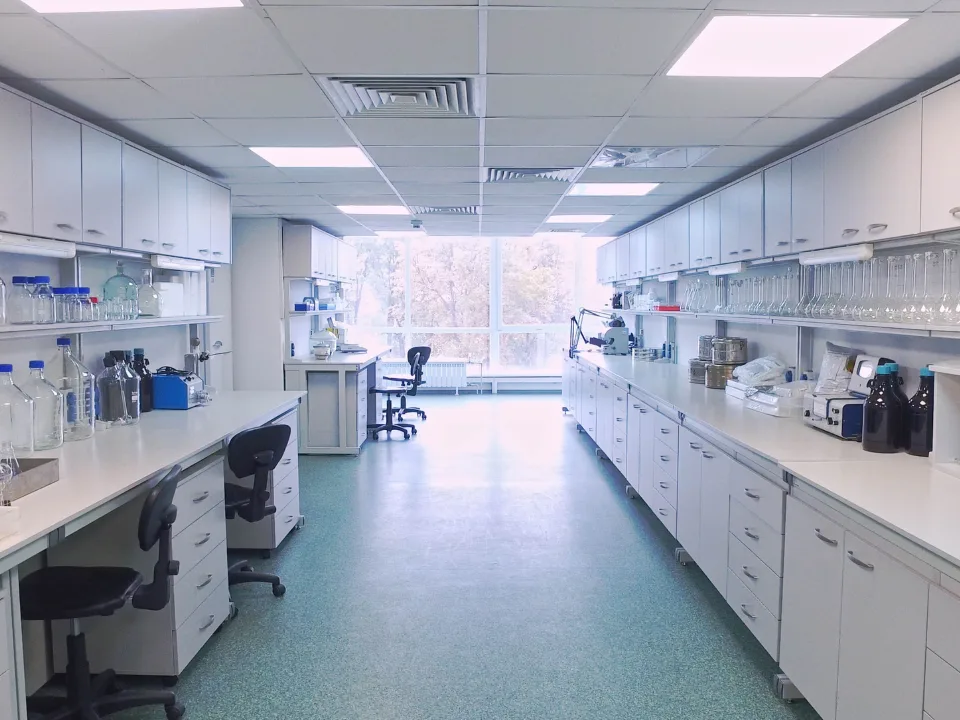




- Harlem’s post-pandemic life sciences buildings, including the Taystee Lab Building and The Labs On 121, remain largely vacant years after delivery.
- NYC life sciences space carries a 37% availability rate, the highest of any U.S. market, with asking rents of $99.17 per SF, per JLL.
- Federal NIH funding cuts and a lack of transit-friendly amenities are compounding Harlem’s struggles even as other NYC lab clusters recover.
Hundreds of thousands of square feet of Harlem lab space sits empty, even as life sciences real estate activity picks up elsewhere in the U.S., according to Bisnow. Developers poured hundreds of millions of dollars into converting former industrial and commercial buildings into labs after the pandemic, betting on a biotech boom that hasn’t reached the neighborhood.
Landlords elsewhere in the city have signed a handful of fresh leases over the past year, but Harlem’s post-pandemic lab towers remain largely dark, leaving developers scrambling for capital and tenants.
Get Smarter About What Matters in New York
Subscribe to our free newsletter covering the biggest commercial real estate stories across the five boroughs — delivered in just 5 minutes.
A Bet That Hasn’t Paid Off
Janus Property Co. invested $700 million to convert a former bakery at 450 W. 126th St. into the Taystee Lab Building. The property has sat empty since opening in 2022 and now faces a foreclosure suit. Nearby, Brandon Miller and Nightingale Properties delivered the 193,000-square-foot Labs On 121 in 2024. Fraud scandals involving both developers overshadowed the project.
Janus founder Scott Metzner said he isn’t giving up on the properties. However, he needs a capital infusion after Wells Fargo called in a loan he couldn’t repay. The neighborhood lost more ground this summer when Volastra Therapeutics announced plans to leave an 11,000 SF lab at Janus’ Mink Building at 1361 Amsterdam Ave. The company plans to move into 18,000 SF at Alexandria’s Kips Bay campus. Harlem Biospace still runs an 11,000 SF startup incubator in the same building. It remains one of the corridor’s few signs of life sciences activity.
The Details
NYC’s life sciences buildings had a 37% availability rate at the end of the first quarter, according to JLL. That was the highest rate of any U.S. market. Asking rents average $99.17 per SF. Boston, the country’s largest life sciences market, averages $76.72 per SF.
“In New York, it’s definitely slower,” said Brianna Friedman, a senior research analyst for life sciences at Savills. “There’s little activity. There’s not much at all.”
Not every NYC lab cluster is struggling. Alexandria Real Estate Equities’ 728,000 SF of city properties are 95.5% occupied. Tenants include Bristol Myers Squibb and Pfizer. In Long Island City, GFP Real Estate and King Street Capital’s Innolabs is fully leased.
Zooming Out
The gap points to a broader vacancy widening between winning and losing submarkets nationwide. Brokers say tenants are concentrating demand in fewer buildings and locations.
“That growth that we’re going to see is going to continue to be focused on more of those hub markets, like San Francisco, San Diego, Boston,” said Cushman & Wakefield Head of Life Sciences and Healthcare Insights Sandy Romero. “After demand resumes in those hub markets, we can expect to see some additional interest in New York.”
Brokers also point to Harlem’s longer commute and thinner retail base. Kips Bay offers stronger transit access and a more established live-work environment. Those factors have helped attract tenants.
“The No. 1 reason why anybody would want to be in Harlem, in particular West Harlem, is because of Columbia and the entire presence up there,” said John Cahill, a senior vice president at JLL.
Why It Matters
Federal research funding cuts are adding to the neighborhood’s challenges. The National Institutes of Health issued $35.3 billion in grants in fiscal year 2025. That was down from $44.9 billion the year before. Grant Witness says $2.1 billion of New York’s $4 billion allocation still hasn’t been distributed.
That funding gap has stalled startups spinning out of Columbia and CUNY. Harlem’s lab market depends heavily on those anchor institutions. The slowdown also comes as Northeast rent growth cools amid rising supply.
“One of the biggest challenges that our city faces is that we are so reliant on the hospitals and the universities to anchor projects,” Cahill said. “The effect has been cataclysmic on life science real estate in the city, not just in Harlem but throughout.”
What’s Next
Owners of struggling lab buildings are increasingly selling at a loss rather than waiting for the market to recover. This month, Bill Ackman bought the vacant 400,000 SF 125 West End Ave. He plans to use it for a family-foundation brain research institute. Meanwhile, Longfellow Real Estate Partners sold a Long Island City lab building for $6 million less than it paid. The firm had spent $120 million on the conversion.
Venture capital funding totaled $29.8 billion nationally last year, according to Cushman & Wakefield. However, investors are increasingly chasing mature companies over early-stage startups. Those startups would typically need lab space, said Maria Gotsch, president and CEO of the Partnership Fund for New York City.
For now, Harlem’s vacant labs may need to wait for a broader capital cycle before demand returns.