




- Distress in Los Angeles office CMBS loans is most severe in urban towers, where median occupancy has dropped to 83% and the special servicing rate stands at 19.7%, according to Trepp.
- Suburban office properties, with 93% median occupancy, are more stable but face an upcoming test: $1.6B worth of loans have their largest tenants’ leases expiring before maturity.
- The trend raises questions about whether the suburban market can avoid the urban towers’ fate or if upcoming lease rollovers will create similar credit pressures.
Occupancy and Servicing Gaps Define LA’s Office Divide
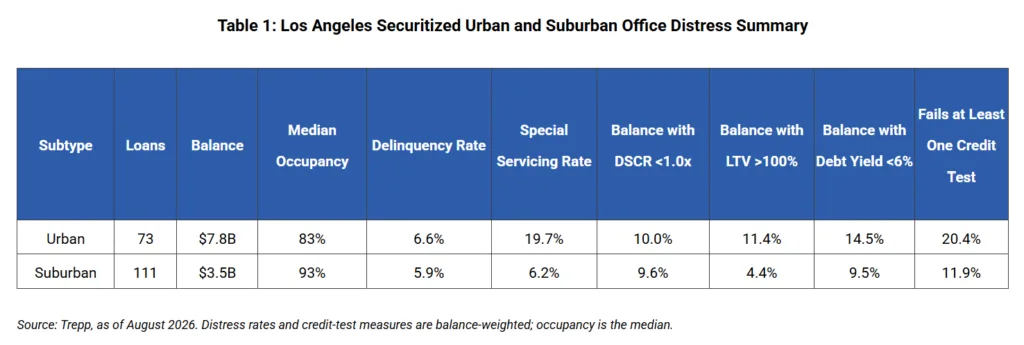
Trepp data reveals a sharp divide between Los Angeles’ urban and suburban office CMBS loans as of August 2026. Urban towers carry $7.8B in outstanding loans across 73 properties, with lower occupancy and greater distress. Median occupancy stands at 83%, while 19.7% of loans sit in special servicing.
By comparison, suburban offices carry $3.5B across 111 properties and maintain a healthier 93% median occupancy. Only 6.2% of suburban loans sit in special servicing. Delinquencies also show the divide, reaching 6.6% for urban offices versus 5.9% for suburban properties. A handful of high-profile towers with significant tenant losses drive much of the urban stress.
Get Smarter about what matters in CRE
Stay ahead of trends in commercial real estate with CRE Daily – the free newsletter delivering everything you need to start your day in just 5-minutes
The Details
Urban distress centers on several flagship assets, including Wilshire Courtyard, One California Plaza, and EY Plaza. Together, these properties represent $959.3M in loans. Servicer commentary placed Wilshire Courtyard’s occupancy at just 52% at the end of 2025. One California Plaza reported 55% occupancy at the end of July 2026, while EY Plaza stood at 64%.
Major tenants have downsized or exited across these properties, weakening cash flows and pushing debt yields below 6%. Some assets also carry loan-to-value ratios above 100%. These pressures pushed all three properties into special servicing or foreclosure. Their struggles highlight how tenant rollover can quickly increase refinancing risk at prominent urban properties.
Suburban Lease Rollover Is the New Pressure Point
Suburban office loans look steadier today, but significant rollover risk remains. Within the $3.5B suburban book, $1.6B involves properties where the largest tenant’s lease expires before loan maturity. That represents 46% of total suburban loan balances.
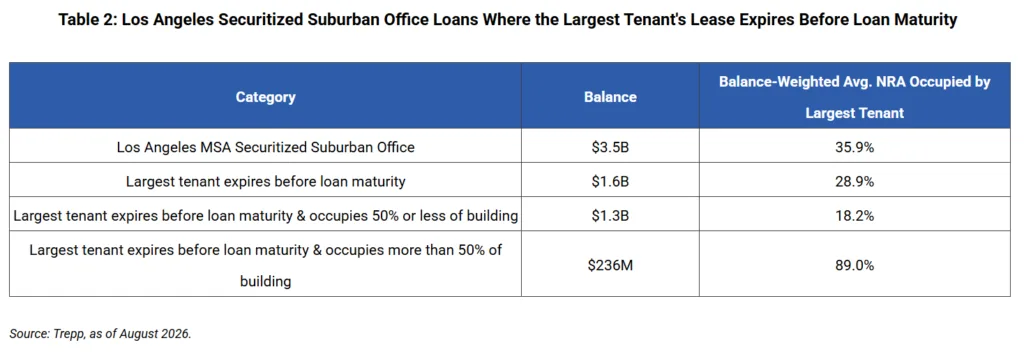
Most exposure involves properties with less concentrated tenancy. About $1.3B involves buildings where the largest tenant occupies under 50% of rentable space. However, $236M depends on tenants occupying an average 89% of their buildings. A major departure could quickly weaken those properties before loan maturity. Suburban stability will face its biggest test as these leases approach expiration.
Why It Matters
LA’s office market remains fragmented, with urban distress concentrated among several prominent towers. Meanwhile, suburban properties appear healthier but face growing rollover risks. Trepp found 20.4% of urban balances fail at least one major credit test. Those tests include DSCR below 1.0x, LTV above 100%, or debt yield below 6%. Only 11.9% of suburban balances fail those tests.
Tenant contractions at major downtown towers can quickly reduce cash flows, increase LTVs, and complicate refinancing. EY Plaza has entered foreclosure, while Wilshire Courtyard and One California Plaza remain in special servicing. The broader office market has increasingly turned to three-year loan extensions as borrowers seek more time to stabilize troubled assets. However, suburban properties could become the market’s next pressure point.
About $1.6B in suburban loans depend on major tenants with leases expiring before loan maturity. Properties with highly concentrated tenancy face the greatest exposure. However, concentration does not always create risk. Warner Bros. occupies 56% of Second Century, with its lease extending more than a decade beyond loan maturity. Long lease terms can make concentrated tenancy attractive to lenders.
What’s Next
Los Angeles office owners and lenders face growing scrutiny around lease rollover, particularly at suburban properties with concentrated tenancy. Urban towers remain the center of distress today. However, refinancing risk could rise as major suburban tenants approach renewal dates.
Lenders will likely place greater weight on remaining lease terms and tenant quality when making future credit decisions. Significant anchor tenant losses could quickly push suburban properties from stable to stressed. If that happens, more suburban loans could enter special servicing during 2027.