



- Of nearly 500 medical office properties resold since 2024, 67% appreciated versus 52% for general office.
- Medical office accounted for 26.2% of office starts in 2025, up from 11.0% in 2020.
- National office vacancy stood at 17.7% in July while office-using employment fell 0.2% over the year.
Medical office has separated itself from the rest of the office market. That is the finding of Yardi Matrix’s August 2026 national report. Demand for traditional space remains weak and is driving restructuring and consolidation. Healthcare property has held up on the strength of demographics and on-site care requirements.
Get Smarter about what matters in CRE
Stay ahead of trends in commercial real estate with CRE Daily – the free newsletter delivering everything you need to start your day in just 5-minutes
Healthcare Hiring Sets the Sector Apart
Education and healthcare form the fastest-growing employment sector nationally, up 2.4% year-over-year. Non-farm employment rose 0.3% over the same stretch. Office-using jobs fell 0.3%.
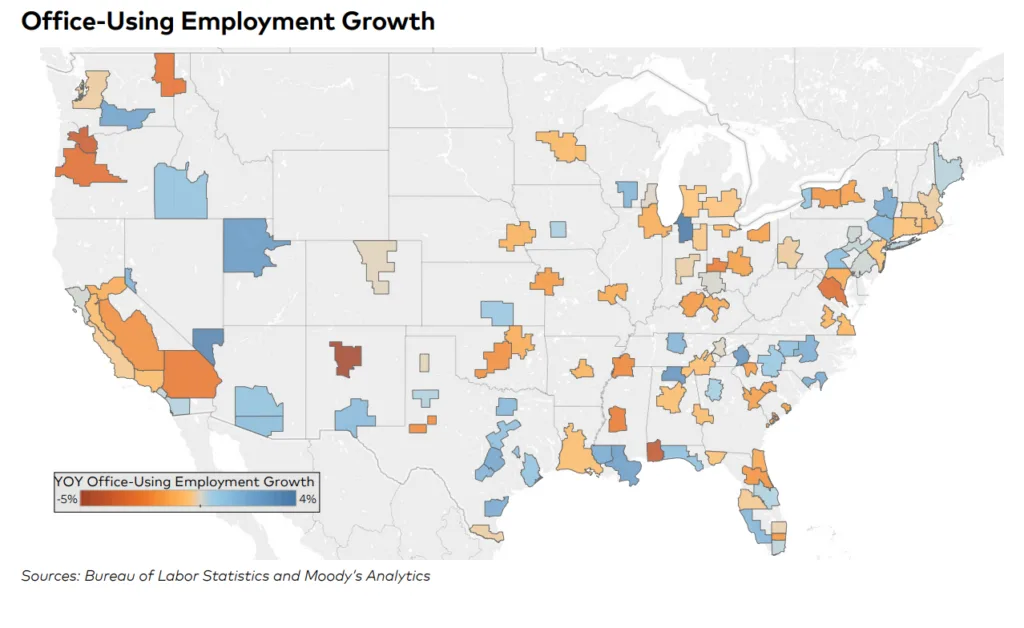
Healthcare also holds up better when the economy slows, since the services are essential. Traditional office tenants have absorbed hybrid schedules into their space plans. Care delivery has not moved off site. An aging population reinforces the pattern. More of the country is moving into heavier healthcare use.
The Details
Yardi Matrix examined nearly 500 medical office properties sold since 2024. Each had two prices available for comparison. Of those, 67% appreciated in value, against 52% for general office. That resilience mirrors earlier data showing medical office investment outperforming as traditional office fundamentals remained under pressure.
The gap was widest in metros with aging populations. Tampa led at 90% for medical versus 71% for general office. Fort Lauderdale followed at 89% and 76%, with Phoenix at 89% and 65%. One Tampa trade shows the range. Tampa General Hospital bought the 51,362 SF building at 17 Davis Blvd. in October 2025. It paid Healthcare Realty $22M, a 177% increase over the $7.9M price in 2014.
Construction Shifts Toward Medical Space
Medical office made up 26.2% of office starts in 2025, up from 11.0% in 2020. The segment holds only 10.4% of total stock. Deliveries reached just over 7M SF in 2025, or 16.8% of all completions. The shift owes as much to what stopped as to what started. General office starts fell 73.0% over the decade to 11.4M SF in 2025. Medical office starts slipped only 9.5% to just over 6M SF.
National Fundamentals Stay Uneven
The national full-service equivalent listing rate was $33.58 PSF in July. That is up 2.6% year-over-year and down nine cents from June. National vacancy was 17.7%, a drop of 130 basis points. Dallas vacancy fell 420 basis points to 18.7%. June marked the metro’s first reading below 20% since late 2023. Miami holds the lowest vacancy among top metros after Manhattan, at 11.6%. Portland sits at a historic high of 22.1%. Its office employment fell 3.8% in June. Office-using sectors added 15,000 jobs in July, per the Bureau of Labor Statistics. They still shed 80,000 jobs over the year.
Why It Matters
Capital looking at office exposure now has a segment with its own fundamentals. Medical office values have held while general office repriced. The construction pipeline has followed that money. The broader market gives investors a live pricing benchmark. Office properties have traded at $198 PSF across 1,576 transactions this year. Volume totals $36.4B.
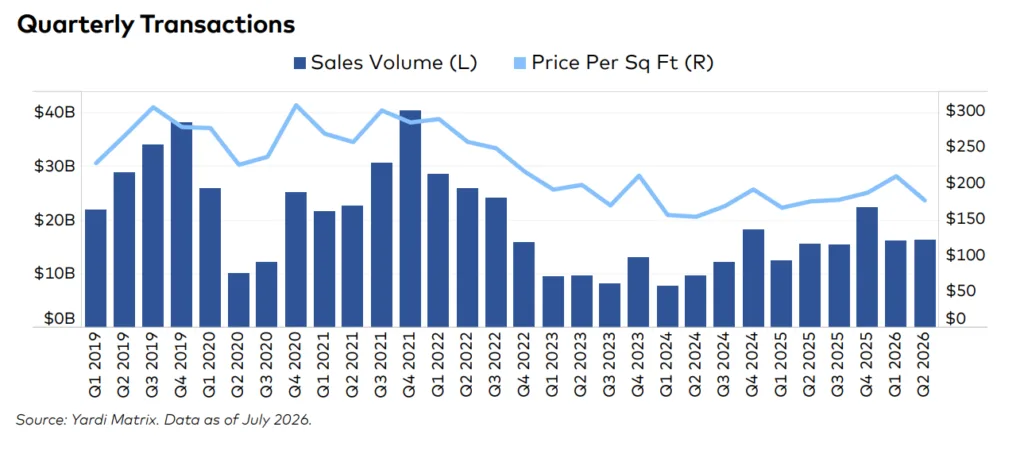
San Francisco shows how far pricing can travel. The metro is at $543 PSF in 2026, still 49.8% below the $1,060 peak in 2020.
What’s Next
Yardi Matrix expects medical office to stay well positioned as the population ages. Demand for healthcare services should grow with it. Another 29.5M SF of office space is under construction nationally, equal to 0.4% of stock.
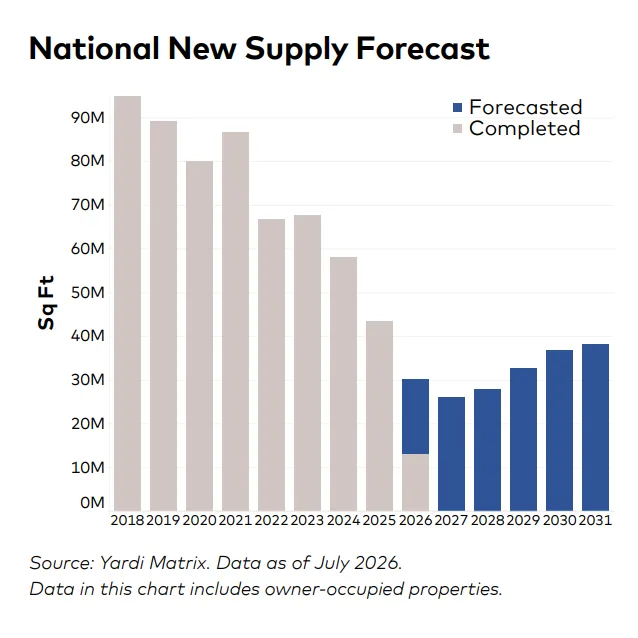
Deliveries reached 13.1M SF through July. Miami leads on development as a share of inventory at 1.8%. That rises to 6.0% once planned projects are included. Dallas is on track for a sustained recovery, per the report. Corporate investment from firms including KFC, Geico and Goldman Sachs is helping.