





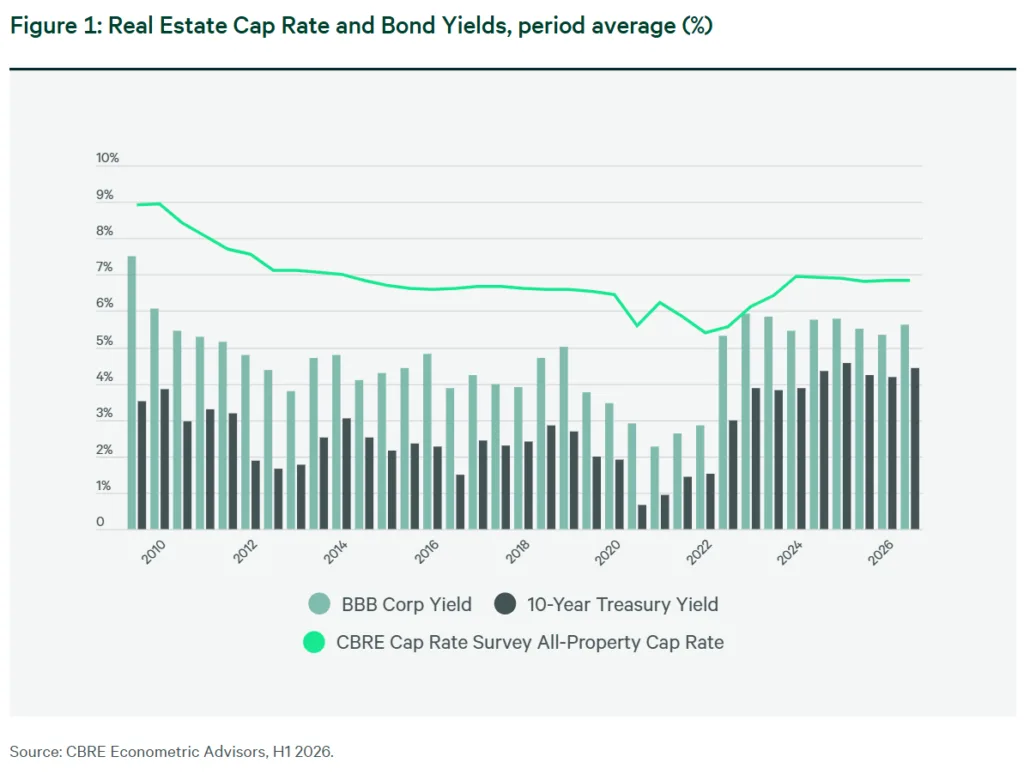
- Cap rates across US property sectors remained broadly flat in H1 2026, even as the 10-year Treasury yield peaked at 4.67%.
- CBRE’s survey reveals a sharp divergence in investor expectations by asset class and region, with the most bearish sentiment around infill multifamily and lower-tier office.
- Sustained higher borrowing costs and geopolitical factors like the US/Iran conflict are keeping CRE transaction volumes subdued, with investors demanding lower yields before reengaging.
Rate Volatility Meets Market Standstill
CBRE’s H1 2026 Cap Rate Survey, published in August, shows the US investment market weathering choppy macrocurrents. Despite the US 10-year Treasury yield peaking at 4.67% in May—up from sub-4% readings just months earlier—average CRE cap rates barely budged, remaining broadly stable across most asset types. This is noteworthy, as periods of such pronounced Treasury volatility have historically pushed real estate yields upward in near lock-step. However, this time, the headline steadiness in cap rates obscures major dispersion: by market, by sector, and by asset class. The survey, drawing on input from more than 200 CBRE professionals across 50+ markets, captures increasingly fractured investor sentiment in a market still searching for a price reset.
Get Smarter about what matters in CRE
Stay ahead of trends in commercial real estate with CRE Daily – the free newsletter delivering everything you need to start your day in just 5-minutes
The Details
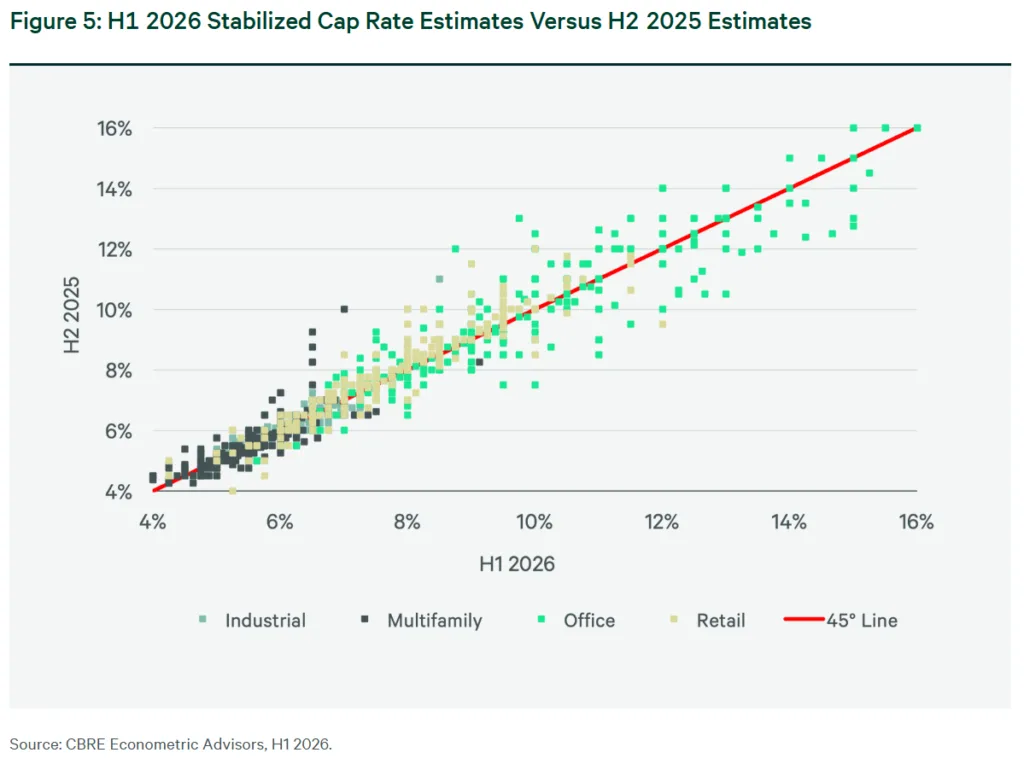
According to the survey, around 60% of respondents now expect cap rates to hold steady in the next six months, though more now anticipate increases than in the prior December 2025 survey. Notably, the eastern US markets saw more cap rate compression, with value-add and Class B/C assets posting sharper moves than Class A stabilized properties. Neighborhood retail, hotels, and industrial led on cap rate compression. In contrast, infill multifamily and lower-quality offices earned the most bearish outlook, with wide disagreement on where yields are headed next. For stabilized multifamily in New York City, for example, cap rates widened from the 4.5%–5% range in H2 2025 to 5%–5.5% in H1 2026. Suburban office cap rates in major Midwest markets like Chicago widened to 10%–12.5% for Class A assets.
Expectation Divergence Deepens
What stands out in CBRE’s latest data is the spread between optimistic and pessimistic projections. Expectations for cap rate expansion are notably strongest in Class C assets across property types, especially offices, with respondents split on the pace and direction of repricing. For example, the difference in cap rate estimates for lower-quality office assets has widened materially, indicating uncertainty around rents, tenant demand, and capital markets liquidity. By comparison, retail and industrial cap rates showed less variance and, in several metros, modest compression. The survey also notes that the gap in office yield estimates grew larger in H1 2026, while other asset types narrowed, highlighting growing bifurcation within the office sector that mirrors transaction data from Q2 2026.
Why It Matters
The flat all-property cap rate suggests a decoupling between core CRE risk premia and bond market benchmarks. This could signal either price stickiness or an impending correction. According to CBRE, the median cap rate for all properties basically held steady. However, that stability masks sharper moves across regions and asset classes. The pricing uncertainty follows a period when US commercial property sales increased 17% YoY in H1 2025. That trend obscures stress in segments like infill multifamily. Cap rates are now up 50–100 bps in key coastal markets since late 2025.
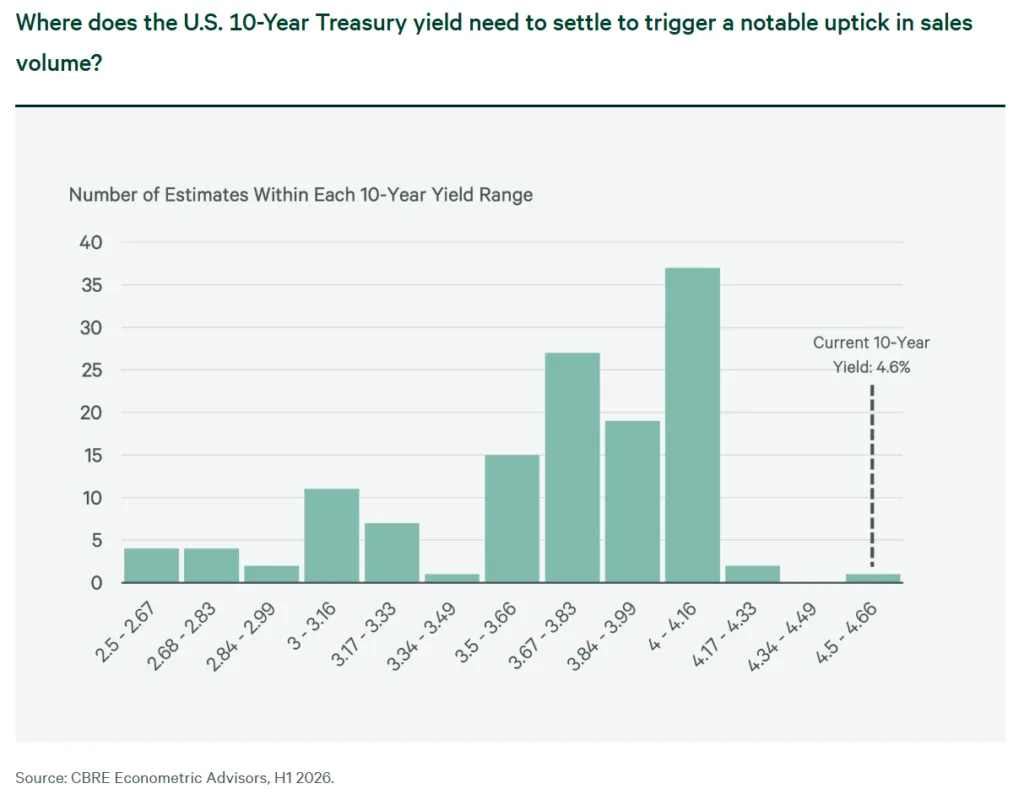
Most telling, perhaps, is that 77% of CBRE Capital Markets professionals in the survey said the US/Iran conflict negatively impacted their forecast for 2026 investment activity. The consensus is clear: higher inflation risks, uncertainty around the Fed Funds rate, and new geopolitical flashpoints are all keeping more capital on the sidelines. The survey further highlights that the median respondent thinks the 10-year Treasury would have to fall to 3.75%—well below the 4.6% mark in July—to spark renewed deal flow. Without that, buyer and seller expectations are likely to remain mismatched, capping transaction volumes for the foreseeable future.
What’s Next
As of August 2026, with Treasury yields hovering above where investors want them for renewed sales, CRE volumes are likely to stay muted. Should borrowing rates ease or macro headlines improve, look for compressed cap rates in neighborhood retail and select industrial markets to lead a modest recovery. Regionally, Class B/C office assets are likely to remain volatile, with some markets continuing to see cap rate expansion until occupier demand stabilizes. The next six months may see a shakeout, as patient capital waits for more attractive entry yields—and distressed owners weigh recapitalization or sales against low bid levels. Investors should watch for meaningful price discovery in Q4 2026 if rates retreat and capital markets activity resumes.