




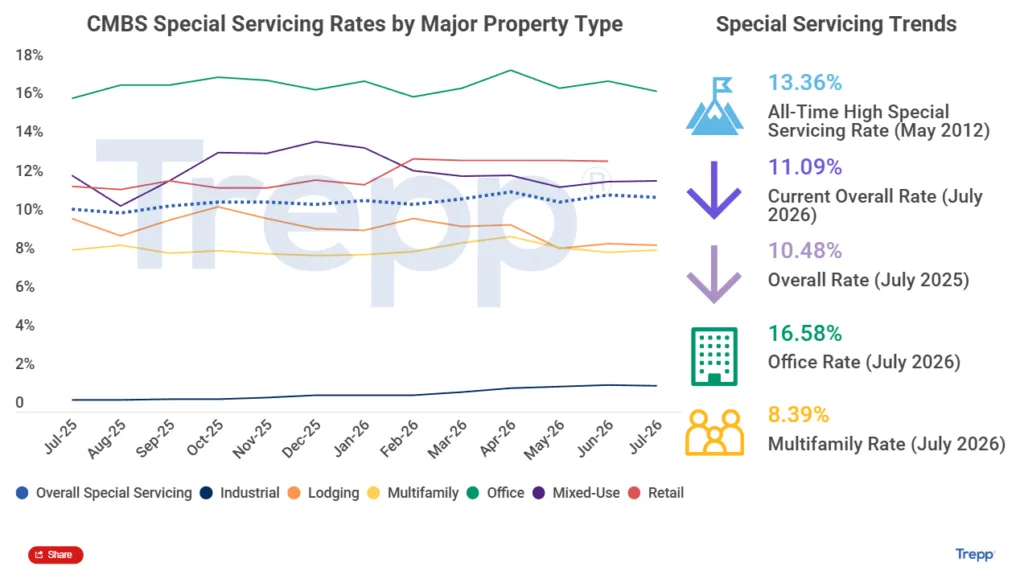
- The US CMBS special servicing rate decreased by 11 basis points to 11.09% in July 2026, according to Trepp.
- Office and lodging sectors drove overall improvement, while retail and multifamily saw increases in special servicing rates.
- Persistent distress, especially in regional malls, highlights lingering risks even as some sectors stabilize.
Office and Lodging Lead Rate Turnaround
The CMBS special servicing rate dropped to 11.09% in July 2026, falling 11 basis points from June. The decline partly reversed the recent upward trend and offered a positive signal for asset-backed credit quality.
Office and lodging, two sectors closely watched by lenders and servicers, posted the strongest improvements. Office special servicing fell 53 basis points to 16.58%, while lodging dropped 26 basis points to 8.63%. Industrial also improved slightly, with its rate declining three basis points to 1.34%.
Concerns over elevated CMBS distress grew throughout 2025 and 2026 as high rates collided with maturing debt. Trepp’s research shows July’s office and lodging improvements carried particular weight within the securitized debt market.
Get Smarter about what matters in CRE
Stay ahead of trends in commercial real estate with CRE Daily – the free newsletter delivering everything you need to start your day in just 5-minutes
The Details
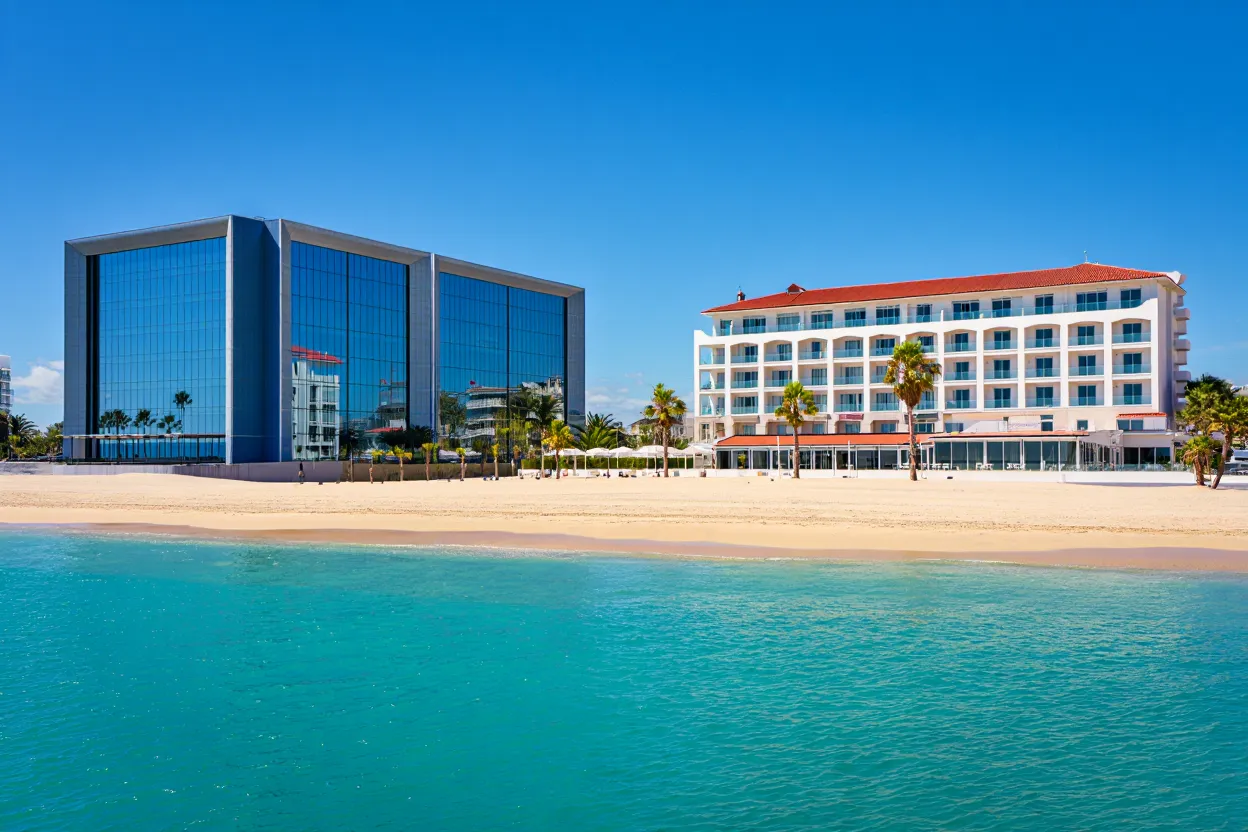
July brought approximately $1.69B in new CMBS loan transfers to special servicing across 41 loans nationwide. The largest new transfer involved a $280M maturity default secured by two beachfront hotels in Santa Monica, CA.
Retail moved in the opposite direction, rising 33 basis points to 13.28%. A wave of regional mall loans entering special servicing after maturity defaults drove the increase. Multifamily also climbed 16 basis points to 8.39%, while mixed-use edged higher to 11.93%.
The data shows continued balance sheet stress alongside improving conditions in several sectors. Office and lodging gains also coincide with renewed transactions and improving property-level net operating income in some markets.
Retail Turbulence and Mixed Results
Despite the overall decline, retail distress remains acute. Regional mall maturity defaults pushed the sector’s special servicing rate 33 basis points higher. The increase highlights retail’s continued exposure to structural changes and tighter credit conditions.
Multifamily also recorded higher special servicing, although its rate remains below previous cycle peaks. Meanwhile, industrial continued outperforming as logistics and warehouse demand supported fundamentals across most US markets.
Special servicing rates increased broadly across property categories during 2024, making July’s office and lodging declines particularly notable. However, $1.69B in new distressed loan transfers shows significant pressure remains across the CMBS market.
Why It Matters
July’s decline suggests CRE distress may be approaching a peak within some of the hardest-hit property categories. Office fell from above 17% to 16.58%, while lodging moved below 9%.
The improvement extends an earlier period when special servicing rates declined for a second consecutive month. These declines suggest lenders are working through portions of the maturity wall and pandemic-era distress. CMBS servicers may also be gaining traction with properties showing stronger fundamentals or securing additional rescue capital.
However, conditions remain uneven across sectors. Mall-driven retail distress shows that property fundamentals still outweigh broader improvements in credit conditions. July’s $1.69B in new transfers and multifamily’s increase also show that volatility remains firmly embedded in the market.
A Bifurcated Market
The CMBS market continues to split sharply across property types. Logistics and select lodging assets show resilience, while retail, mixed-use, and portions of office remain under pressure.
More than 11% of CMBS loans remain in special servicing, according to Trepp. The industry must manage near-term asset distress while preparing for a longer stabilization process.
Borrowers also face refinancing challenges as large loan balances approach maturity. Higher financing costs continue testing properties that lack sufficient cash flow, liquidity, or access to fresh capital.
What’s Next
Expect continued volatility as maturity defaults and tighter credit conditions move through the CMBS market. Investors will watch whether office and lodging maintain July’s improvement or reverse course during coming months.
Retail distress, particularly among regional malls, could keep overall special servicing rates elevated. Future movements will depend on economic conditions, distressed-asset demand, and borrowers’ ability to recapitalize or refinance.
Large loan balances continue approaching maturity throughout 2026 and 2027. Servicer workout activity will therefore remain critical as the market tests whether summer moderation can continue through the second half.