






- Recent vintages of multifamily CMBS are showing sharply higher delinquency rates, especially for loans issued in 2023 and 2024.
- Rising multifamily concentrations in conduit CMBS heighten the importance of underwriting quality and coverage at issuance.
- The data suggests thinner debt service cushions, not just operating deterioration, are driving early distress in these deals.
Thinner Buffers, Rising Stakes
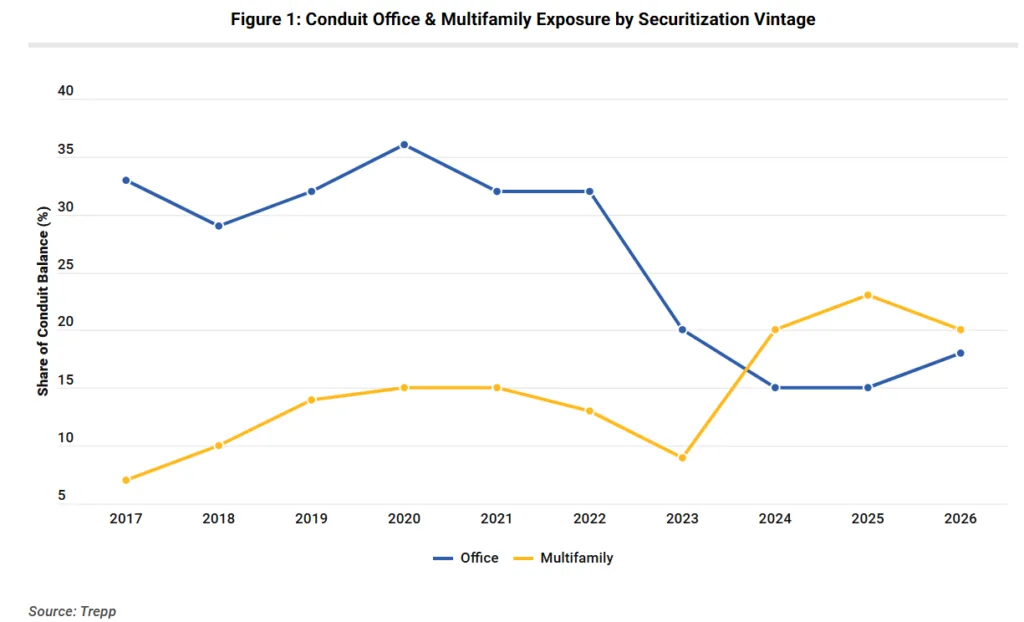
Multifamily loans have rapidly become a larger piece of the conduit CMBS market. According to Trepp, multifamily represented 20% to 23% of conduit securitization balances from 2024 through July 2026. That share has tripled from just 7% in 2017. As a result, early credit issues now pose a much greater risk to overall conduit pool performance.
This rise coincides with a concerning underwriting trend. The 2023 and 2024 multifamily vintages entered the market with historically slim debt service cushions. That limited margin leaves loans more vulnerable to operating pressure. Even modest setbacks can now produce outsized credit consequences.
Get Smarter about what matters in CRE
Stay ahead of trends in commercial real estate with CRE Daily – the free newsletter delivering everything you need to start your day in just 5-minutes
The Details
Recent vintages stand out because of how quickly performance has deteriorated. The 2023 multifamily CMBS vintage reached an 11.13% delinquency rate after 18 months, according to Buschbom’s analysis. That rate measures loans at least 30 days late. By 32 months after securitization, the rate had surged to 29.01%. It stood at 23.8% in July 2026.
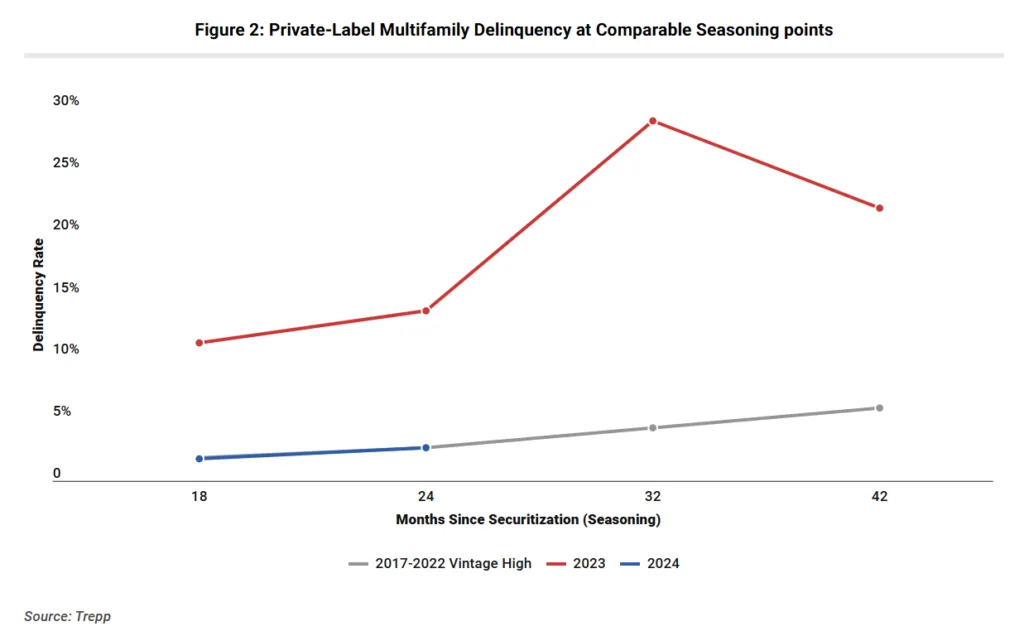
The 2023 vintage contained only $2.8B in multifamily collateral, but newer vintages carry much larger balances. Multifamily collateral reached $20.1B in 2024 and $16.6B in 2025. The 2024 conduit delinquency rate has already climbed to 10.6%. Meanwhile, issuance DSCR fell from 2.51x in 2022 to 1.56x in 2023 and 1.40x in 2024. Current DSCR now stands at 1.36x for 2023 loans and 1.28x for 2024 loans. Those levels sit much closer to default territory.
Occupancy Declines Are Not the Only Culprit
The latest data shows that operating slippage alone cannot explain the sharp increase in stress. The 2022 conduit multifamily vintage experienced larger declines in both DSCR and occupancy than more recent vintages. However, those deals started with substantially thicker coverage. That stronger cushion helped keep delinquencies comparatively low at 4.6%.
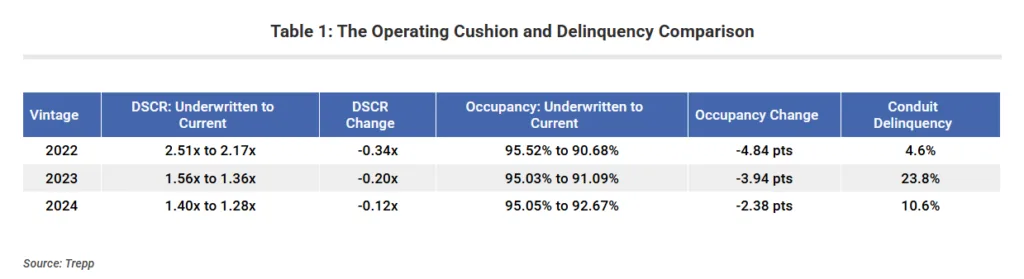
By contrast, 2023 and 2024 vintages started with thinner DSCR levels. Even relatively small operating declines have triggered disproportionate increases in delinquency. This pattern highlights the importance of tracking both origination coverage and post-issuance performance. Two similar multifamily loans can react very differently to market pressure because of their starting cushions.
Credit Cushion Defines Risk Profile
Before 2023, office loans dominated conduit composition. They accounted for roughly one-third of most pools between 2017 and 2022. Multifamily’s share has nearly tripled since then. Many investors viewed that shift as a way to diversify away from office exposure. Meanwhile, multifamily loans from 2021 and 2022 vintages have also faced mounting stress. However, the structural change means multifamily performance now carries much greater weight across conduit pools.
The divergent seasoning profiles show how strongly origination structure can shape credit risk. Small declines in DSCR or occupancy cause greater damage when loans begin with thin margins. As of July 2026, 2024 private-label conduit multifamily delinquencies stood at 10.6%. The 2023 delinquency rate reached 23.8%. Those levels now make multifamily a major conduit credit concern despite office’s past notoriety.
For multifamily CMBS investors, deal-by-deal scrutiny remains essential. A larger multifamily allocation does not automatically create greater risk. However, it amplifies the consequences of underwriting decisions involving loan structure, sponsor basis, assumed rent growth, and DSCR buffers. Buschbom cautions against applying recent-vintage trends wholesale to upcoming 2025 and 2026 pools. Market conditions continue evolving, while those loans remain relatively unseasoned. Still, recent performance reinforces one clear lesson: the initial margin for error matters more than ever.
What’s Next
Multifamily now plays a central role in conduit CMBS, shifting attention toward how the 2025 and 2026 vintages season. These vintages have not yet experienced full economic cycles. Their starting DSCR ratios also remain relatively thin. Surveillance teams will likely focus more closely on loan-level coverage as these pools mature.
Occupancy, rents, expenses, and emerging credit deterioration will also require close monitoring. The sector’s growing footprint means early distress can affect a much larger portion of the CMBS market. That raises the stakes for risk management, credit surveillance, and underwriting decisions across future conduit deals.