




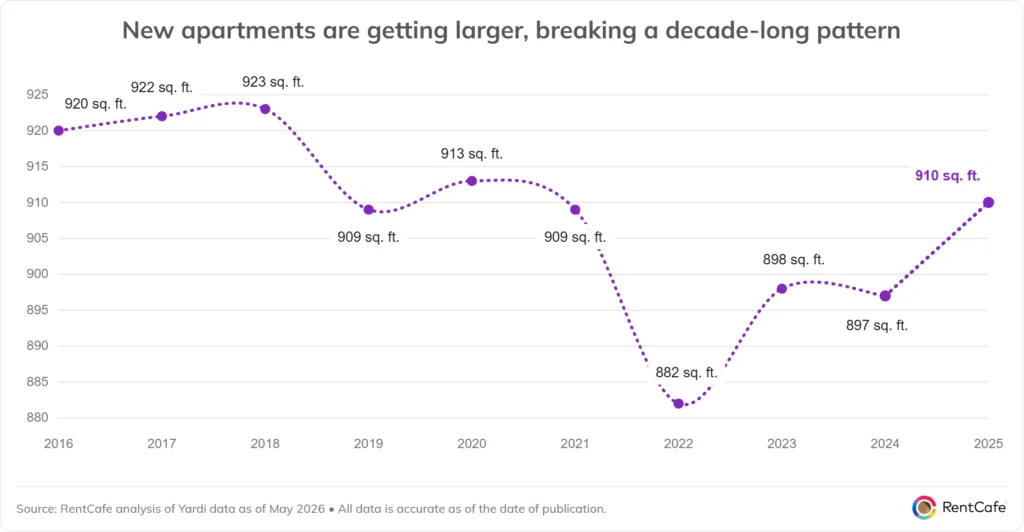
- Average US apartment size rose by 13 SF in 2025, reaching 910 SF nationwide, per RentCafe/Yardi Matrix data.
- Southern cities, especially Tallahassee, Gainesville, and Fort Myers, offer the largest new apartments, while Seattle and Portland are home to the smallest units.
- Developers are designing larger floor plans, signaling continued demand for more space and regional divides in apartment sizing.
Southern Markets Set the Pace for Apartment Growth
Apartment floor plans nationwide are expanding after a decade of shrinkage, with RentCafe reporting that the average new unit in the US reached 910 SF in 2025—a 13 SF gain from 2024. This growth is not evenly distributed: Southern markets, where land is less constrained, now dominate the leaderboard for apartment size. Tallahassee, FL, takes the top spot with new units averaging 1,156 SF, while Gainesville and Baton Rouge follow closely. Meanwhile, renters in the West and Northeast, particularly in high-cost metros like Seattle and Brooklyn, continue to see more compact offerings, highlighting the nation’s geographic divide in multifamily development strategy.
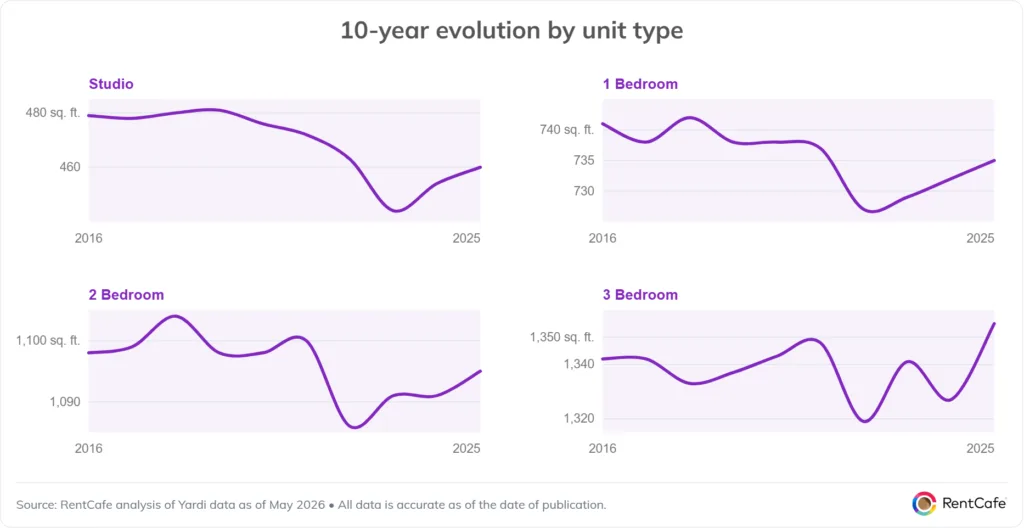
The return to larger units reverses a downward trend seen after 2016, when average floor plans repeatedly shrank below the 900 SF level. Developers and investors are now recalibrating—responding to shifting tenant demands tied to remote work, flexible living, and household changes, especially as migration patterns continue to favor the Sun Belt.
Get Smarter about what matters in CRE
Stay ahead of trends in commercial real estate with CRE Daily – the free newsletter delivering everything you need to start your day in just 5-minutes
The Details
According to RentCafe’s May 2026 analysis of Yardi Matrix data, all unit types saw year-over-year size increases. Studios now average 460 SF (up 6), one-bedrooms rose to 735 SF (up 3), and two-bedrooms edged up to 1,095 SF (up 4). Three-bedrooms led the pack, adding 28 SF on average and now measuring 1,355 SF nationwide.
Southern cities dominate the new apartment size rankings: Tallahassee tops with 1,156 SF per unit, followed by Gainesville (1,126 SF), Baton Rouge (1,042 SF), Fort Myers (1,032 SF), and Knoxville (1,032 SF). In contrast, Seattle takes the dubious crown for smallest average, with new units at just 645 SF—down 47 SF compared to a decade ago. Portland, Tacoma, Brooklyn, and San Francisco round out the bottom tier, though San Francisco’s apartments are bucking the shrinking trend with a 35 SF net gain since 2016.
Gains and Losses Mark a Geographic Divide
Frisco, TX, and St. Petersburg, FL, lead the nation in growth, with the average apartment adding 55 SF since 2016. Irvine, CA, is close behind (+46 SF), and San Francisco stands out among major cities with a significant 35 SF bump. Cities gaining the most space often share key characteristics: growing populations, attractively priced land, and a construction pipeline that favors two- and three-bedroom units.
Conversely, Arlington, TX, tops the list for shrinking units: average size dropped by 287 SF—almost the area of a master bedroom. Birmingham, Columbia, Detroit, and Tacoma saw cuts exceeding 150 SF per unit, typically tied to a product mix shift toward smaller, higher-density floor plans able to match intense urban demand. While unit counts rose, square footage fell, reflecting developers’ focus on maximizing yield and affordability.
Why It Matters
The renewed expansion in average unit sizes has broad implications for leases, development, and investment strategies across US multifamily. CBRE’s 2025 US Multifamily Report highlights that remote work and hybrid arrangements continue to push renters toward larger apartments. The 13 SF national increase, while modest, signals a notable shift: new supply is responding to evolving consumer preferences for more functional space—whether for home offices, family life, or amenity-rich living.
Demand for space is especially strong in the South, where cities like Tallahassee and Gainesville deliver units more than 200 SF larger than the national average. This trend is reinforced by population migration out of dense, high-cost regions into more affordable Sun Belt metros. For developers, adding square footage can be a differentiator in crowded markets, not just a response to local zoning or land economics. That said, one-bedroom apartments and studios still account for more than half of new supply (52.9% in 2025), suggesting that smaller units remain integral to urban inventory, particularly in markets like Seattle and Brooklyn, where affordability and density are key.
The divergence in sizing is also a critical metric for investors modeling rent growth, retention, and tenant composition. Markets with increasing unit sizes often capture households looking to upgrade, while declines in average size often point to a focus on singles or cost-sensitive renters. Either way, tracking these shifts is essential for underwriting new deals and repositioning existing assets.
What’s Next
Construction pipelines point to continued growth in apartment sizes, especially in the South. Meanwhile, apartment construction timelines shortened slightly in 2024, helping developers bring new supply to market faster. Cities like Gallatin, TN, Palmetto, FL, and Ocala, FL, lead upcoming deliveries. Average new unit sizes in these markets exceed 1,200 SF.
At the other end, markets including Newark, NJ, and Seattle will keep prioritizing compact footprints. New completions there average below 650 SF. RentCafe expects demand for flexible, spacious apartments to persist, particularly among relocating renters. Developers will likely keep designing larger units where land economics make it feasible.