





- Buffalo led all major US metros with 3.6% single-family rental rent growth in H1 2026, per Chandan Economics and Arbor Realty Trust.
- Northeast and Midwest metros dominated the top 10 for SFR rent growth, outpacing most Sun Belt markets.
- The share of SFR markets with rent gains hit 75.7% in June 2026, marking the broadest momentum this year.
Midwest and Northeast Surge Past Sun Belt Staples
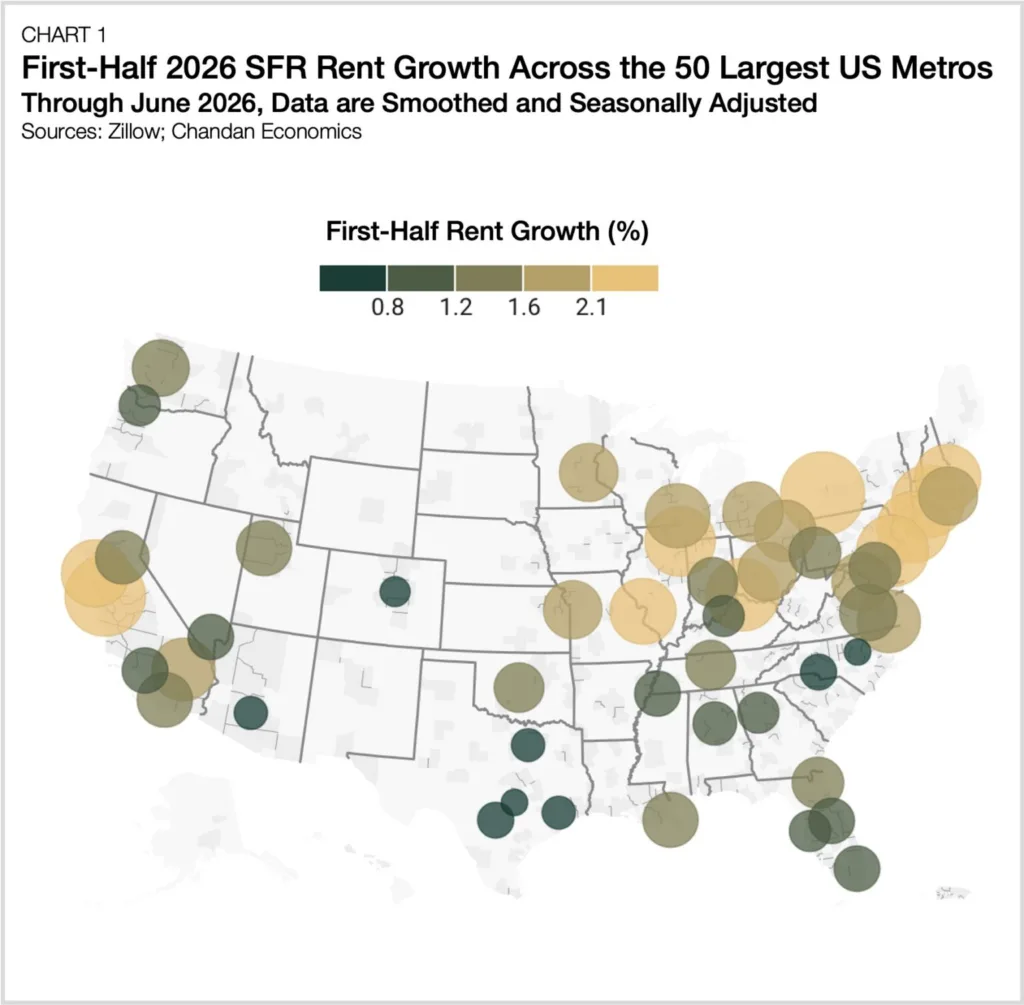
Single-family rental (SFR) rent growth opened 2026 with an unmistakable regional shift. Chandan Economics, in partnership with Arbor Realty Trust, reports that eight out of the ten fastest-growing metros for SFR rents in the first half of 2026 were in the Midwest or Northeast. The surge marks a stark contrast from the pandemic era, when Sun Belt cities routinely drove national SFR rent benchmarks.
By June, the leadership board was topped by Buffalo, NY, at 3.6% rent growth, leaving high-flying Sun Belt markets further behind. The report’s use of Zillow’s Observed Rent Index underscores how market momentum has become more distributed as affordability concerns rise in legacy growth markets.
Get Smarter about what matters in CRE
Stay ahead of trends in commercial real estate with CRE Daily – the free newsletter delivering everything you need to start your day in just 5-minutes
The Details
The data reflects broad-based, if uneven, momentum. Buffalo’s 3.6% growth led all 50 largest US metros, followed by San Jose, CA, at 3.3%—exceptional as San Jose is also the priciest SFR market, averaging $4,794 per home monthly. Cincinnati and Hartford tied for third at 2.7%. New York and Philadelphia followed at 2.6%, with Chicago just behind at 2.5%.
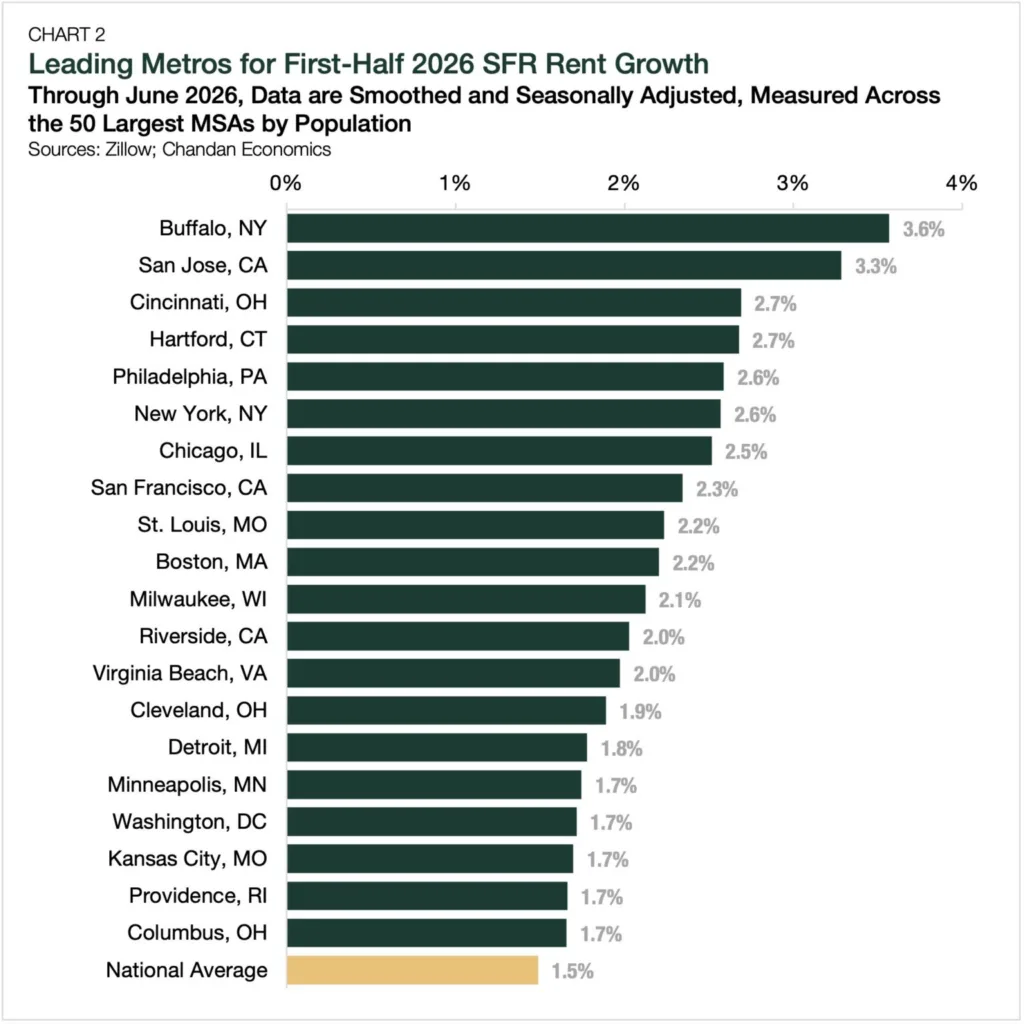
Meanwhile, Northern California bucked regional patterns, with San Jose and San Francisco both in the top ten. Sun Belt powerhouses, however, posted notably weaker results: Austin and Raleigh managed just 0.3%, Denver saw 0.4%, and Dallas, Houston, and Phoenix each posted 0.5%. Overall, SFR rents were up across all major metros between December 2025 and June 2026.
Rent Growth Widens Across Markets
The trend was not confined to these top performers. In June, 456 out of 602 tracked SFR markets posted monthly rent increases. That pushed the share of markets with rising rents to 75.7%, the highest level this year.
The broader acceleration follows earlier signs that SFR rent growth was slowing as homes remained available longer. This brings the percentage of markets with rising rents well above the 69.4% recorded in December 2025.
The report notes this broadening strength represents an 11.2-point jump from a post-pandemic cyclical low in May 2025. Despite trailing pre-pandemic averages, the trajectory has rebounded significantly toward normalization.
Why It Matters
This evolving SFR rent growth landscape has direct implications for investors, operators, and lenders focused on single-family rental portfolios. Lead markets like Buffalo, Cincinnati, and Hartford—traditionally seen as more stable but lower growth—are now outperforming high-profile metros. The newfound momentum in the Northeast and Midwest indicates capital may pivot toward these regions, especially as Sun Belt cities contend with supply increases and affordability ceilings.
A wider distribution of rent growth also suggests resilience against regional shocks and opens the door for both institutional and small-scale investors to diversify further. With average rents still moderately below pre-pandemic ‘boom’ measures, a normalization toward those baselines could signal room for further upside in key SFR markets as demand persists. The competitive outlier status of San Jose, the most expensive market with second-highest growth, further highlights how local supply-demand imbalances still trump broader macro trends in certain areas.
Per Chandan Economics, as the SFR sector becomes more differentiated, close attention to market-by-market factors such as local supply and property economics will be increasingly important. The 2026 acceleration represents both a return to normal seasonality and a fresh spatial realignment of rental growth hotspots—remaking the traditional SFR investment playbook.
What’s Next
The second half of 2026 will test whether the Northeast and Midwest can sustain outperformance amid long-term economic headwinds and new supply pipelines gradually coming online nationwide. Operators and investors will be tracking whether Sun Belt metros regain pricing momentum or whether changing migration, affordability, and household formation dynamics keep shifting rent growth northward and inland.
Meanwhile, with nearly three-quarters of tracked US SFR markets now notching positive rent moves, watch for increased transaction activity and capital flows chasing these emergent regional leaders.