






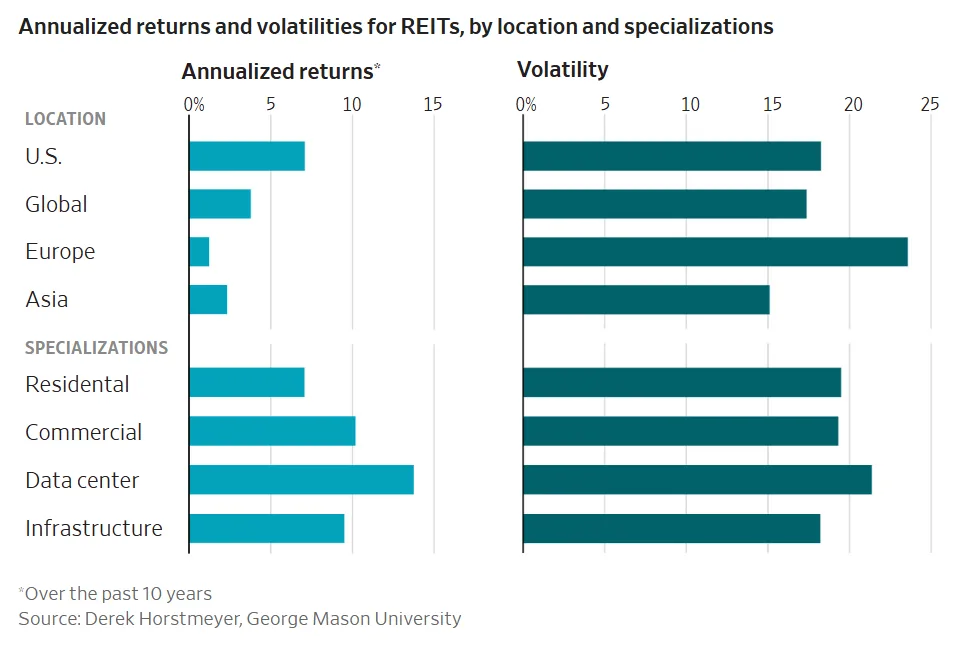
- US-focused REITs achieved a 7.08% annualized return over the last decade, the highest among major regions, per WSJ analysis.
- Data center REITs led US sector performance with 13.75% annualized returns and saw increased volatility due to tech demand.
- European REITs lagged with just 1.23% annual returns and the highest volatility, underscoring regional performance gaps in global CRE investment.
US Outperformance Sets Global Benchmark
The Wall Street Journal cited research using Morningstar Direct data that shows US-focused REITs outperformed global peers over 10 years. Investors tracking broad REIT index funds or sector-specific ETFs saw strong results, particularly across specialized US niches. Meanwhile, Europe lagged in both returns and stability.
Derek Horstmeyer at George Mason University led the study comparing REIT mutual funds and ETFs across regions and US sectors. The findings showed a clear long-term advantage for the American market. US REITs returned 7.08% annually between 2016 and 2026. European REITs returned only 1.23%, while Asian REITs produced 2.33%. Europe recorded 23.56% volatility, while Asia posted a lower 15.10%.
Get Smarter about what matters in CRE
Stay ahead of trends in commercial real estate with CRE Daily – the free newsletter delivering everything you need to start your day in just 5-minutes
Specialization and the Rise of Data Center REITs
Sector performance played a major role in US REIT results. Data center REITs delivered 13.75% annualized returns with 21.36% volatility. The artificial intelligence boom strengthened this risk-reward profile after 2023, although the sector’s outperformance began earlier.
Commercial-focused REITs followed with 10.18% annual returns and 19.30% volatility. Infrastructure REITs, including cell towers and pipelines, generated 9.51% annualized returns with 18.20% volatility. Residential REITs lagged with 7.05% annualized returns and 19.47% volatility. That performance closely matched the broader US benchmark.
Global REIT Performance Divergence
Comparisons across regions highlight US strength and the challenges facing other markets. Morningstar data cited by WSJ shows European REITs generated the lowest annual returns at 1.23%. They also recorded the highest volatility, forcing investors to accept greater risk for significantly weaker returns.
Asia produced a modest 2.33% return alongside a steadier risk profile. Its results reflect market maturity and fewer sector opportunities compared with the US. Meanwhile, US REIT specialization has increased over the past 15 years. Technology-driven assets like data centers have helped investors capture outsized returns. Traditional residential and diversified strategies produced more moderate results.
Why It Matters
For institutional and retail CRE investors, these results strengthen the case for careful sector and regional selection. Horstmeyer and his George Mason University team analyzed 10 years of performance across regions and US sectors. Data centers led the rankings, supported by rapid digital transformation and rising artificial intelligence demand. That trend accelerated after 2023.
Data center REITs generated 13.75% annualized returns, highlighting the potential value of technology-linked CRE strategies. Meanwhile, improving US home construction activity adds another signal of momentum across the broader domestic real estate market. Conversely, European REITs returned only 1.23% annually while volatility exceeded 23%. Legacy office and retail portfolios contributed to that weakness, alongside slower economic growth and political instability.
Asia delivered neither high returns nor region-leading stability during the period. Overall, the results emphasize the importance of sector and geographic focus within global REIT allocations. They also show that risk can vary significantly beyond headline yields, particularly outside the US and across slower-growing sectors.
What’s Next
Digital infrastructure demand continues rising, keeping data center REITs at the center of public and private capital strategies. Deeper sector specialization could create further performance divergence. AI and cloud adoption should continue increasing pressure on existing data center capacity.
European REITs may need to reconsider portfolios and strategies to reverse their long-term underperformance. Investors should also track sector rotation and regional capital flows when managing global real estate allocations. As the US extends its lead, exposure to high-growth CRE subsectors could become increasingly important for outperforming passive benchmarks.