




- Landlords in rent-controlled markets are seeing net operating income (NOI) collapse as expenses outpace capped rent revenue, per Trepp data.
- Examples from New York, Los Angeles, and Saint Paul show stabilized properties becoming cash-flow negative, leading to special servicing and potential foreclosure.
- The decoupling of revenue controls from expense reality may trigger value destruction, shrink acquisition volumes, and worsen housing affordability.
Structural Imbalance in Multifamily Economics
Trepp’s analysis, highlighted in recent thought leadership, exposes a fundamental flaw in US rent stabilization frameworks. Cities like New York, Los Angeles, and Saint Paul tightly regulate revenue through rent caps or stabilization formulas. However, these frameworks never adjust allowable rent growth for rising insurance, property taxes, utilities, or payroll costs. That omission becomes more significant as multifamily owners face a tougher economic environment than during the zero-rate era.
The widening gap between capped rents and floating expenses now threatens property performance across regulated markets. Meanwhile, the Federal Reserve’s higher-rate policy has intensified pressure on property values. Trepp says the June and July 2026 FOMC meetings reinforced expectations for elevated rates. Higher cap rates now magnify every dollar of lost NOI, accelerating value declines.
Get Smarter about what matters in CRE
Stay ahead of trends in commercial real estate with CRE Daily – the free newsletter delivering everything you need to start your day in just 5-minutes
The Details
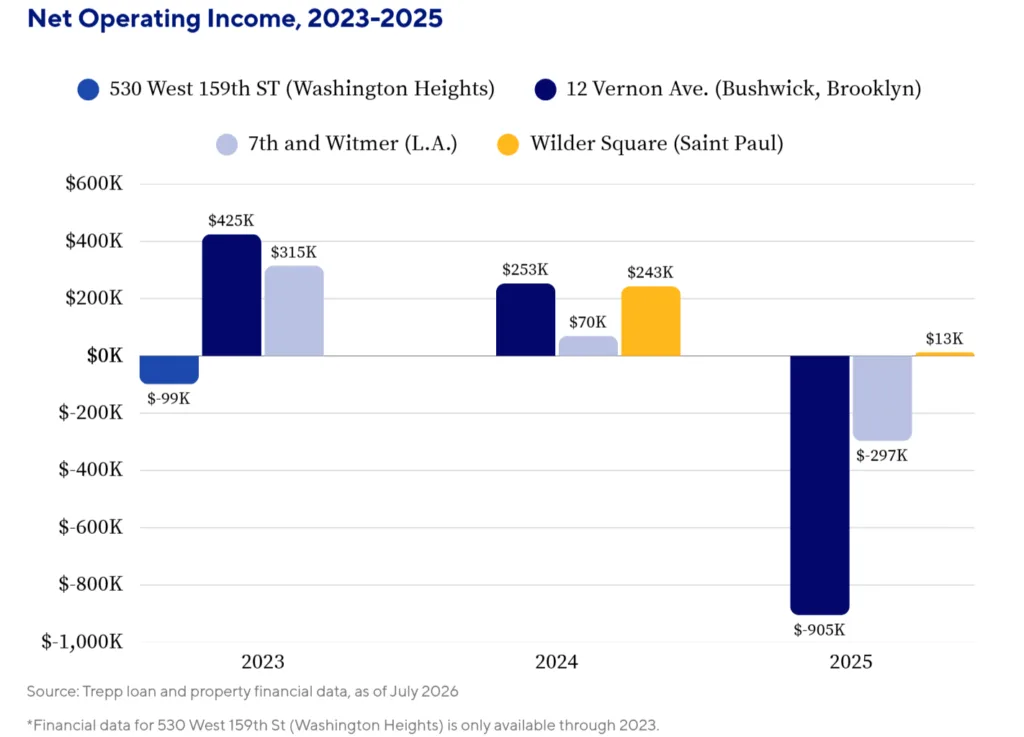
Trepp analyzed loan and property financial data across regulated markets to highlight this mismatch. In Manhattan, a 12-unit rent-stabilized property at 530 West 159th Street generated $201,471 in annual revenue. Operating expenses reached $300,815 in 2023. The property posted negative $99,344 NOI despite 92% occupancy. Rising expenses, with utilities nearing 70% of revenue, overwhelmed limited rent growth. The loan entered special servicing in July 2023. Foreclosure followed that September, and the lender took title in January 2026.
Brooklyn showed similar pressure. A 212-unit property saw NOI fall from $424,891 in 2023 to negative $905,110 by 2025. Operating expenses jumped 55% year over year and outpaced modest revenue gains. Los Angeles’ 76-unit Section 8 property and Saint Paul’s 136-unit Wilder Square followed similar paths. Both slipped into negative cash flow because local rent rules capped revenue growth. These trends affected newer assets and conservatively leveraged properties alike. The data challenged assumptions that distress only impacts older or poorly underwritten buildings.
Decoupling Rent Controls From Expense Inflation
These examples reflect a broader structural problem. As of July 2026, Trepp identified 484 multifamily properties in New York with DSCRs below 1.0x. California recorded another 601 properties below that threshold. Many remained well stabilized and conservatively financed. Yet expense growth pushed them into distress because revenue stayed capped.
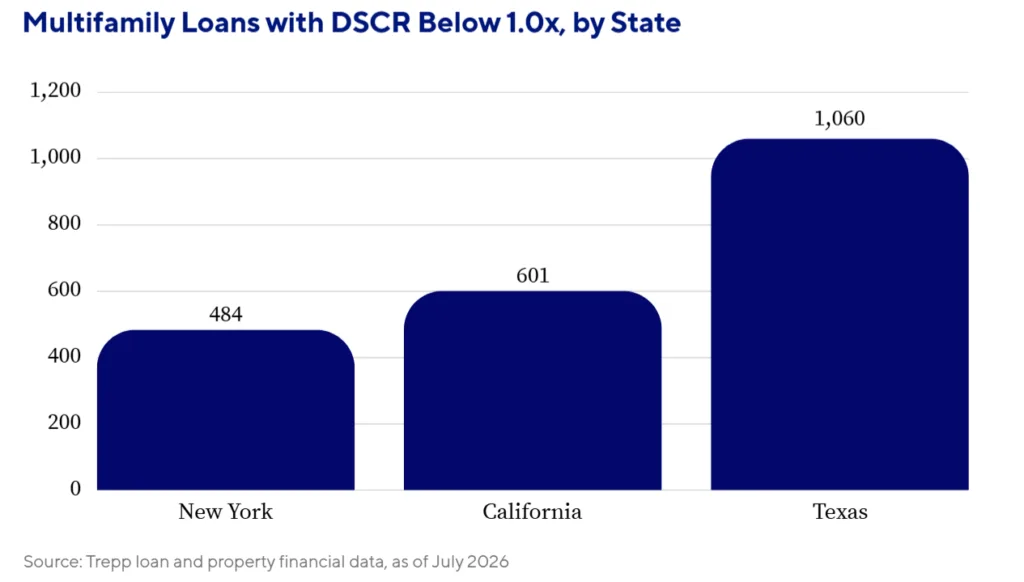
Texas also reported more than 1,000 multifamily properties below 1.0x DSCR. However, oversupply from 2021 and 2022 created those losses instead of rent regulation. Trepp argues that oversupply-driven weakness eventually corrects through market cycles. Regulation-driven income erosion, however, creates persistent structural pressure. That contrast also explains why many public apartment owners continue emphasizing demand recovery as the key driver of improving operating performance, rather than relying on rent growth alone.
This imbalance also spreads through the capital stack. Agency lenders, including Fannie Mae and Freddie Mac, continue absorbing growing losses and legal costs. Their guarantees only cover the credit tail. Meanwhile, regional and community banks remain exposed through non-agency multifamily debt. Many lenders still rely on “extend and pretend” strategies. Those extensions delay the problem instead of closing the revenue-expense gap.
Why It Matters
NOI remains the foundation of commercial real estate performance. Trepp’s loan-level data shows how revenue controls combined with unchecked cost inflation destroy value. Every dollar of lost NOI, capitalized at a 6% cap rate, removes more than $16 in asset value. One Brooklyn property’s $1.33M NOI decline erased roughly $22.2M in value. Even smaller affordable and Section 8 properties experienced multi-million-dollar valuation losses.
Falling values also freeze transaction activity. Buyers refuse to underwrite capped income against unlimited operating costs at market pricing. As a result, transaction volumes in regulated markets trail national averages. Liquidity continues shrinking as sellers hold assets, buyers retreat, and lenders accumulate additional exposure.
Meanwhile, owners face mounting taxes, insurance, staffing, and utility costs without matching rent growth. Many delay maintenance, reduce staffing, or abandon properties entirely. The Washington Heights foreclosure illustrates the contradiction. The building stayed 92% occupied but still failed financially. Policies designed to preserve affordability may instead reduce housing quality and discourage future supply.
The trend also raises legal and policy questions. Regulatory takings claims still face high legal hurdles. However, Trepp’s occupied, rent-paying examples may attract greater legal scrutiny. Policymakers could reduce pressure by indexing allowable rent increases to major operating expenses. Without reform, capital will likely continue leaving critical housing markets. That shift could deepen affordability challenges and reduce long-term reinvestment.
What’s Next
Trepp expects negative NOI and DSCR pressure to continue unless regulators introduce expense pass-throughs or link rent increases to operating costs. Equity cushions will likely keep shrinking. More properties could breach debt covenants, increasing foreclosures and lender workouts. Industry groups and local governments will probably debate regulatory takings standards more aggressively.
Capital markets will also keep discounting assets burdened by revenue and expense mismatches. Without structural reform, transaction activity and lending volumes will likely remain weak. Owners may defer reinvestment in aging properties. Those trends could further reduce multifamily liquidity and worsen long-term housing affordability.