



- Tanger upped its annual funds from operations guidance after Q2 tenant sales rose 5% year-over-year.
- World Cup tourism and early back-to-school demand fueled traffic, with core FFO and revenue beating Wall Street forecasts.
- The outlook improvement points to resilient brick-and-mortar retail fundamentals and renewed space demand as development slows.
Domestic Travel and Event Tailwinds Boost Retail
Tanger Inc. is riding a wave of elevated domestic travel and earlier-than-usual back-to-school shoppers, according to Bloomberg. The North Carolina-based REIT increased its full-year guidance for the second time in 2026, citing both the surge in shopping center visits and stronger spending. Major events—like the World Cup and blockbuster film releases—have put more feet in their outlet centers, helping counter act potential headwinds facing the wider retail sector.
Average tenant sales at Tanger’s outlets gained 5% in Q2, despite fears earlier this year around international instability and weaker consumer sentiment. Ongoing conflicts in popular getaway destinations, from the Caribbean to the Middle East, have funneled travel demand into domestic hotspots where Tanger operates, providing an additional retail lift.
Get Smarter about what matters in CRE
Stay ahead of trends in commercial real estate with CRE Daily – the free newsletter delivering everything you need to start your day in just 5-minutes
Discounts and Diversification Spark Growth
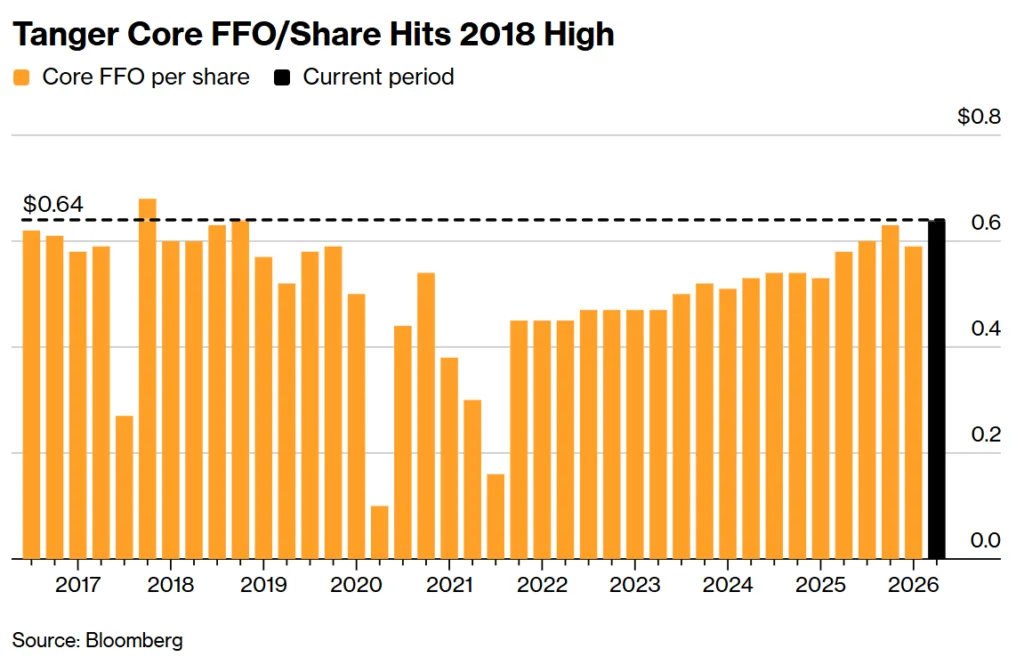
Facing high brand pressures and consolidating department stores, Tanger has leaned into its value proposition. CEO Stephen Yalof told Bloomberg that the outlet’s combination of retailer-funded promotions and traditionally lower prices lured more customers during peak shopping periods. Second-quarter revenue hit $156.4M—outpacing Wall Street’s $146.3M target. Meanwhile, core funds from operations (FFO) reached $0.64 per share, a 10% gain from 2025 and above analyst estimates.
Tanger’s playbook also includes expanding beyond off-price outlets. In May, the REIT acquired a 301,000 SF mall near Toledo, Ohio for roughly $60M. Other major retail landlords are also benefiting from healthy leasing demand, reinforcing confidence in physical retail despite economic uncertainty. Tanger is targeting diversified retail as new construction lags and retailer demand for space intensifies.
Resilient Retail Fundamentals Outpace Expectations
Data from Marcus & Millichap shows retail sales jumped 6.7% year-over-year in June 2026, outpacing inflation and underpinning healthy tenant demand nationwide. Even as inflation, tariffs, and fuel costs bite, overall space absorption rebounded in Q2 after a slow start to the year—stabilizing retail occupancy and encouraging rent growth. Nationally, retail vacancy remains historically low at 4.9%, with multi-tenant rents posting a 2.2% annual rise.
As department store volatility and limited new supply combine with consumer shifts toward value and experience, retail landlords like Tanger are attracting tenants seeking resilient, cost-effective storefronts. The investment appetite remains robust: Multi-tenant retail traded at a 7.3% average cap rate over the past 12 months as investors chase stable returns.
Why It Matters
Tanger’s improved outlook signals continued strength for outlet and open-air shopping as domestic travel and experiential retail trends buoy fundamentals. With traffic boosted by both events like the World Cup and the timing shift in shopper behavior, brick-and-mortar’s value advantage is on full display. As Yalof put it, “The least expensive way to put product in front of a consumer is in a brick and mortar environment.” The company’s 5% same-center sales growth and core FFO reaching a 2018 high highlight how well-positioned outlets are to capitalize on both retailer needs and consumer preferences.
This is a meaningful data point for a sector frequently challenged by headlines about e-commerce and shifting sentiment. Marcus & Millichap’s data suggests overall retail remains a favored asset class, with robust deal volumes and limited new supply likely to maintain landlord leverage in many regions. Single-tenant vacancy is at just 4.6%, while lifestyle and strip centers track close to the overall average, reflecting durable space demand not just for bargain outlets but for many formats post-pandemic.
What’s Next
Tanger’s Q2 momentum could persist as domestic travel remains strong, back-to-school retrenches as a “shopper holiday,” and film/event calendars keep boosting foot traffic. With core FFO per share now expected to land between $2.45 and $2.52, up from previous projections, the firm has room to pursue further acquisitions—particularly as department store consolidation and constrained development intensify competition for quality space. Most industry analysts expect cap rates to hold steady and retail asset trading to remain brisk, especially for properties with durable income and management-light footprints. If demand remains as healthy as absorption and occupancy suggest, retail landlords could see more upside heading into the holiday quarter.