




- Three days in-office is the new norm for 89% of US employers, but actual attendance still trails expectations, per CBRE’s 2026 survey.
- Nearly half of organizations rate their current workplace experience as average or below average, with only 14% pursuing transformative improvements.
- Two-thirds of occupiers plan to maintain or expand US office portfolios over the next three years, with AI and flexibility shaping new strategies.
Stable but Selective: Hybrid Becomes the New Normal
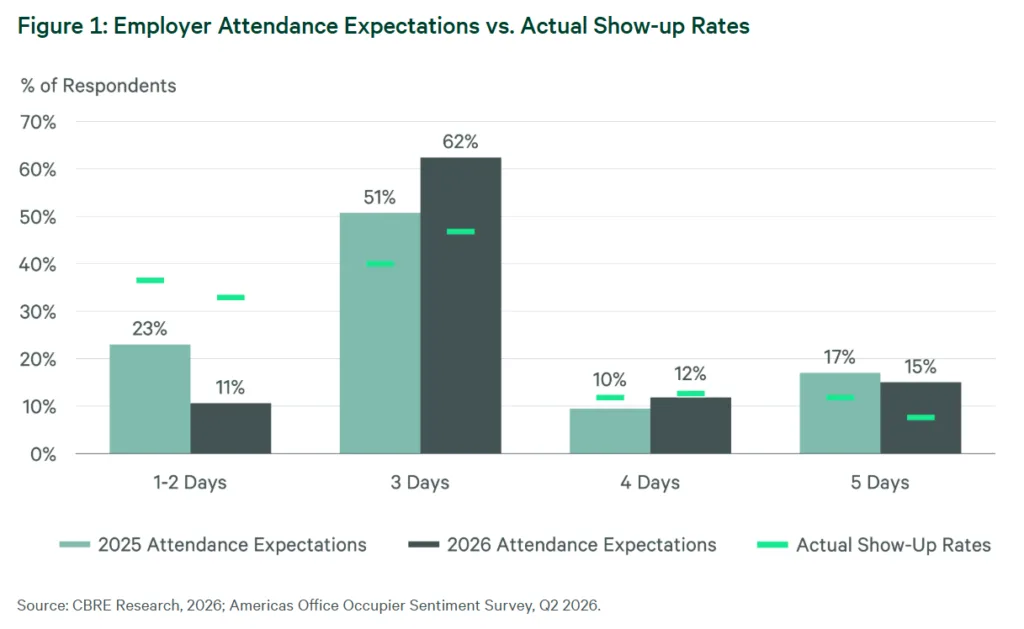
CBRE’s 2026 Americas Office Occupier Sentiment Survey, as reported by CBRE Research, shows US office occupiers finding their balance after years of flux. The survey captures a clear shift: 89% of employers now require at least three days of in-office attendance, up from 78% in 2025. However, the average actual attendance lands at 2.9 days—still shy of the 3.2-day employer target. The gap between expectations and real behavior remains persistent but is narrowing as hybrid work cements itself as a fixture. For the fourth year in a row, about a third of organizations believe office use will rise in the near future, underscoring the sense that the market has stabilized—but is not static.
This matters for the US office landscape. According to CBRE, 66% of companies plan to keep or grow their space over the next three years. The tech sector is a notable outlier, with 64% planning expansion, compared to 41% in 2025. Meanwhile, large employers reduced their contraction plans from 60% to 46%. That trend aligns with broader market data showing fewer companies planning office reductions as expansion strategies regain momentum. The US office market is shifting from post-pandemic retreat to careful repositioning.
Get Smarter about what matters in CRE
Stay ahead of trends in commercial real estate with CRE Daily – the free newsletter delivering everything you need to start your day in just 5-minutes
Hybrid Mandates with Room to Grow
The swift uptick in employer expectations for office attendance reflects a broader recalibration. Per CBRE’s 2026 survey, just 11% of companies expect workers to be in the office only 1–2 days weekly, a stark drop from 23% the previous year. While the number of days required is climbing, real-world show-up rates are slower to follow; roughly three times more organizations observe 1–2 days of actual attendance than officially require it.
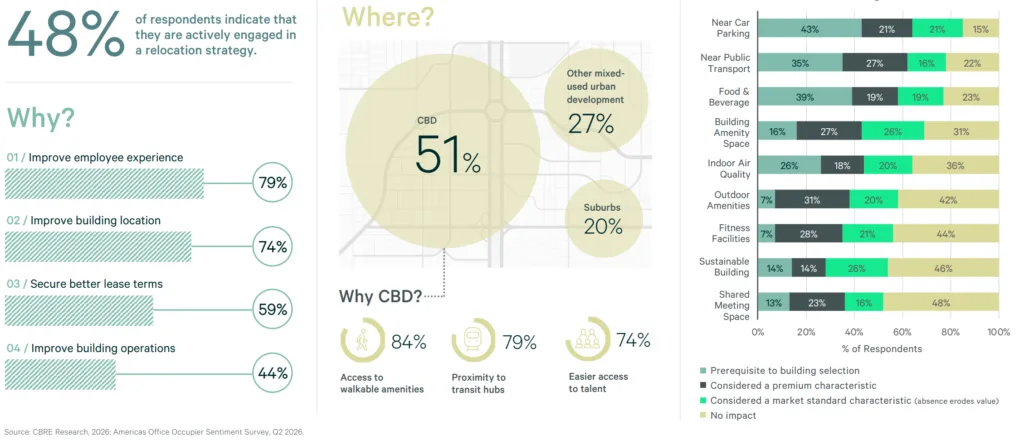
What’s driving—or impeding—the return? The top motivator for coming in is engaging with colleagues (77%), while key deterrents are inconvenient locations (62%) and underwhelming amenities (53%). Employees are more likely to make the commute when the workplace offers functional tech, meeting space, and places to focus. For occupiers, this means site selection and thoughtful upgrades to building amenities are no longer nice-to-haves but essential levers for attendance and retention.
Incremental Investment Holds Back Transformation
While the debate over office relevance has faded, real investment lags conviction. According to the 2026 CBRE data, 47% of respondents rank their office experience as average or worse. Headquarter locations see most companies simply maintaining or marginally refining existing setups—real reinvention is rare, with only 8% at HQs and just 6% at non-HQ sites reporting meaningful transformation. Additionally, 25% of non-HQ spaces are slated to be vacated rather than upgraded, reflecting continued rightsizing driven by hybrid work and pre-pandemic inefficiencies.
The biggest barrier to transformative workplace investment is competing business priorities. Most organizations are caught between optimizing space (74%) and enhancing employee experience (62%)—goals that often conflict. Budgets are also limited by top-line focus on AI, digital transformation, or broader business change. Absent a more decisive strategy, offices risk becoming neither cost-effective nor a magnet for talent—a dilemma CBRE argues is increasingly unsustainable as new technologies drive up the bar for employee experience.
AI, Flex Space, and the Evolving Office Portfolio
The CBRE survey shows AI’s influence on space planning is rising fast, with 23% of occupiers already feeling its effects and another 30% expecting meaningful impact within two years.
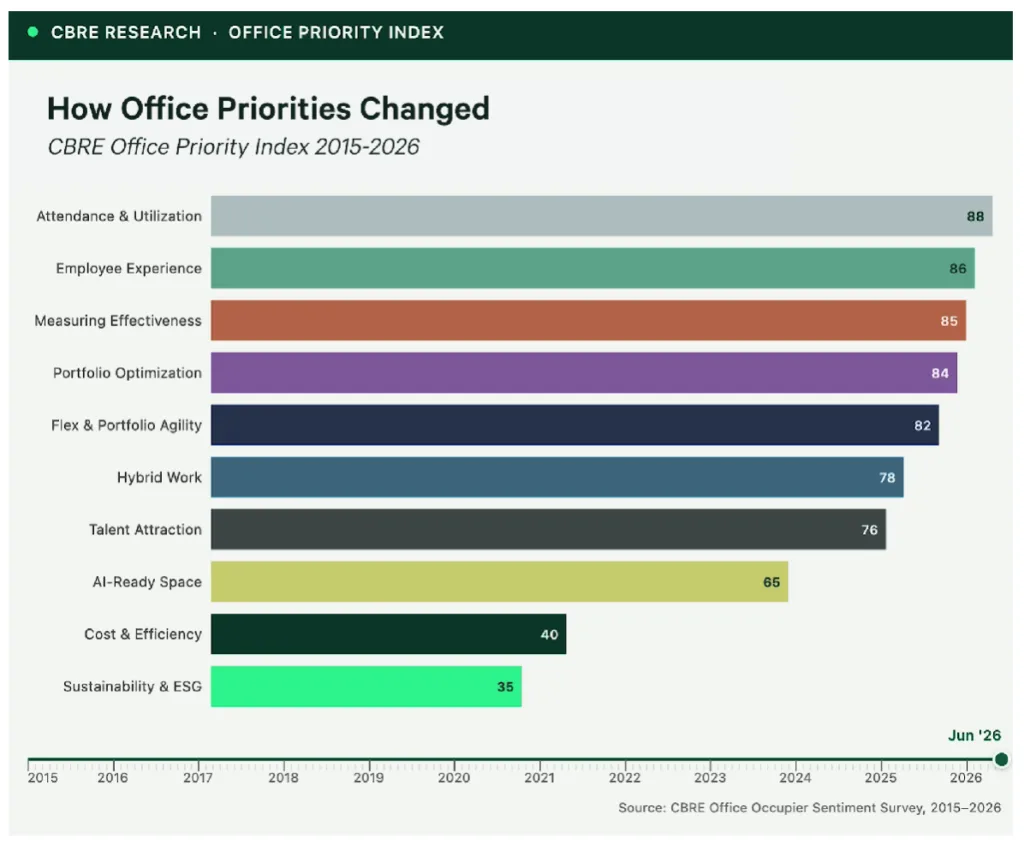
Tech and financial services firms are at the forefront, while large organizations are more likely to adjust their real estate to accommodate new workflows. But AI is changing office form, not just size: half of respondents anticipate more multipurpose, reconfigurable space, and 30% expect to add specialized environments such as labs or innovation centers. Additionally, 36% see a greater need to invest in amenities to attract and retain top AI-driven talent.
This complexity has pushed the industry from blanket contraction to tailored portfolio strategies. Flexibility has become fundamental. While most portfolios still rely on long-term leases, flex space is mainstream—with 84% of respondents pursuing some form of flex, whether to manage headcount volatility, test new markets, or control capital costs. Expansion and contraction clauses are now standard tools for both tenants and landlords, offering a hedge against uncertainty from both hybrid work and new technology adoption.
Why It Matters
All signs indicate that the fear-driven retreat in office leasing has ended. The CBRE 2026 survey, covering responses from representative US occupiers across industries and company sizes, suggests the market has reached equilibrium. Notably, the panicked contraction seen after 2020 has receded; now, a near-even balance prevails, with approximately one-third of organizations planning to expand and a similar share preparing to contract in the next three years. For the office sector, this marks a clear shift from crisis to recalibration.
Importantly, sectoral splits are emerging. Tech occupiers, long viewed as bellwethers for demand volatility, drive recent expansion—accounting for 21% of new leases in H1 2026, their highest market share since 2019. Meanwhile, large enterprises, though still consolidating, are rightsizing at a more tempered pace, with just 46% planning reductions versus 60% the prior year. As AI adoption accelerates in these firms, occupier strategies will become even more nuanced—sometimes contracting to optimize, sometimes expanding to enable new ways of working.
The upshot for both landlords and occupiers: competition is heating up for locations with walkability, transit access, and strong amenities. Location trumps building quality—relocating companies are prioritizing neighborhoods that deliver functional, convenient, and talent-attracting workplaces. Flexible leasing is more than a pricing lever; it’s a core retention tool. Meanwhile, buildings that can’t offer competitive experience, sustainability, or adaptability will continue to underperform in occupancy and rents as flight-to-quality becomes structural, per CBRE’s findings.
What’s Next
The next three years will challenge office owners and users to adapt portfolios as workplace priorities keep shifting. Investors should expect continued demand for amenity-rich, urban locations, and must invest accordingly or risk rising vacancy and reduced rents. Occupiers, for their part, will need to integrate flexibility into real estate strategy, balancing long-term commitments with short-term needs through a mix of traditional and flex leases.
AI adoption will drive further experimentation with space and amenity mix, especially for the largest and fastest-growing tenants. Ultimately, the winners will be those who align location, space quality, and adaptability to attract tomorrow’s workforce and maximize the value of every office dollar spent.