



- The US defense sector’s shift to a wartime footing is fueling rapid expansion in CRE demand, per Bisnow.
- New and existing defense contractors are leasing and building record volumes of specialized space nationwide.
- Trillion-dollar defense budgets signal a long-term CRE tailwind, especially for industrial and tech-focused assets.
Wartime Posture Reshapes Demand
The US defense sector is growing at its fastest pace in decades as the federal government ramps up spending and moves to a permanent wartime footing. Bisnow reports that this shift, catalyzed by conflicts in Iran and Ukraine, is driving significant demand for specialized commercial space as contractors accelerate expansions and new entrants pour into the market. Defense Secretary Pete Hegseth in November directed the Pentagon’s procurement to operate as if in ongoing conflict, ending two decades of “in-between” readiness and creating urgent needs across supply chains.
This has unleashed a surge of activity across the defense industrial base. The Center for Strategic and International Studies (CSIS) reports roughly 10,000 new defense and aerospace firms have entered the market in two years, with $120B in new investment for 2025 alone. CRE professionals are seeing the effects play out in real time, as brokerages report exponential increases in client requirements and unprecedented project velocities.
Get Smarter about what matters in CRE
Stay ahead of trends in commercial real estate with CRE Daily – the free newsletter delivering everything you need to start your day in just 5-minutes
Build-to-Suit and Leasing Surge
Commercial landlords focused on defense and aerospace are riding historic demand waves. COPT Defense Properties reported 518,000 SF of leasing in Q2 2026, including 171,000 SF of new development or space taken off the market. The trend also mirrors broader industrial demand, as investors continue to compete for modern facilities supporting advanced manufacturing and critical supply chains. COPT maintains a 94.5% occupancy rate and broke ground on 885,000 SF of new projects in the second quarter, with pre-leasing at 73%. Virtually all new government requirements involve sensitive compartmented information facility (SCIF) specifications, a high-margin segment for build-to-suits.
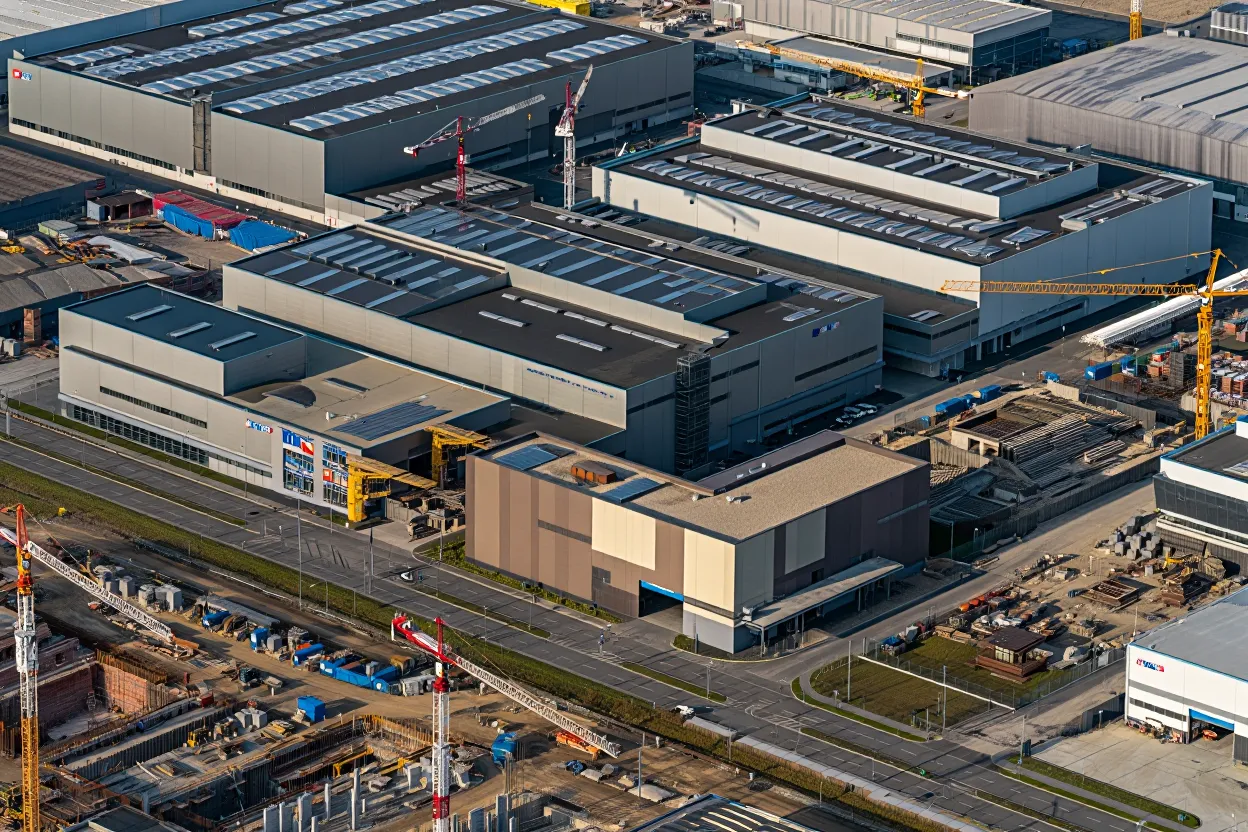
Major weapons producers and fast-growing startups alike are committing capital to manufacturing hubs. Anduril celebrated the opening of a $2B drone plant outside Columbus, Ohio, in March, kicking off a plan to deliver more than 5M SF by 2035. Shipbuilders are also expanding, with Austal USA in Mobile, Alabama, breaking ground on a 370,000 SF sub factory and Hanwha and JPMorgan investing at the Philadelphia Navy Yard. States are competing for projects by offering tax and development incentives to defense manufacturers.
Sustained Acceleration Amid Budget Boom
President Trump has prioritized defense spending, proposing $1.5T for the next fiscal year and directing further funds amid war costs that have reached at least $38B for Iran alone. On July 22, the US House narrowly approved an additional $1.1T for military operations. This historic federal investment is the backbone of CRE demand, as contractors must replenish depleted stockpiles and ramp up capabilities.
The July CSIS analysis highlighted contracts like a $35B deal with Lockheed Martin to quadruple annual THAAD interceptor output, triggering new factory construction in Camden, Arkansas. Lockheed’s related missile deals will pump billions into facilities across at least five states over the next three years. Other firms—including Boeing, L3Harris, and Honeywell Aerospace—are scaling up munitions manufacturing, projecting a need for even more commercial space as production pivots to drones and cost-effective precision weapons through 2031.
Why It Matters
CRE demand from the defense sector is no short-term spike—it’s a structural shift with a long tail. With more than 10,000 new defense and aerospace firms founded in the past two years and $120B in investment for 2025, per CSIS, industry insiders expect pace to accelerate further in 2026. States and municipalities are racing to offer incentives, knowing that each new facility can bring hundreds of millions in investment and thousands of jobs. For institutional owners and investors such as COPT Defense Properties, government tenants now account for over 35% of rental revenue (Q2 2026), and pre-leasing rates are outperforming broader industrial and office benchmarks.
Specialized asset requirements—including SCIFs, high-tech manufacturing specs, and hybrid office-showroom combinations—are locking in high-margin deals that are less vulnerable to broader economic cycles. As conflicts drive defense procurement and supply chains move onshore, the defense CRE pipeline is likely to remain robust even as other asset classes face cyclical headwinds. Cities like Washington, D.C., are emerging as key hubs, especially for firms that need proximity to policymakers, while industrial corridors across the Sun Belt and Midwest are set to capture manufacturing expansions. JPMorgan Chase’s $24M commitment to the Philadelphia Navy Yard and Hanwha’s $5B manufacturing investment highlight that blue-chip investors see the opportunity as long-term.
What’s Next
The House’s additional $1.1T budget package faces an uphill climb in the Senate, but consensus around defense spending remains strong. CRE brokers servicing the sector anticipate a surge in new requirements as more contracts are awarded and replenishment orders follow. With major weapons systems—like the THAAD interceptor and precision missiles—moving into multiyear ramp-ups and the Pentagon focused on both production capacity and technological advancement, requirements for secure, tech-enabled, and expandable space will likely intensify through the next decade. Watch for further development activity, especially in strategic corridors and near critical transportation and policy nodes, as both legacy defense giants and nimble newcomers look to scale.