



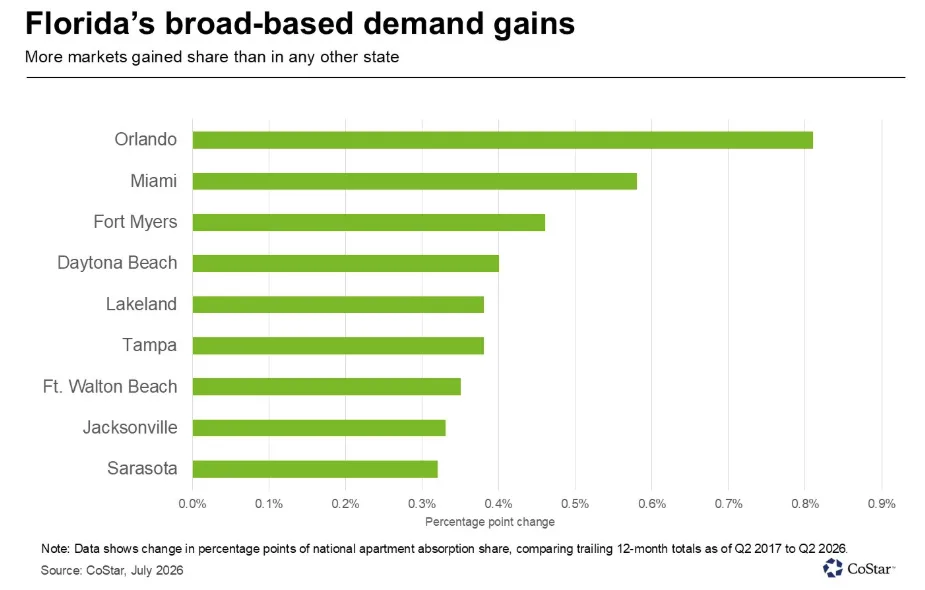
- Florida now holds 12.2% of US apartment demand, up from 6.7% in 2017, according to CoStar.
- Nine Florida cities—including Sarasota, Jacksonville, and Fort Myers—ranked among the nation’s top gainers.
- The state succeeded where others failed: broad demand growth spread far beyond the usual metro hotspots.
Statewide Gains, Not Just in the Big Three
Investors and analysts have long viewed Miami, Orlando, and Tampa as Florida’s apartment demand engines. But CoStar reports that over the past decade, renter appetite has surged well beyond those high-profile metro areas. From mid-sized cities like Sarasota to smaller coastal outposts like Fort Walton Beach, Florida has produced more markets with exceptional apartment demand gains than any other state. In total, nine Florida cities rank among the nation’s top 20 share gainers since 2017—an unmatched geographic spread.
This breadth stands out among traditional Sun Belt peers. While Texas continues to see strong absorption in Dallas-Fort Worth and Austin, the remaining Texas metros lost ground. North Carolina and Arizona tell similar tales, with Charlotte and Phoenix dominating their states’ growth. By contrast, Florida’s multifaceted expansion signals a structural shift in migration, development, and investment patterns.
Get Smarter about what matters in CRE
Stay ahead of trends in commercial real estate with CRE Daily – the free newsletter delivering everything you need to start your day in just 5-minutes
The Details
Between 2017 and 2026, Florida’s share of national apartment demand nearly doubled, climbing from 6.7% to 12.2% per CoStar’s analysis. Jacksonville, Fort Myers, Daytona Beach, Lakeland, Sarasota, and Fort Walton Beach—alongside the familiar Miami, Orlando, and Tampa—drove this growth. Orlando, for example, increased its share of national demand from 1.5% to 2.4%, while Sarasota grew from 0.5% to 0.8%, despite its smaller scale. This uptick translated to robust deal activity and new development, as illustrated by Belpointe’s 424-unit Aster & Links project in downtown Sarasota.
Crucially, these gains often occurred despite significant supply-side headwinds. Florida battled some of the country’s most aggressive apartment construction, resulting in periods of elevated vacancies and heightened concessions. Still, absorption outpaced expectations in most markets, underscoring the depth of underlying demand.
Florida’s Growing Apartment Geography
What sets Florida apart is the diversity and simultaneity of growth. The state’s major metros, second-tier cities, and smaller communities all expanded their demand footprint together. Population inflows—retirees, remote workers, and young professionals alike—spread widely, not simply clustering in the biggest cities. Businesses responded with statewide expansion, encouraging developers to follow suit. This dispersion created a self-reinforcing cycle: more demand allowed new construction, which in turn attracted institutional attention to markets once considered niche.
In competitive states like Texas and Arizona, apartment demand growth was mostly confined to one or two cities. Florida, meanwhile, has built a network of interconnected demand centers up and down its peninsula and panhandle. The result is a resilient, statewide multifamily investment profile less vulnerable to swings in any single metro’s fortunes.
Why It Matters
Florida’s apartment boom stands out for both its scale and geographic breadth. No other state has seen as many markets gain demand share. This expands the map for institutional investment and development pipelines. Investors now have more opportunities beyond Florida’s traditional apartment hubs.
However, rapid Sun Belt construction has also pushed landlords toward heavier rent concessions as new supply competes for tenants. Florida’s strong absorption helps offset that pressure. Sarasota nearly doubled its market share in under a decade while expanding new construction. Orlando’s 2.4% share also reflects sustained momentum.
The self-reinforcing dynamic at play—wherein demand and supply mutually expand—may endure as long as Florida’s business climate and population inflows hold up. For now, Florida presents a rare template where geographic diversification and long-term demand growth go hand-in-hand, markedly different from other Sun Belt stories centered on one or two hubs.
What’s Next
Short-term headwinds remain, especially as a fresh crop of deliveries comes online in 2026. Some submarkets may face pronounced vacancy and rent moderation as supply catches up. Yet, the broader narrative—robust, geographically extensive renter demand—positions Florida to weather volatility better than most. Developers are expected to keep targeting a diverse mix of locations, and institutional investors will likely follow the shifting demand map. The ultimate test will be whether Florida’s multifamily absorption can keep setting the national pace as construction cycles ebb and flow.