



- Office-to-multifamily conversions are gaining traction due to discounted property values and persistent tenant underutilization.
- National office vacancy rates remain elevated at 17.7%, with significant disparities between metros and slow improvements overall.
- Markets like Chicago and Seattle illustrate both the potential and the limitations of current conversion trends amid ongoing sector distress.
Falling Values Open Conversion Opportunities
Persistent low office demand and steep discounts on property sales are shifting the calculus for office-to-multifamily conversions, according to Yardi Matrix’s July 2026 report. As office values remain at or near historic lows, developers previously wary of costly conversions are now seeking opportunities to repurpose underutilized assets. Since early 2024, nearly half of all office transactions with repeat sales have sold at a discount, reflecting the deepening distress across the sector. With national physical utilization stuck around 55%, and vacancy rates remaining well above healthy thresholds, more investors are willing to look beyond the traditional risks of conversion—especially as the threat of further value erosion looms.
The numbers support this momentum. In 2025 alone, 11.8M SF of office space transitioned to or began conversion into multifamily, surpassing any prior year. Yardi’s Conversion Feasibility Index now identifies a staggering 2B SF of US office inventory as potential candidates for conversion, with a meaningful subset offering particularly strong feasibility.
Get Smarter about what matters in CRE
Stay ahead of trends in commercial real estate with CRE Daily – the free newsletter delivering everything you need to start your day in just 5-minutes
The Details
National office vacancy reached 17.7% in June 2026, down 170 basis points from last year. However, vacant space and property distress remain historically high. Kastle’s Back to Work Barometer has shown office utilization near 55% for several years. That persistent level highlights the sector’s chronic underuse.
Discounted transactions have become common in cities like Chicago, where 59% of office deals since 2024 traded below previous prices. Chicago identified 95M SF of office space suitable for conversion. This potential helped stabilize vacancy at 17.8% in June.
The 111 W. Illinois conversion shows how steep discounts can support redevelopment. The 2008-built office sold at a 77% discount to its 2015 price. That lower acquisition cost made multifamily redevelopment more financially viable.
Seattle presents a different picture. Its office vacancy reached 24.7%, while 47.5M SF is theoretically eligible for conversion. However, few projects have launched. City incentives, including tax deferrals, helped move at least one major project into construction.
The 201 Queen Anne Ave property traded at an 11% discount to its 2005 sale price. Still, Seattle’s conversion market remains sluggish compared with Chicago.
Conversion Momentum Faces Variable Market Headwinds
The office-to-multifamily trend remains uneven across major markets. Chicago stands out for deep asset discounts and its notable conversion pipeline. Meanwhile, Seattle and Portland face high vacancies but much less conversion activity. Policy hurdles and negative tenant perceptions continue to constrain progress.
Nationally, conversion feasibility varies significantly by property. Yardi Matrix estimates only about 5% of office inventory perfectly fits conversion requirements. Another 19% could support conversion with adjustments. Despite these limitations, completed and underway conversions have reached record levels.
Full-service equivalent office listing rates averaged $33.67 PSF nationally in June. Several gateway markets posted much higher asking rents despite elevated vacancies. San Francisco’s vacancy reached 25.8%, while Portland hit 22.1%.
Portland also shows how dramatically office valuations have reset. U.S. Bank’s departure from “Big Pink” contributed to the tower’s challenges. The property later traded at an 88% discount to its 2015 sale price.
Why It Matters
Persistently high vacancies and stagnant utilization are forcing investors to reconsider the US office sector’s long-term value. Yardi Matrix reported 11.8M SF of office-to-multifamily completions and construction during 2025. That represents a sharp acceleration from earlier years.
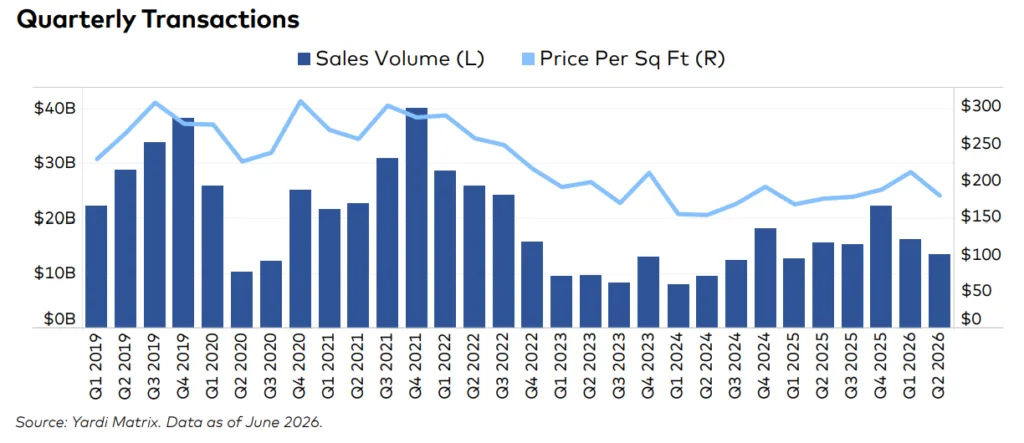
The increase shows investors have become more receptive to conversion risk while office pricing remains depressed. Nearly half of recent repeat sales have traded at discounts. Even newer properties remain vulnerable to significant valuation declines.
That repricing extends nationwide, with distressed office properties in several major markets trading at discounts approaching 90%. These steep resets can create stronger economics for investors considering conversions or other redevelopment strategies.
Chicago’s 111 W. Illinois illustrates that shift. The property moved toward conversion after its value dropped 77% from its previous sale. Lower acquisition costs can quickly improve residential redevelopment economics.
What’s Next
CRE players should expect conversion momentum to continue through 2026 as more office assets trade at substantial discounts. Developers are also refining their adaptive reuse strategies as more projects move through planning and construction.
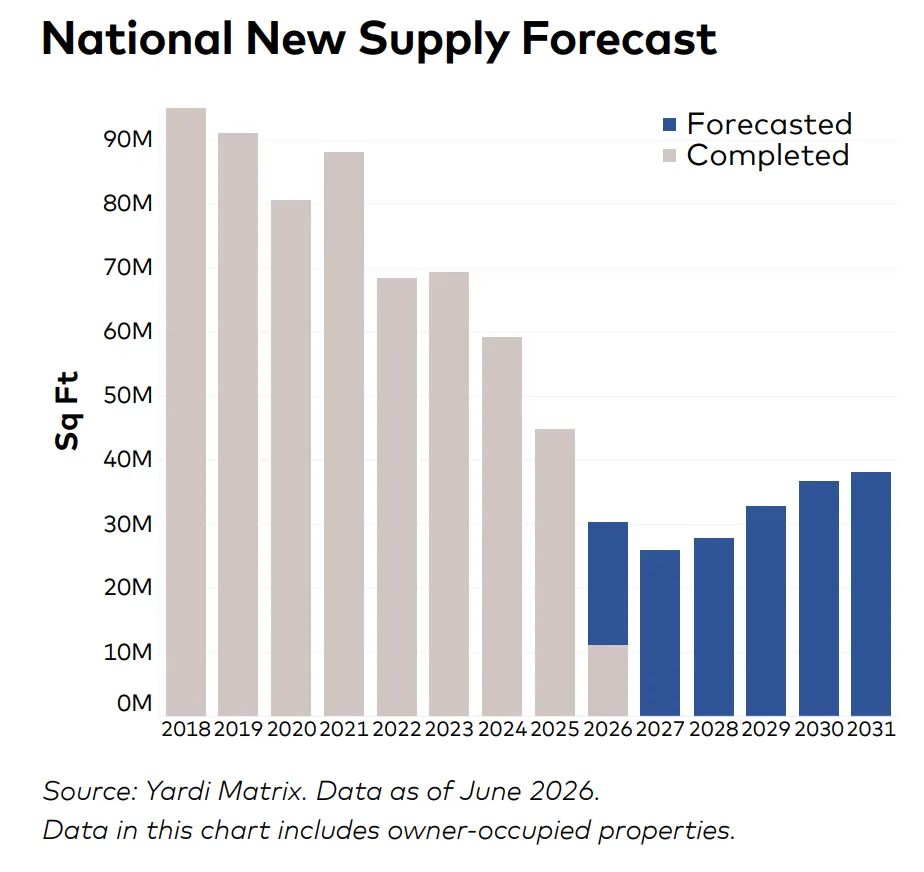
Yardi identified 2B SF of conversion-eligible US office space, suggesting a substantial runway for additional repurposing. However, only a fraction of that inventory will ultimately become housing.
Cities supporting conversions through zoning changes, incentives, and streamlined permitting could capture more investment activity. Markets without those measures risk carrying vacant office space for much longer.
Meanwhile, cap rates and valuations will likely remain under pressure until office demand achieves a sustained recovery. Alternatively, conversions and other removals could gradually rightsize the sector’s oversized supply base.