






- Securitized agency loan delinquency dipped to 0.47% in May, per Trepp data.
- Fannie Mae and Ginnie Mae/FHA/HUD saw improved performance, while Freddie Mac’s rate rose.
- Aggregate movement reflects program mechanics more than underlying loan distress.
Low Delinquency, But Not Uniform Performance
The US agency securitized loan market posted another strong month in May 2026, according to a report from Trepp. The headline agency delinquency rate dipped to 0.47%, continuing the stability seen since mid-2025. But the calm surface hides persistent splits among different agency issuers.
While overall agency credit outperforms virtually every other major debt product—with 99.32% of balances current and foreclosure activity described as “effectively nonexistent”—the devil is in the details when zooming into each issuer’s book.
Get Smarter about what matters in CRE
Stay ahead of trends in commercial real estate with CRE Daily – the free newsletter delivering everything you need to start your day in just 5-minutes
The Details
May’s overall 0.47% delinquency rate is close to historical lows. Fannie Mae recorded a significant improvement, dropping to just 0.24%, the lowest since at least mid-2025. Ginnie Mae—covering FHA and HUD portfolios—declined again to 0.51%, sustaining a tightening trend for over a year. By contrast, Freddie Mac saw its rate rise to 0.87%.
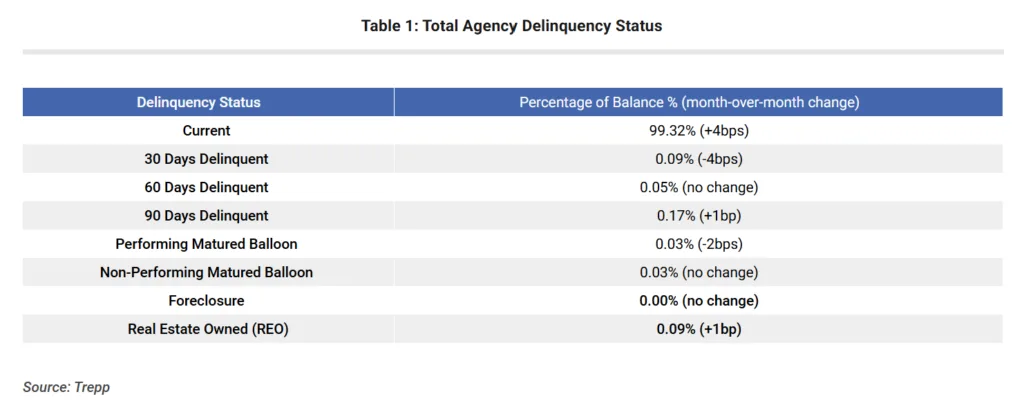
This uptick is concentrated in its Small Balance Loan (SBL) program, which now sits at 5.00% delinquency. However, performing and non-performing matured balloon exposure across all programs remains limited, and early-stage delinquencies are steady.
Freddie Mac SBL Weighs on the Average
The rise in Freddie Mac’s delinquency tracked with continued challenges in the legacy SBL program. As more matured loans remain unresolved inside securitized pools, their weight increases relative to new originations. That pattern also mirrors broader concerns around aging SBL portfolios, where legacy loans continue to shape delinquency trends even as newer vintages perform well.
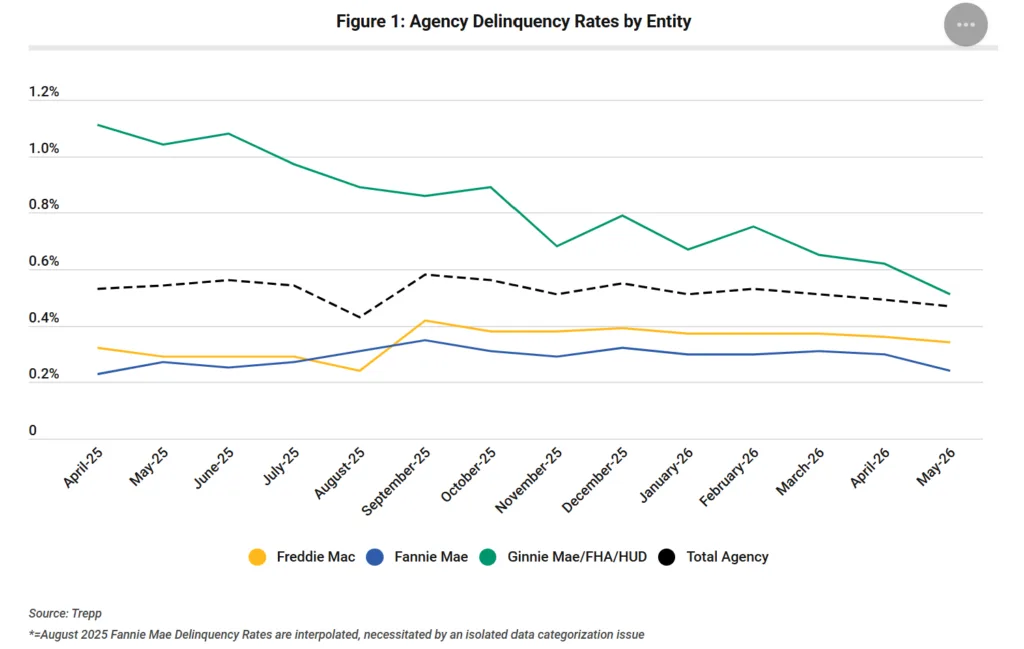
In contrast, Ginnie Mae’s improvement has been driven by a larger pool of new, performing loans diluting the impact of long-standing delinquencies. Fannie’s book, with fewer maturities and tighter filtering, continues to set the pace for agency multifamily credit. The differences speak more to the structure and age of each program than to broader signs of credit stress.
Why It Matters
The low aggregate agency delinquency rate is a bright spot in a capital markets environment otherwise fraught with distress in riskier segments. For multifamily investors and lenders, these numbers reaffirm agency paper as the bedrock of US housing finance, consistently outperforming private-label alternatives and most other CRE debt asset classes.
Fannie Mae, with its 0.24% delinquency, has reached new operational efficiency, making it an even more attractive counterparty. Meanwhile, Freddie Mac’s woes—especially in SBL—don’t represent new distress, but rather servicing inefficiency and legacy program runoff. Agencies’ negligible foreclosure activity and rapid dilution of troubled legacy assets give confidence that headline numbers are unlikely to rise sharply soon. But with Freddie’s SBL delinquencies at 5.00%, their resolution pace could nudge rates up or down.
What’s Next
With overall agency delinquency near historic lows, the market will watch how quickly Freddie Mac can work through its aged SBL maturities. Fannie Mae and Ginnie/FHA/HUD are poised to maintain or even improve their positions barring any major economic shocks.
Given continued origination activity in healthier programs and virtually nonexistent foreclosure, expectations are for agency performance to stay robust. If Freddie Mac accelerates resolution of legacy SBL loans, the headline delinquency rate could dip even further in the coming quarters.