




- Houston property owners are increasingly demolishing obsolete office buildings when land values exceed the value of the structures.
- Debt-free assets are leading the trend because heavily leveraged properties often cannot move forward with demolition or redevelopment.
- The shift highlights how persistent office vacancies continue to reshape Houston’s commercial real estate landscape.
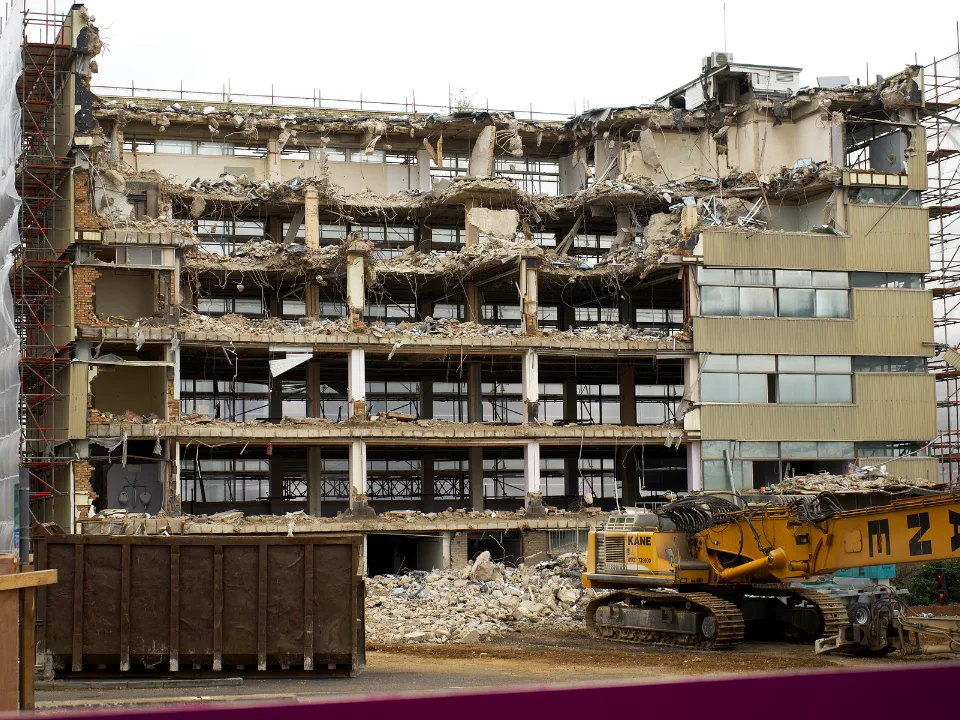
Houston’s office downturn is creating a new source of demand for demolition contractors, per Bisnow. Instead of investing in aging buildings with little leasing potential, some owners are choosing to remove obsolete offices altogether and hold the land for future opportunities. The strategy is most common among debt-free properties in strong locations, where carrying vacant buildings has become more expensive than maintaining an empty site.
Get Smarter about what matters in CRE
Stay ahead of trends in commercial real estate with CRE Daily – the free newsletter delivering everything you need to start your day in just 5-minutes
Houston Office Vacancy Keeps Pressure on Aging Assets
Houston continues to face one of the nation’s weakest office markets. According to JLL’s Q1 2026 data, the metro posted a 26.8% office vacancy rate, driven largely by aging Class-B and Class-C buildings that struggle to compete with newer space.
Many owners have few practical options. Buildings tied to distressed loans often remain in limbo because lenders have little interest in taking ownership or funding demolition. As a result, obsolete properties frequently sit vacant for years, even when their long-term outlook appears limited.
The Details
One example is the 109K SF office building at 5100 Westheimer Road, directly across from The Galleria. Built in 1973, the property recently entered demolition after decades under the same ownership.
Property manager Joe Evans said the economics eventually favored removing the structure. According to Harris Central Appraisal District records, the property carries a $9.3M appraised value, with roughly $7M attributed to the land alone. Land value has exceeded the building’s value since at least 2017.
The owner previously explored selling the site for redevelopment and reviewed concepts for high-rise construction. Those plans stalled after market conditions weakened, and the pandemic further reduced office demand. Evans said annual maintenance costs had become comparable to the cost of demolition, making removal the more practical decision.
Prime Sites Stand Out
The demolition activity remains selective rather than widespread. Grant Mackay Demolition is also removing the neighboring 5050 Westheimer office building after completing several other major projects across the Houston area. The company recently demolished the former 1M SF Fluor campus in Sugar Land and is working on a parking structure tied to renovations at the George R. Brown Convention Center.
Even so, estimator Braden Keith believes many additional candidates exist. He points to clusters of nearly vacant office properties along Westheimer and in Sharpstown. Financing remains the biggest hurdle. High interest rates make many projects difficult to justify, even when owners no longer want the buildings.
Why It Matters
Houston’s demolition trend reflects a broader reset across aging office inventory. In many cases, the underlying land has become more valuable than outdated buildings that require expensive maintenance and attract limited tenant demand.
The trend also highlights an important divide in today’s office market. Owners without debt have flexibility to remove obsolete assets and wait for better market conditions. Owners with distressed loans often lack that option, leaving vacant buildings frozen until lenders or borrowers reach a resolution. That dynamic could slow the cleanup of obsolete inventory even if demand for redevelopment eventually improves.
What’s Next
Demolition activity is likely to continue where owners control valuable land without significant debt. Prime sites near major employment centers or mixed-use districts may become increasingly attractive once capital markets improve.
For much of Houston’s aging office stock, however, the timeline remains uncertain. Until financing conditions ease or distressed assets change hands, many obsolete buildings will likely remain standing despite limited leasing prospects. The city’s elevated vacancy rate suggests that deciding whether to renovate, redevelop, or demolish will remain a defining challenge for office owners over the next several years.