





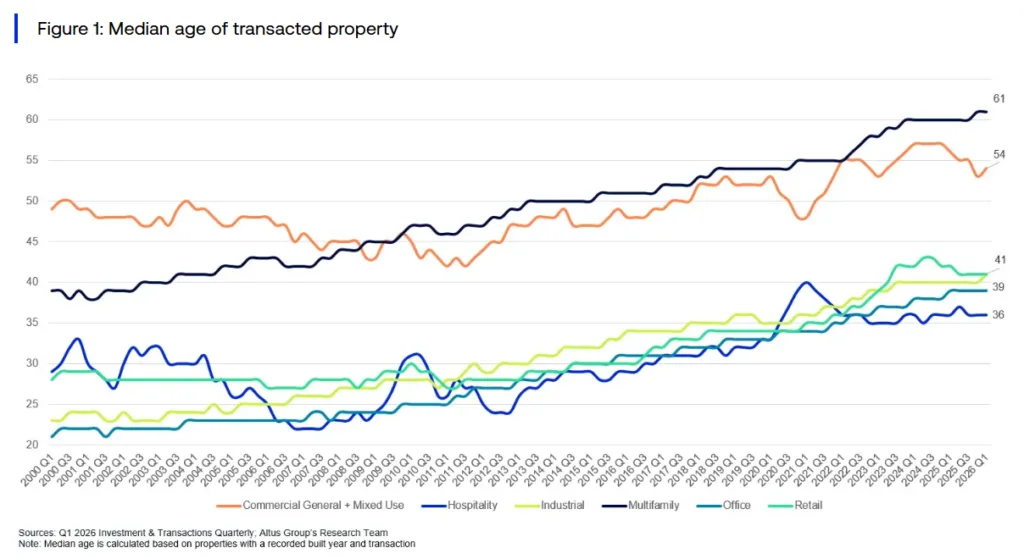
- Median transaction ages in Q1 2026 hit historic highs across most CRE sectors, reflecting a slowdown in new development and selective selling of newer product.
- Vintage does not consistently signal higher value; in sectors like multifamily and industrial, older or middle-aged properties frequently command higher prices per SF than newer assets.
- The widest spread between vintage and pricing appears in retail, but even there, some of the oldest stock is appreciating fastest—challenging the industry’s assumptions about age and value.
The Limits of Vintage as a Value Signal
Median property age has climbed steadily across core CRE sectors, pointing to both a slowdown in new construction and a tendency for owners to hold onto newer product. According to Altus Group’s Q1 2026 data (via Reonomy), typical transacted assets now reach record ages: 61 years for multifamily, 41 for industrial and retail, and 39 for office.
On the surface, this might suggest that older assets are increasingly in demand, or that the pool of saleable product is aging as new supply wanes. But the data complicates the typical assumption that newer properties always command a pricing premium—the so-called vintage premium thesis. Instead, each sector’s pricing dynamics reveal a more nuanced relationship between age, location, and value.
Get Smarter about what matters in CRE
Stay ahead of trends in commercial real estate with CRE Daily – the free newsletter delivering everything you need to start your day in just 5-minutes
The Details
Altus transaction data shows no linear relationship between property age and pricing in Q1 2026. In multifamily, 1980s and pre-1970s properties led median price per SF. Meanwhile, 2000s-built assets traded below every other vintage.
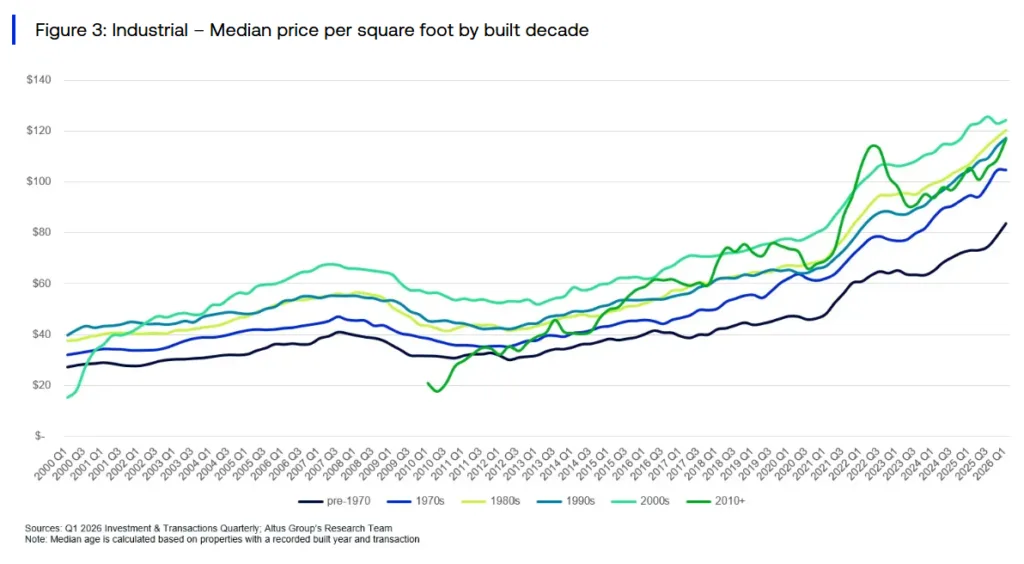
Industrial assets from the 1980s, 1990s, and 2000s outperformed post-2010 buildings on a PSF basis. However, post-2010 properties posted the strongest quarterly price growth at 7.4%. In office, post-2010 trophy assets commanded a 44.6% premium over 2000s-built properties. Still, pricing differences across older office vintages remained relatively small.
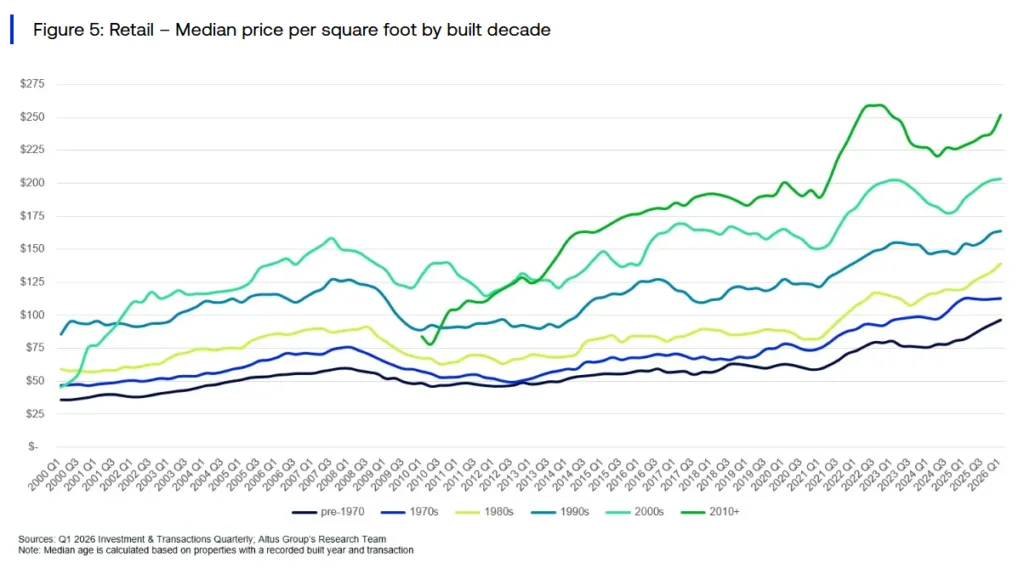
Retail showed the widest pricing gap by vintage. Post-2010 properties sold at a 161.5% premium to pre-1970 assets. However, the oldest retail centers gained 17.7% year over year. Meanwhile, the newest properties remained 2.7% below their 2022 peak.
Vintage Premiums and Sector-by-Sector Divergence
Multifamily showed the sharpest divergence. Properties built during the 2000s remained the cheapest cohort after falling 9.8% year over year. This underperformance has continued since late 2022. Meanwhile, 1980s and pre-1970s infill assets led pricing. Many serve as workforce housing in strong locations and attract GSE-backed financing.
Industrial followed a similar pattern. The oldest facilities, often in land-constrained infill markets, posted the strongest annual price growth at 14.5%. Office trophy assets still commanded the highest prices. However, pricing gaps across older office vintages remained narrow.
Retail pricing followed a more traditional pattern, with newer properties commanding higher values. However, appreciation told a different story. Older centers delivered stronger gains, highlighting the sector’s pricing complexity.
Why It Matters
These findings challenge investors and brokers who use property age as a shortcut for value. Property age does not consistently determine market value. Instead, structural and cyclical forces shape pricing across sectors. These include slower development, sticky capital, and buyer demand for targeted submarkets.
Multifamily illustrates this trend clearly. Older, well-located assets often outperform newer properties. Supply constraints and public financing programs continue supporting demand.
Industrial tells a similar story. Older infill facilities benefit from strong locations despite lacking modern features. Office and retail only follow traditional pricing patterns at the highest end. Trophy offices and modern shopping centers still command premiums. This sector-by-sector split mirrors broader market conditions, where property fundamentals remain resilient even as performance varies across asset classes.
However, these trends could shift as liquidity, tenant demand, and capital allocation change. Investors should balance vintage with location, financing access, and tenant quality. Relying on age alone could produce misleading valuations as market conditions continue evolving.
What’s Next
The median age of traded CRE assets will likely keep rising. As a result, vintage-driven pricing trends may become even more complex. Future research will likely examine how location, capital flows, and sector-specific conditions shape pricing across different property ages.
For now, investors, lenders, and brokers should underwrite assets more carefully. They should rely on granular market data instead of broad vintage assumptions. This approach remains especially important in multifamily and industrial, where pricing trends continue defying expectations.