





- Gen Z adults living at home represent latent rental demand in several US metros, with McAllen, TX, leading the list according to Chandan Economics.
- California and Texas cities, including Stockton, Fresno, El Paso, and Bakersfield, are heavily represented among the top metros for Gen Z household formation potential.
- Locally driven renter demand could help stabilize multifamily markets as post-pandemic migration trends fade and new supply hits.
Delayed Launch Fuels Local Demand
The US rental market is facing a new demand catalyst as Gen Z adults continue to delay moving out on their own. Chandan Economics, in partnership with Arbor Realty Trust, reports that as post-pandemic migration stabilizes, pent-up household formation among adults aged 18 to 27 could supply a crucial new wave of renters. According to the 2024 American Community Survey, metros like McAllen, TX (with roughly 140 Gen Z adults living at home per 1,000 adults), Stockton, CA, and Fresno, CA stand out for their high concentrations of young adults still residing with parents. This shift creates a pipeline of future renters for multifamily operators to watch.
Get Smarter about what matters in CRE
Stay ahead of trends in commercial real estate with CRE Daily – the free newsletter delivering everything you need to start your day in just 5-minutes
The Details
McAllen leads the nation with about 140 Gen Z adults living at home per 1,000 adults. It ranks well ahead of other metros. Stockton, CA, follows with 114.9, while Fresno, CA, has 112.6. El Paso, TX, reports 112.4, and Bakersfield, CA, reaches 111.2.
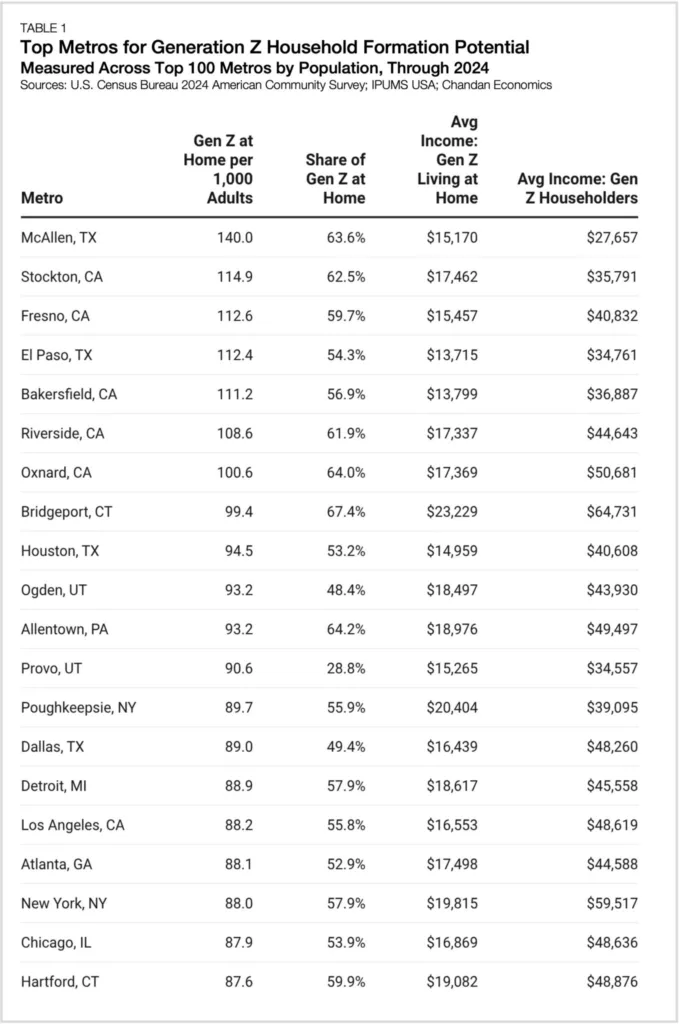
Income data show household formation remains accessible in secondary markets. In McAllen, at-home Gen Z adults earned $15,170 on average in 2024. Independent Gen Z householders earned an average of $27,657. The trend extends beyond smaller markets. New York, Los Angeles, and Chicago also rank among the top 20 metros. Affordability is only one factor. Age distribution, cultural norms, and local economies also shape these patterns.
Rent Growth Patterns Reflect Demographic Support
Markets with large Gen Z at-home populations show stable rent growth, even if gains remain modest. McAllen and El Paso posted annual rent growth below 1%, according to Chandan Economics. Those results trailed national averages. However, they outperformed most Texas metros, which recorded negative growth.
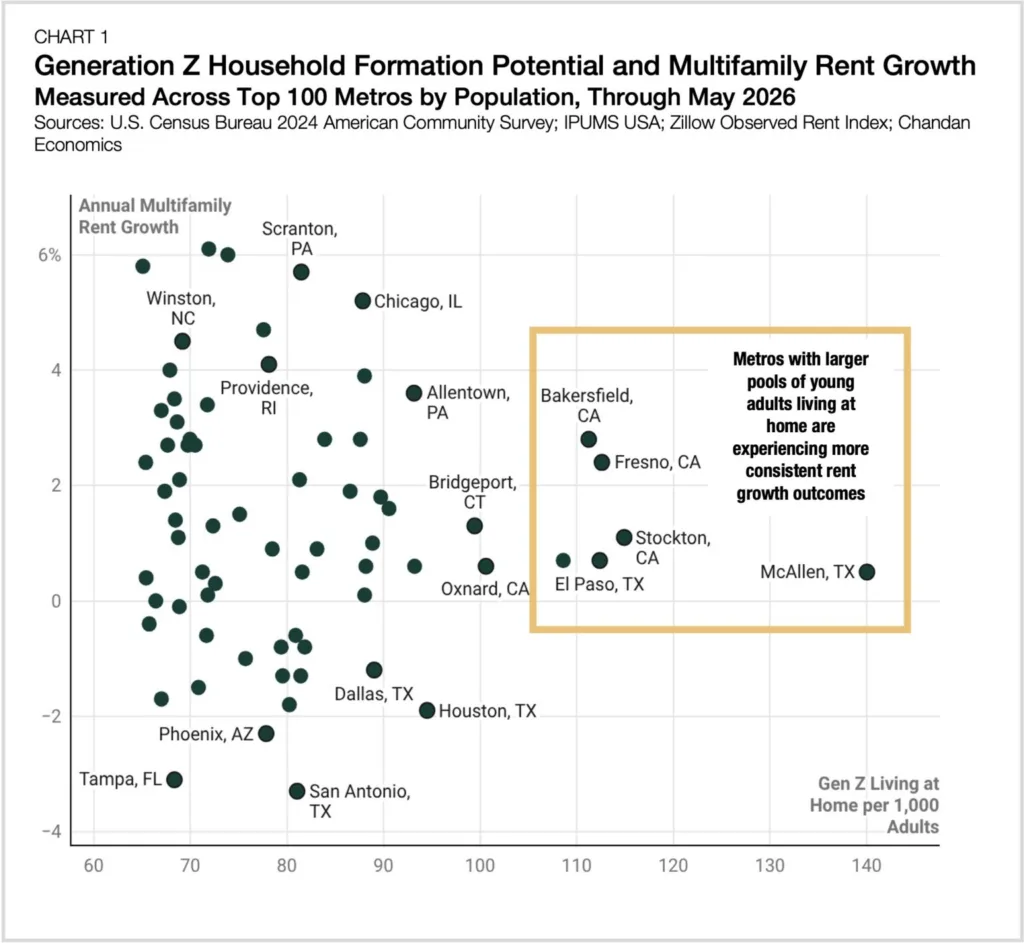
By contrast, metros with fewer Gen Z adults at home showed greater swings. Urban Honolulu posted 6.4% annual rent growth, while North Port, FL, saw rents fall 5.7%. The data suggest delayed household formation can support multifamily rents. This demand source may help offset weaker migration and rising supply.
Why It Matters
Tracking Gen Z household formation gives investors and operators a forward-looking view of rental demand. Large numbers of young adults living at home represent future household growth. That potential matters as economic pressures and new supply reduce migration-driven demand. Recent data also show household formation has slowed nationally, making these built-in demand pools more valuable for multifamily owners.
The trend offers defensive benefits. McAllen may trail other markets in rent growth today. Still, its locally generated demand could cushion prolonged downturns or oversupply. Chandan Economics and Arbor Realty Trust highlight this advantage in smaller Texas and California cities. These markets combine demographic potential with stronger rent performance than regional peers.
Looking ahead, affordability, culture, and demographics will shape future demand. CRE professionals must understand not only current renters but also future ones. Identifying who is ready to enter the market has become a strategic priority.
What’s Next
Multifamily investors and developers should watch Gen Z household formation through 2027. They should focus on secondary and smaller gateway markets in California and Texas. Migration shifts and poor affordability in primary metros could boost local demand. As inventory rises, operators must attract and retain the next wave of Gen Z renters. Tracking American Community Survey and Census data will help identify when and where this cohort enters the market.