








In this webinar, Alex Thomas, Research Manager at John Burns Research and Consulting, shared the latest Q2 2026 CRE Capital Markets Update and Fear and Greed Survey results in partnership with CRE Daily. He was joined by Chris Nevinsall, who leads rental research covering apartments, build-to-rent, and single-family rentals.
The survey shows that commercial real estate investors remain cautious, with sentiment stuck just above stagnant levels. While many investors still expect to increase exposure over the next six months, tighter capital access, inflation concerns, and rental market weakness continue to slow decision-making.
Download the Full Survey Results
The 26-page survey chartbook provides deeper insights and visuals into investor sentiment, capital trends, and the evolving CRE landscape. Download the complete report for a sector-by-sector breakdown and exclusive investor commentary.
"*" indicates required fields
By downloading, you agree to our Terms and Privacy Policy. You will also start receiving CRE Dailys free newsletter. You can unsubscribe anytime.

Conversation Highlights
The overall Fear and Greed Index stands at 56 out of 100, placing the market slightly above stagnant levels. A healthy market typically falls between 70 and 90, while a score of 50 signals a flat market.
The latest reading represents a slight decline from prior quarters, though sentiment has stayed broadly consistent over the past year. Industrial continues to outperform the broader index, while office remains the weakest sector.
Investors Remain on Pause
Most commercial real estate investors are still not making major portfolio changes. About 71% said they neither increased nor decreased exposure to a particular sector.
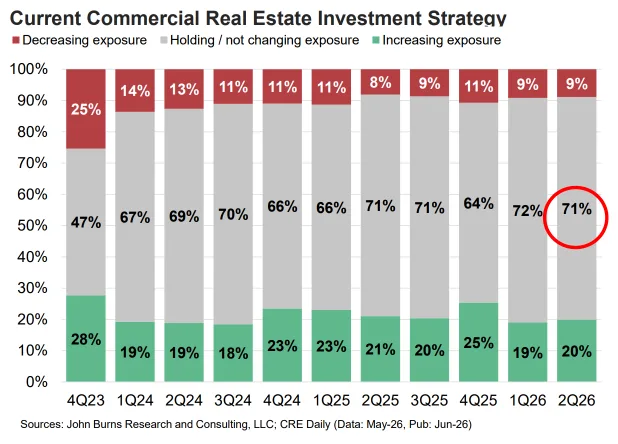
That holding pattern reflects elevated uncertainty across the industry. Investors continue to cite limited visibility as a key reason for slower activity and cautious capital deployment.
Even so, the outlook is not fully negative. About 39% of investors expect to increase CRE exposure over the next six months, compared with just 10% who expect to decrease exposure.
Capital Access Reverses Course
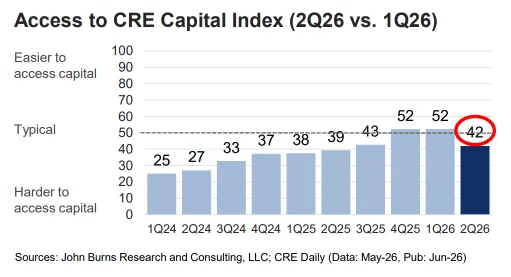
The biggest shift in the survey came from access to capital.
After several quarters of gradual improvement, investors reported that capital became harder to access in Q2 2026. This reversal appeared across all four tracked sectors: multifamily, industrial, retail, and office.
Rising borrowing costs are a major factor. The 10-year Treasury yield moved from below 4% in March 2026 to roughly 4.5% to 4.6%, increasing pressure on long-term debt.
Short-term relief also looks uncertain. According to the webinar, rate cuts that were previously priced into expectations have largely disappeared, suggesting SOFR-linked debt may remain elevated through the year.
Inflation Pressure Changes Underwriting
Inflation concerns are now directly affecting acquisition assumptions.
The webinar pointed to rising energy costs as a key driver of renewed headline inflation pressure. Higher energy costs are also starting to affect producer prices and core goods inflation.
Investors are responding by changing how they underwrite new acquisitions. About 72% said the recent increase in oil prices and related inflation concerns changed their underwriting for the next six months.
The most common changes include higher reserves, increased operating expense assumptions, higher borrowing costs, and adjusted rent growth assumptions.
Most investors are treating the shock as a margin squeeze. They are cutting NOI assumptions rather than making major changes to exit cap rates or return hurdles.
Build-to-Rent Investors Wait for Policy Clarity
Policy uncertainty has also weighed heavily on build-to-rent investment.
The webinar discussed the 21st Century Road to Housing Act, which originally included a Senate provision requiring newly built detached rental properties to be sold after seven years.
The House version removed that mandatory disposal requirement, creating more policy clarity. However, the change came during the survey period, after many responses had already been collected.
Among investors actively involved in build-to-rent, nearly two-thirds said they had put future investments on pause due to policy uncertainty.
Some investors are waiting without shifting capital. Others have already moved money elsewhere, including into multifamily.
Multifamily Rent Growth Still Needs Time
Multifamily remains under pressure from lingering supply and weaker demand.
Current apartment rent growth is roughly flat year over year, while build-to-rent rents are down about 70 basis points. The slowdown is especially visible in Sunbelt markets, though weakness has spread more broadly.
The supply wave has crested, but many new units are still in lease-up. That continues to weigh on rents, especially in markets with heavy recent construction.
About 65% of investors do not expect rent growth to return to 3% or more until 2028 or later.
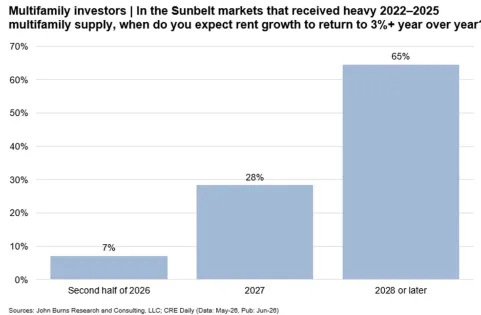
Chris Nevinsall said the rental market is still working through the end of the 2021 and 2022 boom period. Immigration slowed in 2025, job growth moderated, and demand has not yet recovered enough to accelerate rent growth.
AI Adoption Becomes Widespread in CRE
AI is quickly becoming part of everyday CRE operations.
The survey found that 72% of investors are using AI for market research. Another 53% are using it for deal underwriting, while 38% are using it for legal work.
Only 16% said they are not using AI.
That suggests investors are leaning into AI to create efficiencies in a slow market. As transaction activity remains limited, firms are using technology to improve research, underwriting, legal review, and internal workflows.
The slides from the webinar are below.