








- Institutional investors and REITs are buying office assets again, helping push US office investment sales to $20.5B in Q1 2026, according to Avison Young.
- Manhattan has emerged as a focal point for large office deals, including SL Green’s $730M acquisition of 65 E. 55th St. and Vornado’s stake purchase in Park Avenue Plaza.
- Improving leasing activity, return-to-office momentum, and demand for trophy properties are giving institutional buyers confidence that the office market has stabilized.
Bisnow reports that office investors that spent the past several years avoiding the sector are starting to come back. Institutional buyers and publicly traded REITs ramped up office acquisitions in early 2026 as leasing activity stabilized and confidence returned to high-end workplace assets, particularly in gateway markets like New York City.
According to Avison Young’s Q1 2026 office report, US office investment sales reached $20.5B during the first quarter, up 38.6% from the same period in 2025. Institutional investors accounted for $7.1B in office purchases year-to-date through mid-May, nearly matching their total investment volume for all of 2023.
Get Smarter about what matters in CRE
Stay ahead of trends in commercial real estate with CRE Daily – the free newsletter delivering everything you need to start your day in just 5-minutes
Manhattan Office Comeback
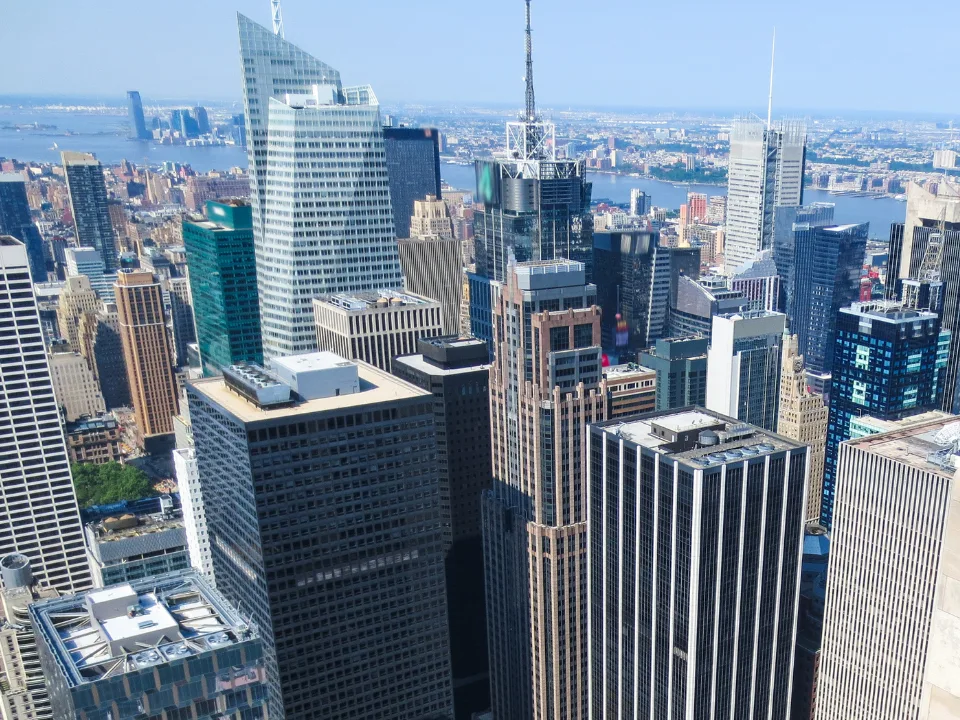
Manhattan has become the clearest signal that large institutional capital is willing to reengage with office properties. In January, SL Green Realty closed on its $730M acquisition of 65 E. 55th St., a Midtown office tower near Park Avenue. Three months later, Vornado Realty Trust acquired a 49% stake in Park Avenue Plaza in a deal valuing the property at roughly $1.1B.
Those transactions followed several major office trades completed in the second half of 2025. RXR and Elliott Investment Management purchased 590 Madison Ave. for $1.1B in August, while Norges Bank Investment Management and Beacon Capital Partners acquired 1177 Sixth Ave. for $572.3M in September.
Avison Young Head of US Investment Sales James Nelson told Bisnow that institutional buyers returning to the market are encouraging their peers to follow. Unlike private investors that moved aggressively into discounted office opportunities earlier in the recovery, institutions typically move slower because investment committees demand clearer signs of stability before approving deals.
The Details
REIT activity has accelerated alongside institutional acquisitions. Avison Young reported that REIT office investment volume reached $3.3B year-to-date through mid-May 2026. That figure already surpassed the full-year 2023 total of $1.9B and is approaching 2025’s annual total of $3.6B.
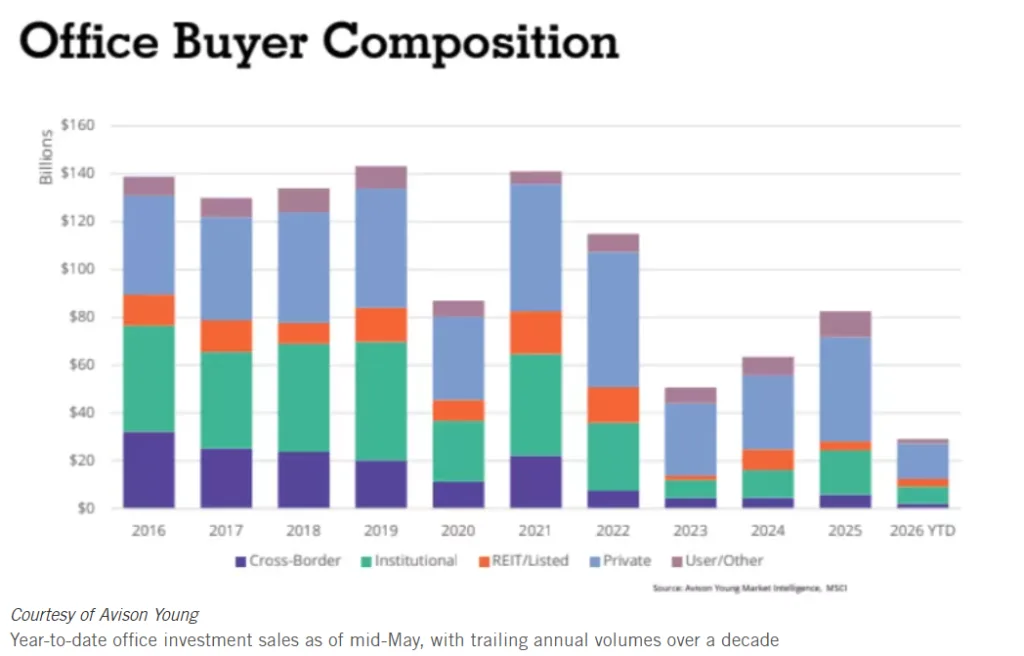
Market participants say improving fundamentals are helping office assets pass institutional underwriting standards again. Avison Young Senior Manager of US Capital Markets Market Intelligence Alex Ern told Bisnow that stronger return-to-office trends, rising trophy office rents, and AI-driven tenant demand have clarified which office buildings remain competitive.
That clarity is also showing up in the development pipeline. BXP is moving forward with two ground-up office developments in Washington, DC, totaling roughly 320K SF and anchored by law firms. The projects are expected to deliver in 2028 and 2031. In Manhattan, BXP is also developing a 930K SF office tower above Grand Central Terminal.
The Trophy Office Divide
Institutional capital is not flowing evenly across the office sector. Investors remain heavily focused on newer, highly amenitized Class A and trophy assets in prime urban locations, while older commodity office buildings continue to struggle with vacancy and refinancing pressure.
Manhattan exemplifies that split. Nelson told Bisnow that Avison Young is tracking more than 10M SF of office development underway in the borough. Developers continue betting on premium buildings with strong transit access and modern amenities. Similar capital flows are also elevating Sun Belt markets into gateway investment territory.
That aligns with broader leasing trends seen across major gateway markets. According to CBRE’s Q1 2026 office report, high-quality buildings continue outperforming lower-tier office product in both occupancy and rent growth, particularly in New York, Boston, and Washington, DC.
Why It Matters
Institutional investors returning to office acquisitions marks an important shift for the broader capital markets environment. These firms largely exited the office sector after the pandemic disrupted occupancy patterns and created uncertainty around long-term demand. Their willingness to buy again suggests confidence that pricing has reset and that the highest-quality office assets can still generate durable returns.
The shift could also improve liquidity across the office sector after several years of muted transaction volume. Institutional buyers and REITs typically bring larger pools of capital and longer investment horizons than private opportunistic investors, helping establish pricing benchmarks that can support refinancing and future deal activity.
What’s Next
Market watchers expect institutional office investment activity to continue building through the second half of 2026, particularly in gateway cities where leasing fundamentals are strongest. Trophy office assets in Manhattan, Washington, DC, and other major CBDs are likely to remain the primary targets for both acquisitions and new development.
The bigger question is whether confidence eventually broadens beyond elite assets into the wider office market. For now, institutional capital appears focused on a narrow segment of high-performing buildings, but rising transaction activity could signal the early stages of a more durable office recovery.