








- Los Angeles’ “mansion tax” has become a major friction point for multifamily development, with developers citing the transfer levy as a reason projects no longer pencil.
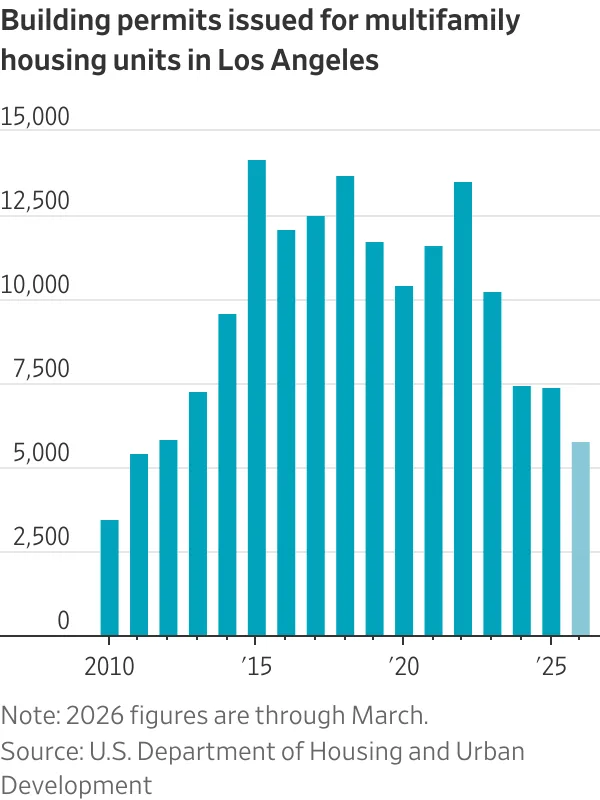
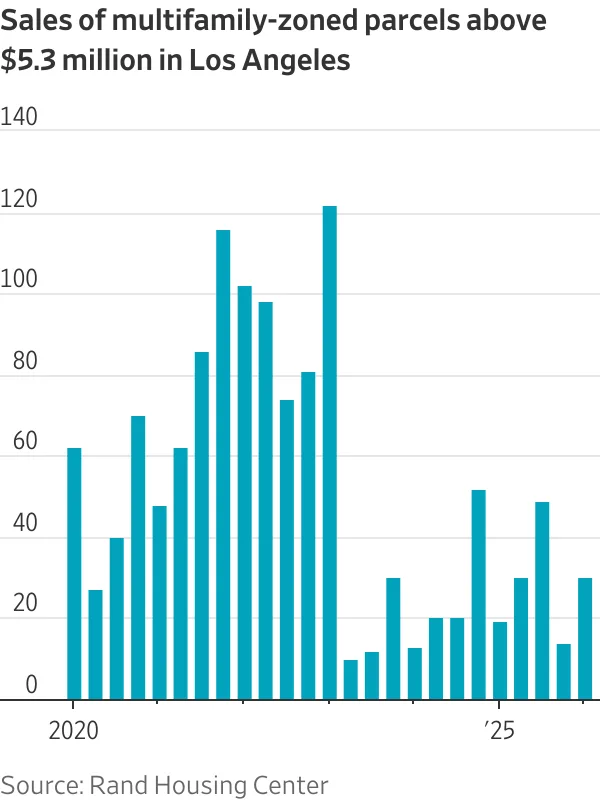
- Multifamily permits in the city fell 46% between 2022 and 2025, while land sales for apartment-zoned sites above the tax threshold dropped nearly two-thirds, according to Rand Housing Center data.
- City officials and business groups are now weighing amendments or exemptions as pressure builds to preserve housing production without eliminating affordable housing funding.
The WSJ reports that Los Angeles’ voter-approved “mansion tax” was pitched as a way to fund affordable housing and tenant protections during the city’s worsening homelessness crisis. Three years later, developers, economists, and even some early supporters say the measure may be suppressing the very housing production Los Angeles desperately needs.
The transfer tax, formally known as Measure ULA, applies to property sales above $5.3M and affects far more than luxury homes. Multifamily, mixed-use, vacant land, and commercial properties all fall under the levy, creating added costs for apartment developers already facing elevated financing, labor, and entitlement expenses.
Get Smarter about what matters in CRE
Stay ahead of trends in commercial real estate with CRE Daily – the free newsletter delivering everything you need to start your day in just 5-minutes
A Stalled Venice Beach Apartment Project
Developer Jason Grant planned to assemble two adjacent parcels roughly 3 miles from Venice Beach for an eight-story apartment project with nearly 100 units. After buying one parcel in early 2023, Grant backed away from acquiring the second site once the transfer tax took effect, according to The Wall Street Journal.
The project never moved forward. The site remains occupied by aging apartments, small storefronts, and a vacant palm-reading shop instead of new housing in one of Los Angeles’ supply-constrained neighborhoods.
Grant’s experience mirrors broader developer concerns that the tax reduces project returns at a time when multifamily deals already face tighter margins.
The Details
Measure ULA imposes a 4% tax on property sales above $5.3M and a 5.5% tax on deals exceeding $10.6M. The tax applies to the gross transaction value regardless of whether a project is profitable.
According to Los Angeles city data cited by the WSJ, 61% of revenue generated so far has come from single-family home sales, with the remainder tied to commercial, multifamily, mixed-use, and vacant properties.
Supporters originally projected annual revenue between $600M and $1.1B. City figures show the measure generated roughly $1.19B over three years, though only $119.4M had been distributed as of April 30.
Most deployed funds have supported rental assistance, eviction defense, and affordable housing initiatives. City documents show 1,790 affordable apartments slated to receive funding from the program carry projected development costs averaging nearly $780K per unit.
Apartment Construction Slows
Developers argue the transfer tax compounds existing barriers to building in Los Angeles, including lengthy permitting timelines, neighborhood opposition, and high construction costs.
According to federal data cited by the WSJ, Los Angeles issued permits for 7,363 multifamily units in 2025, down 46% from 2022 levels and the lowest annual total since 2013.
Land transactions have also slowed sharply. Jason Ward, an economist at the Rand Housing Center, found that sales of multifamily-zoned parcels above the tax threshold fell nearly two-thirds in the three years after the measure passed compared to the prior three-year period.
Some major developers have shifted activity elsewhere. LaTerra Development told the WSJ it has not started a new multifamily project within Los Angeles city limits since the tax passed, instead pursuing deals in Burbank, Sacramento, Texas, and New Mexico.
Why It Matters
Los Angeles already faces a housing shortage measured in the hundreds of thousands of units. Policies that discourage land sales or reduce multifamily feasibility risk deepening supply constraints even as city leaders push for more housing production.
The tax may also be undermining local government revenue in unexpected ways. A study from Harvard Business School researchers estimated reduced property transactions tied to the measure could offset roughly 80% of the new tax revenue through lower property-tax collections. City revenue has also trailed early projections, adding pressure on officials reviewing the policy’s structure.
The debate highlights a broader challenge facing high-cost cities: balancing progressive housing policies and tenant protections with the financial realities of getting new projects built.
What’s Next
Los Angeles officials are now evaluating possible changes to Measure ULA, including exemptions for newly built multifamily and commercial properties. An ad hoc City Council committee has been meeting since March to study the policy’s market impact.
At the same time, a statewide ballot initiative backed by the Howard Jarvis Taxpayers Association would repeal transfer taxes like Los Angeles’ measure across California. The campaign has reportedly raised $14M from real estate investors and tech executives including Peter Thiel, Eric Schmidt, and Chris Larsen, according to campaign finance records cited by the WSJ.
Whether lawmakers revise the tax or voters repeal it outright could shape the future economics of apartment development not only in Los Angeles, but across California’s largest housing markets.