







- Yardi Matrix’s May 2026 office report warns that widespread AI adoption could significantly alter office demand, workplace layouts, and leasing strategies.
- Miami recorded the lowest office vacancy rate among the top 25 metros at 12.5%, while Austin led the nation in office-using job growth at 1.6% year over year.
- Developers are pulling back on new supply, with Class A properties accounting for 86% of the national office pipeline as tenants prioritize premium space.
Artificial intelligence is emerging as the office sector’s next major disruption, adding another layer of uncertainty to an already fragile recovery. Yardi Matrix’s May 2026 National Office Report argues that AI adoption could reshape not only employment levels, but also how companies use office space, how long they lease it, and what types of buildings remain competitive.
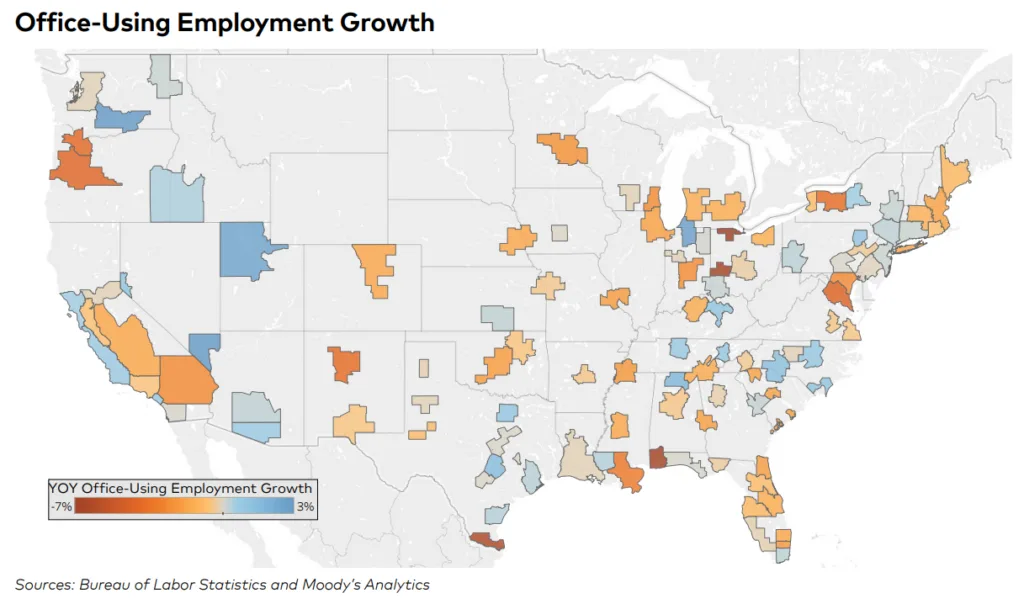
At the same time, several markets continue to outperform. Miami posted the lowest vacancy rate among the top 25 office metros, while Austin led the country in office-using employment growth, highlighting how migration trends and industry concentration continue to drive localized demand.
Get Smarter about what matters in CRE
Stay ahead of trends in commercial real estate with CRE Daily – the free newsletter delivering everything you need to start your day in just 5-minutes
AI’s Office Wildcard
Yardi Matrix outlined three possible outcomes tied to AI adoption. In the most severe scenario, AI replaces large portions of the workforce, sharply reducing office employment and demand. A second scenario assumes companies retain much of their workforce while using AI to improve productivity, reducing space needs without eliminating them entirely. The third possibility involves an AI investment bubble that leads to layoffs, stalled hiring, and broader economic weakness.
The report points to mounting evidence that AI is already reshaping hiring patterns. Companies including Meta, PayPal, Block, and Cloudflare have announced workforce reductions while ramping up AI investment. According to research cited from the Dallas Fed and Stanford University, younger workers in AI-exposed industries are seeing falling employment rates even as wages rise for experienced workers.
That dynamic could fundamentally alter office usage. Instead of large teams working in centralized offices, experienced employees may oversee smaller groups augmented by AI tools and agents. Yardi Matrix said that shift would favor flexible layouts and shorter lease structures over traditional long-term office footprints. The trend also aligns with rising tech-sector layoffs that continue weighing on office demand across major markets.
Miami’s Office Market Stands Apart
Despite broader uncertainty, several Sun Belt markets continue outperforming national averages. Miami’s office vacancy rate fell to 12.5% in April 2026 from a peak of 15.7% in early 2025, giving it the lowest vacancy among the top 25 metros tracked by Yardi Matrix.
The market’s growth has been fueled by sustained expansion in financial services and corporate relocations. Palantir recently announced plans to move its headquarters from Denver to Miami, joining firms such as JPMorgan, Amazon, and Citadel that have expanded their South Florida presence in recent years.
Miami also posted one of the nation’s highest average listing rates at $58.41 PSF, trailing only Manhattan and San Francisco among major office markets. Trophy pricing remains especially strong in Brickell, where 1450 Brickell carried the metro’s highest listing rate at $160 PSF.
Austin is seeing a similar growth story play out through employment gains. The Texas market recorded 1.6% year-over-year growth in office-using jobs as of February 2026, the highest among major metros tracked in the report. Financial firms including Peak6 and Togetherwork have relocated headquarters to Austin, helping diversify the city’s economy beyond traditional tech employers.
Flight to Quality Accelerates
Developers are continuing to pull back on speculative office construction nationwide. Yardi Matrix reported that only 29M SF of office space remains under construction nationally, representing just 0.4% of existing stock.
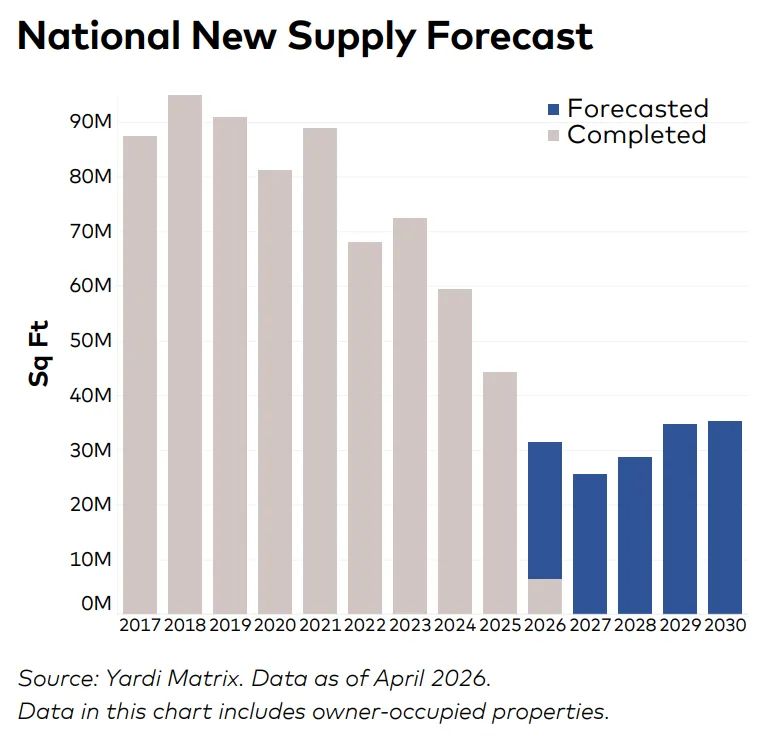
More notably, 86% of that pipeline consists of Class A and Class A+ projects. Developers are concentrating almost exclusively on amenity-heavy, premium buildings as demand for commodity office space weakens.
Yardi Matrix expects annual office completions to bottom out in 2027 at just under 30M SF before gradually increasing through 2030. Still, the report suggests AI-related uncertainty and prolonged employment concerns could limit future development starts.
Coworking operators may benefit from the transition. The report argues that flexible office products are positioned to gain relevance as companies reevaluate long-term space commitments and adapt to changing workforce structures.
Distress Deepens in Legacy Office Markets
Washington, DC continues facing heavy pricing pressure, with 65% of office transactions in 2025 trading below prior sale values, according to Yardi Matrix.
Average office pricing in the district fell to $158 PSF in 2025, nearly half of 2020 peak levels. In one example cited by the report, Douglas Development acquired a 155,000-SF office property at 1233 20th St. NW for $12.4M in April 2026, down sharply from its $65M valuation in 2018.
Nationally, office sales volume totaled $18.1B through April, with assets trading at an average of $214 PSF.
Why It Matters
The office sector is no longer dealing solely with remote work fallout or elevated interest rates. AI introduces a structural question about how many office workers companies will ultimately need and how much space those employees will occupy. According to Yardi Matrix, the uncertainty is already pushing tenants toward flexibility, premium assets, and shorter-term commitments.
Markets with strong population growth, diversified economies, and expanding financial sectors — including Miami and Austin — appear better positioned to weather the transition than slower-growth legacy office hubs.
What’s Next
Office landlords and investors will closely watch how AI adoption impacts hiring over the next 12 to 24 months. If companies continue trimming headcount while investing heavily in automation, demand for traditional office footprints could weaken further. At the same time, flexible workspace providers and top-tier Class A buildings may capture an outsized share of future leasing activity as occupiers prioritize adaptability over scale.