






- US REITs outperformed broader equities through the first half of 2026, with the FTSE Nareit All Equity REITs Index returning 14.9% year to date versus 11.1% for the Dow Jones US Total Stock Market and 10.3% for the Russell 1000.
- Performance was uneven across property types, but leadership was clear. Lodging/resorts, specialty, and data centers posted the biggest gains through June, while office led all sectors during the month itself.
- The split between property sectors and financing vehicles shows where investors are leaning. Equity REITs have benefited from improving sector fundamentals, while commercial mortgage REITs remain under pressure.
US REITs widened their lead over broader equities in the first half of 2026, with listed real estate outperforming despite elevated rates. According to Nareit, the FTSE Nareit All Equity REITs Index rose 1.5% in June, bringing its year-to-date total return to 14.9%.
That topped the broader market. The Dow Jones US Total Stock Market fell 0.4% in June and is up 11.1% year to date, while the Russell 1000 slipped 0.5% in June and has gained 10.3% so far this year.
Get Smarter about what matters in CRE
Stay ahead of trends in commercial real estate with CRE Daily – the free newsletter delivering everything you need to start your day in just 5-minutes
Sector Winners Drove Returns
Performance was broad, but a few sectors carried the gains. Lodging/resorts led all REIT property types through June with a 42.8% total return, followed by specialty at 34.1% and data centers at 33.2%, according to Nareit.
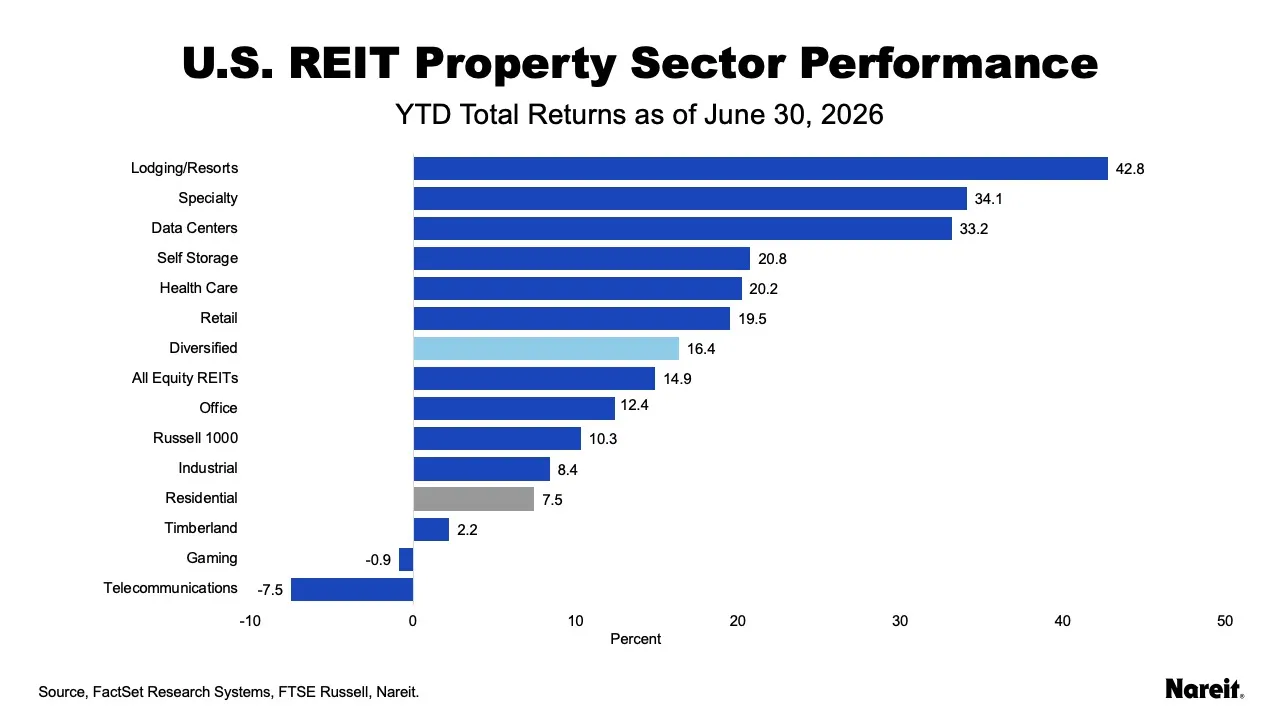
June’s leaders looked different. Office REITs posted a 12.2% return for the month, ahead of lodging/resorts at 12.0% and health care at 8.0%. The office rally stands out because the sector has spent the past two years under pressure from weak demand, high vacancy, and refinancing concerns.
Mortgage REITs Lag the Recovery
Mortgage REITs have not shared in the same rebound. The FTSE Nareit Mortgage REITs Index gained 2.5% in June and is up 2.3% year to date. Within that group, home financing REITs rose 4.2% in June and 5.2% year to date, while commercial financing REITs fell 2.4% in June and remain down 5.6% this year.
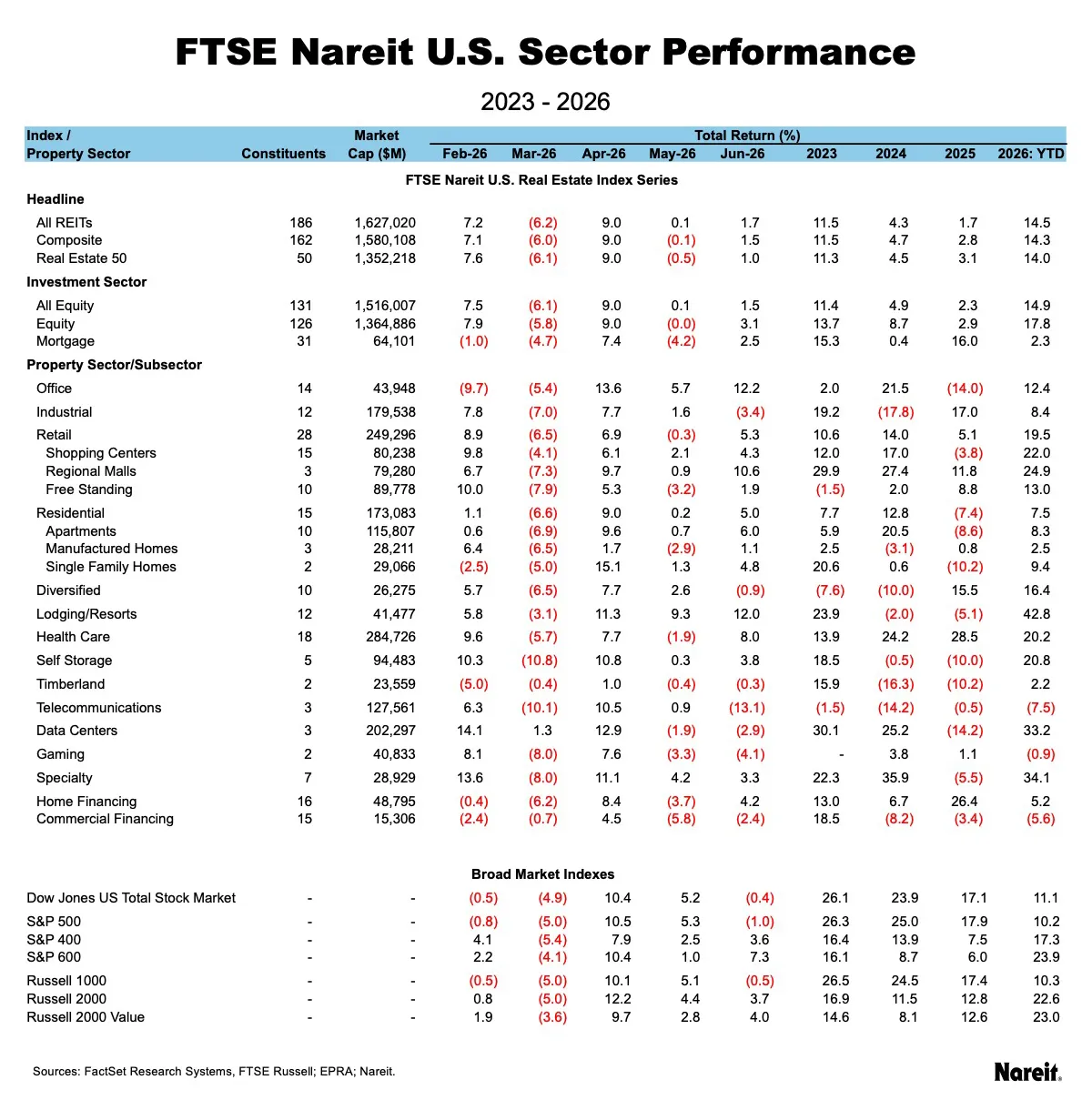
That split points to where investors still see risk. Equity REITs tied to stronger property fundamentals are drawing capital, while commercial mortgage exposure remains more challenged.
Why It Matters
REITs are outperforming in a market still dealing with higher rates. The 10-year Treasury ended June at 4.44%, roughly flat from May, yet equity REITs still posted stronger returns and offered a 3.68% dividend yield, versus 1.03% for the S&P 500.
For CRE investors, the first-half performance shows public REITs remain one of the stronger ways to play real estate in 2026. It also underscores a growing divide between property sectors with real operating momentum and credit-heavy parts of the market still facing stress.
What’s Next
The second half setup will hinge on whether REIT fundamentals can keep overpowering rate pressure. If Treasury yields stay near current levels, sector selection will likely matter more than broad real estate exposure. Data centers, lodging, and health care appear to have the clearest momentum today, while office remains the biggest wild card.
Investors will also be watching whether commercial mortgage REITs can stabilize. If they cannot, that could reinforce concerns around refinancing risk and credit conditions across parts of the CRE market. For now, though, listed equity REITs have been one of the stronger corners of the market in 2026, and the first-half numbers show they are not just keeping pace with stocks. They are beating them.