








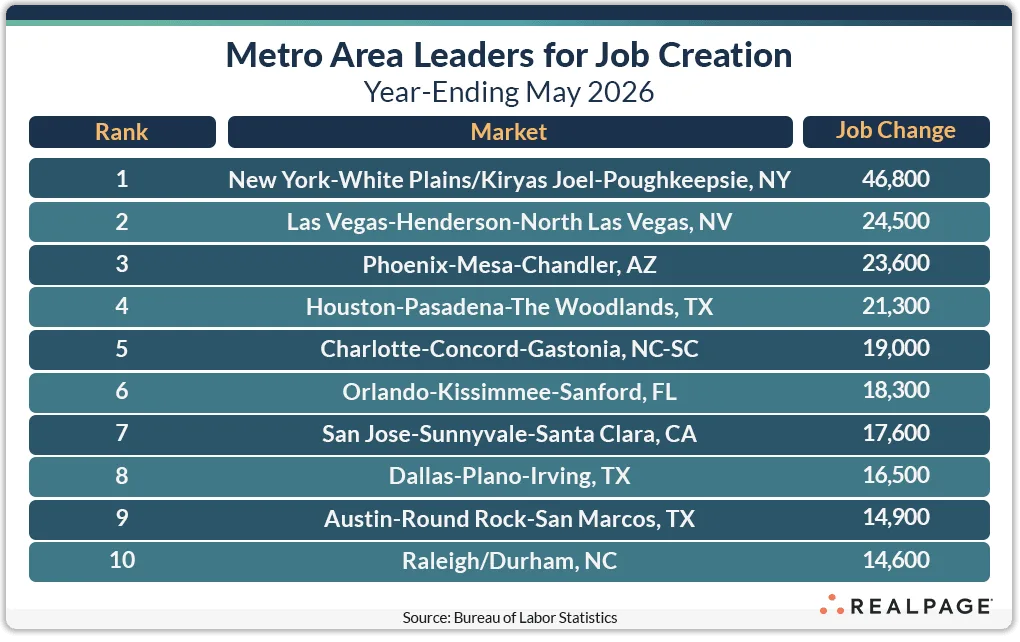
- The nation’s top 10 job gain metros added 217,100 jobs in May 2026, up 56,100 from the previous month’s annual gain.
- Markets with the largest job losses reported deeper cuts, worsening to a combined 224,900 lost jobs year-over-year, led by Washington, DC’s reductions.
- Texas, the Carolinas, and the Mountain West regions outperformed as US employment growth and declines increasingly diverged by location.
Polarization in US Job Markets Intensifies
The latest Bureau of Labor Statistics data shows a widening gap between metro areas gaining and losing jobs. RealPage Analytics Blog reports that, for the year ending May 2026, the top 10 US metro areas for employment gains increased the pace of their hiring versus April, while the markets with the deepest declines posted even steeper annual losses.
This divergence is regional, with the Midwest and Northeast lagging and much of the South and West seeing above-average hiring. Even within large states like California and Florida, fortunes differ widely between metros, underlining the fragmentation in economic momentum.
Get Smarter about what matters in CRE
Stay ahead of trends in commercial real estate with CRE Daily – the free newsletter delivering everything you need to start your day in just 5-minutes
The Details
According to RealPage Analytics, the 10 leading metros for job gains in May 2026 added a total of 217,100 jobs over 12 months—56,100 more jobs than the same group’s annual tally as of April, a nearly 35% increase month-to-month. New York topped the list with 46,800 new positions, followed by Las Vegas.
Houston climbed to fourth, replacing San Diego. In contrast, the bottom 10 markets saw job cuts deepen by another 25,000 to a total annual net loss of 224,900 roles. Most of these job losses originated in hubs like Washington, DC, due in part to federal government reductions. For context, just one year ago the cities now posting the steepest losses had actually gained a modest 10,400 jobs.
Regional Winners and Losers Split
The report highlights clear geographic patterns. Texas, California, and North Carolina each logged at least four metros among the top 30 for absolute job gains. Growth hotspots include Texas, the Carolinas, and the Mountain West, while losses gathered in the Midwest, Northeast, and parts of California’s Southern region (except San Diego).
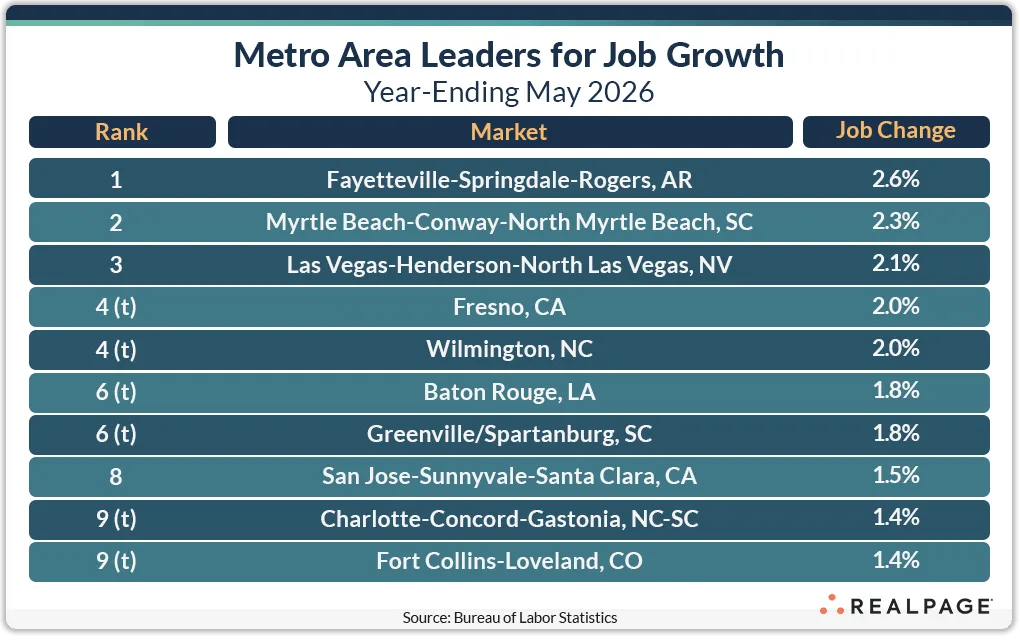
South Florida was also mixed: Miami eked out employment growth, but Fort Lauderdale and West Palm Beach recorded cuts. State capitals, college towns, and tourist destinations—such as Fayetteville-Springdale-Rogers (Arkansas), Myrtle Beach, and Las Vegas—led in job growth percentage, reflecting a smaller-market advantage. Conversely, metros like Washington, DC, and Portland, OR suffered the largest percentage declines, underscoring region-specific headwinds.
Why It Matters
The bifurcation of job markets has real implications for commercial real estate strategy. Markets that continue to post robust job gains—New York, Las Vegas, Houston, and their peers—tend to see healthier demand in the multifamily, office, and retail sectors. This trend supports expectations that stronger hiring will remain a key driver of commercial real estate demand through 2026.
According to RealPage Analytics, Texas, California, and North Carolina each represent key nodes of positive economic momentum, giving owners and investors clearer signals for future deployments. However, persistent losses in the Midwest and Northeast, and even inside states like California and Florida, signal risk for underwriting and portfolio exposure.
On the granular side, metros like Las Vegas, San Jose, and Charlotte not only ranked among the top markets for absolute job gains but also cracked the top 10 for annual percentage growth. For example, Myrtle Beach led growth rates in May 2026 with a 60 basis-point improvement over April, and Greenville/Spartanburg posted a 50 basis-point gain.
Smaller metros swinging from steep employment losses to strong growth, such as Baton Rouge and Fort Collins, highlight the volatility possible outside primary markets. On the downside, Washington, DC saw a 2.9% annual drop, driven by cutbacks in federal government roles—a stark reversal compared to the same time last year, per BLS and RealPage.
What’s Next
CRE players should watch for continued volatility and divergence across US regions as economic fundamentals shift. While primary markets with deep talent pools and business investment—especially in Texas and the Southeast—are expected to sustain gains, fragile performance in key Northeastern and Midwestern metros may drive reassessments of asset value and redevelopment plans over the coming quarters. RealPage notes that winners and losers are increasingly determined by local economic bases and sectoral drivers, hinting at more city-level and intra-state competition for jobs and investment ahead. Investors will need to prioritize submarkets with resilient job growth to buffer portfolios against rising regional risk in the balance of 2026 and beyond.