




- Self-storage property sales nearly doubled, with $6B trading hands through November 2025 versus $3B in 2024, per MMCG Invest.
- Major deals—including Public Storage’s $10.5B purchase of National Storage Affiliates—underscore renewed investor appetite and higher pricing.
- Sector yields are normalizing to low double digits as rents stabilize, prompting investors to revise return expectations.
Rates, Sales, and a Market Reset
Soaring interest rates and weaker home sales damaged self-storage’s reputation as a recession-resistant, high-yield asset. According to Bisnow, property values fell about 25% from their peak during 2024 and early 2025.
Fewer household moves and tighter financing drove much of that decline. The pullback also reflected broader CRE pressure across several property sectors.
However, self-storage faced added exposure because the sector depends heavily on housing turnover. Nuveen Real Estate tracked the market bottom in Q2 2025. Since then, easing rate pressure and stronger homebuying activity have improved sentiment.
Get Smarter about what matters in CRE
Stay ahead of trends in commercial real estate with CRE Daily – the free newsletter delivering everything you need to start your day in just 5-minutes
The Details
The recovery is becoming visible in capital flows and asset pricing. Public Storage completed its $10.5B National Storage Affiliates acquisition in July 2026. The transaction became the sector’s largest deal ever.
Earlier this year, StorageMart acquired 15 New York City properties for $1B. The portfolio included 1.3M SF of storage space. Total transaction volume reached nearly $6B through November 2025, doubling 2024 volume.
First-half 2026 activity reached $2.8B, below the $3.8B recorded one year earlier. However, investors paid an average $123 per SF. Yardi Matrix reported that pricing represented a 26% increase from 2025.
Investor Selectivity and Historical Comparisons
Today’s investors have become far more selective. The Ardent Cos. said only a small share of potential deals ultimately reaches contract. Developers and investors have also tightened construction decisions and underwriting standards.
That discipline follows rapid post-pandemic development, particularly across Sun Belt metros. Reliant Real Estate and Extra Space Storage also highlighted major changes in expected returns.
Immediately after the pandemic, investors frequently achieved double-digit returns. Some deals generated yields between 18% and 20%. Today, new supply and normalized moving activity have pushed expected yields toward 10% to 12%.
Why It Matters
Self-storage’s recent evolution reflects broader CRE trends. Pandemic-era performance attracted significant capital from investors seeking dependable income and strong yields.
Recent sector data also shows improving stabilization, although rent growth remains softer than during the pandemic-era surge. That backdrop supports more disciplined underwriting as investors reassess return expectations.
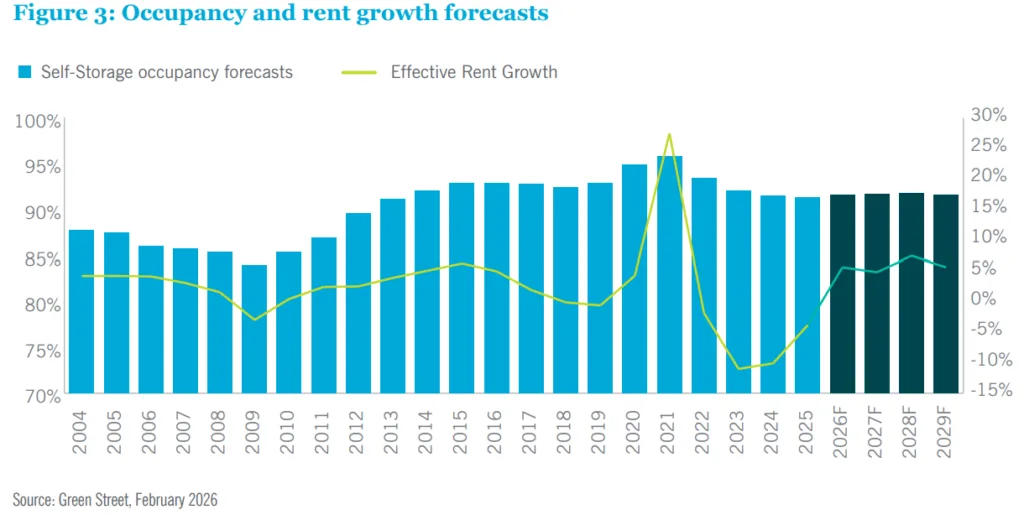
Nuveen Real Estate identified Q2 2025 as the sector’s pricing trough. That reset pushed less committed investors aside. It also increased attention on properties with durable in-place cash flows.
By November 2025, average pricing per SF had increased 26% year over year. That improvement suggests institutional investors increasingly believe the sector has moved beyond its weakest period.
A More Disciplined Cycle
However, the new cycle will not recreate the easy outperformance seen after the pandemic. Heavy development created excess supply in several markets. That inventory continues limiting rent growth and outsized returns.
“The high teens are gone,” Extra Space Storage’s Zachary Dickens said. Leading investors now emphasize cautious optimism and more realistic return expectations.
Still, self-storage cash flows remained resilient throughout the downturn. Competition for strong properties is increasing, while lenders and buyers continue applying stricter underwriting.
What’s Next
Industry leaders expect self-storage to enter a more stable return environment. Home sales and household moves should gradually support demand as residential activity improves.
However, investors should expect continued performance differences between individual properties and markets. Well-located, stabilized facilities should continue attracting premium pricing. Weaker projects could face longer lease-up periods or difficulty attracting buyers.
Developers will likely approach new construction cautiously. Higher replacement costs and selective financing increasingly favor fewer, higher-quality developments. Disciplined underwriting and realistic yield expectations will remain critical.