




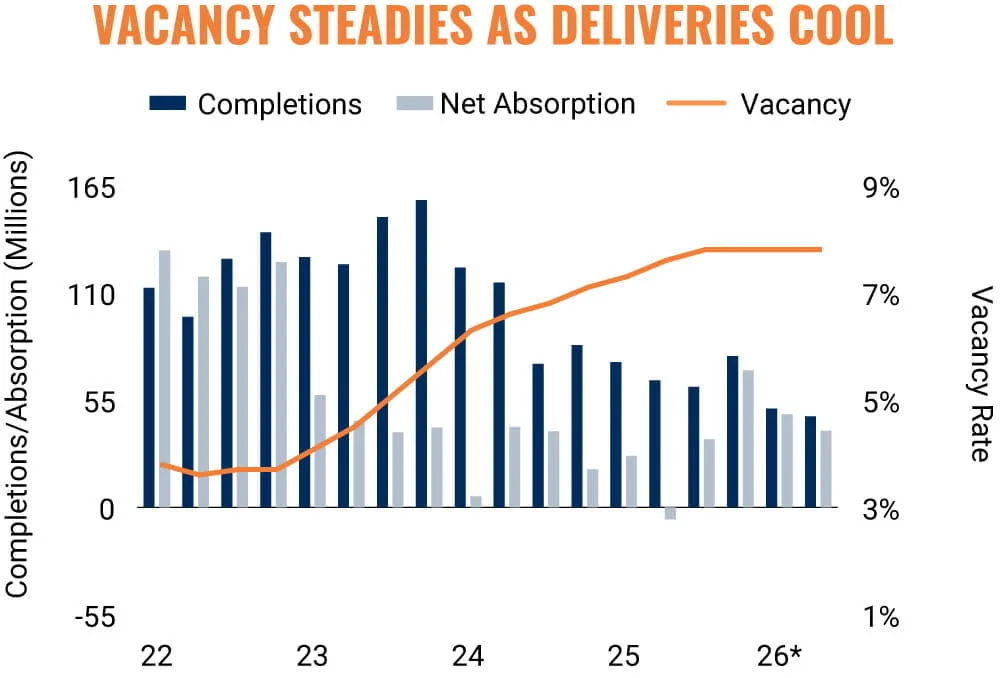
- Industrial vacancy stabilized at 7.8% as slower development offsets strong but moderating absorption.
- Sharp increases in international shipping and domestic trucking costs add volatility, complicating retailer import and inventory plans.
- Investor demand for industrial assets remains robust despite higher cap rates and muted rent growth, signaling market confidence.
Industrial Sector Anchored Amid Trade Crosscurrents
US industrial property fundamentals showed surprising stability in mid-2026, despite rising transportation costs and global trade headwinds. Consumer spending and e-commerce demand continue to support warehouse absorption, according to Marcus & Millichap and other market data. Meanwhile, East Asia-to-West Coast container costs surged from $1,850 before the Middle East conflict to over $7,000 in July. Importers now face new Section 301 tariffs while making critical inventory decisions ahead of the holiday season.
The industrial sector continues to resist broader volatility, supported by a 6.7% increase in headline retail sales during June. Non-store sales also posted double-digit growth, strengthening demand from consumer-driven warehouse users. These trends continue to support leasing and absorption as developers slow construction amid persistent supply chain friction.
Get Smarter about what matters in CRE
Stay ahead of trends in commercial real estate with CRE Daily – the free newsletter delivering everything you need to start your day in just 5-minutes
The Details
Net industrial absorption slowed during Q2 2026 but still exceeded year-ago levels, when tariffs first rattled importers. Developers delivered 46.6M SF, marking the lowest quarterly supply total since 2014. Steady demand and slower construction kept national industrial vacancy flat at 7.8% over the past 12 months. Vacancy declined further among warehouses above 200,000 SF during the year ending in June. Properties below 50,000 SF maintained the lowest vacancy rate at 4.6%, despite increases across some other smaller properties.
Source: Marcus & Millichap
Industrial rents reached a plateau, with average asking rents nearly unchanged year-over-year. They increased just 0.5% from Q2 2025. Meanwhile, rising shipping and trucking expenses continue to inflate industrial operating costs. Domestic trucking rates have jumped 35% since February, increasing inflationary pressure for logistics operators and tenants.
E-Commerce and Trade Policy Reshape Warehouse Demand
E-commerce, sporting goods, and consumer electronics continue driving demand after robust spending growth during 2026’s first half. Consumer spending has remained a key support for industrial demand, particularly across retail-linked warehouse and distribution networks. However, rising supply chain costs and tariff uncertainty are forcing occupiers to reconsider inventory strategies. These changes could reshape absorption patterns across major port and inland distribution markets. New Section 301 tariffs have replaced last year’s Section 122 tariffs, adding another layer of complexity. The policy shift could influence leasing strategies as retailers prepare for the peak season.
Construction starts continue to decline, while strong demand and measured new supply support stability across leading logistics corridors. Warehouse performance also varies by size. Larger Class A bulk warehouses continue tightening, while smaller infill properties face slightly higher vacancy. Still, vacancy across smaller properties remains healthy by historical standards.
Why It Matters
Industrial has outperformed much of commercial real estate, but the sector now faces its strongest crosswinds in years. Marcus & Millichap and CoStar data show national vacancy holding at 7.8% despite shifting trade conditions. Inflationary pressures and unpredictable shipping timelines have also complicated operating decisions. Transpacific container costs surged from $1,850 to over $7,000, creating an unexpected supply chain shock. Higher costs raise the stakes for inventory timing and location decisions among warehouse occupiers.
Investor sentiment remains resilient as transaction activity continues climbing despite higher cap rates. Industrial cap rates increased from a sector low of 6.0% in 2022 to 6.8% in Q2 2026. Investors appear willing to accept higher yields alongside long-term confidence in e-commerce demand and US distribution hubs. Steady retail sales and consumer spending further support the sector’s underlying value. However, unpredictable tariffs and rising logistics costs could increase operating expense volatility and influence pricing through year-end.
What’s Next
Occupiers will focus on peak-season inventory decisions while balancing new tariffs, freight costs, and Amazon-era consumer expectations. Development starts are slowing, which should keep new supply muted through the remainder of 2026. That dynamic could stabilize vacancy or drive compression across supply-constrained submarkets.
Capital markets could maintain or accelerate transaction activity as investors target bulk distribution centers and strategic logistics nodes. Persistent supply chain friction could also encourage reshoring and inventory decentralization. These shifts would add another layer of complexity to regional industrial trends over the coming quarters.