



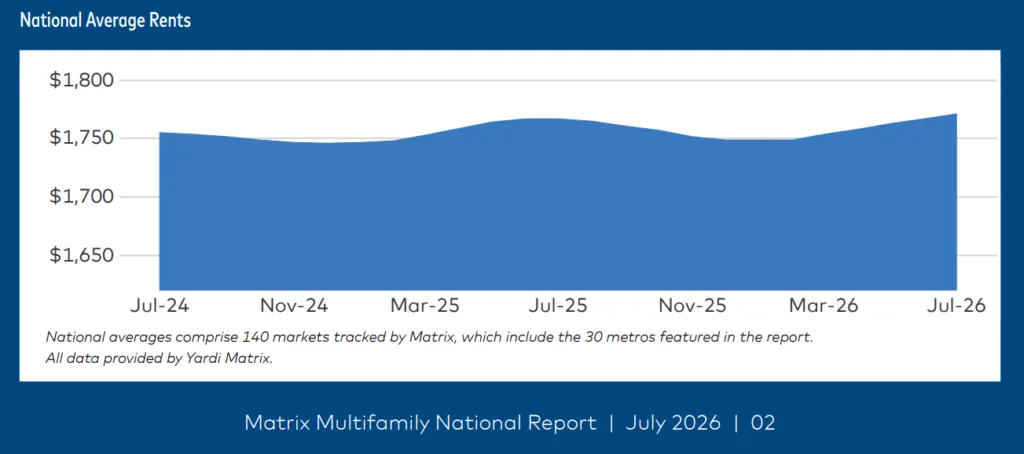
- US multifamily rents rose by $4 in July, marking the strongest July rent increase since 2015 outside of the volatile post-pandemic period.
- Markets like San Francisco and New York led annual rent growth, but occupancy rates and pricing power remain pressured by hefty new supply.
- The 21st Century ROAD to Housing Act recently became law, streamlining development incentives but imposing new limits on single-family rental acquisitions.
Supply Wave Moderates, But Rent Gains Return
According to Yardi Matrix’s July 2026 National Multifamily Report, the US apartment market notched its most robust July rent hike in more than a decade, with average advertised rents climbing $4 to $1,771 per month. This comes despite a subdued broader landscape, marked by 1.3% rent growth year-to-date and year-over-year growth of just 0.2%.
Analysts note that while concessions are still widespread and the surge of new supply continues to weigh on many markets, renewed rent growth signals healthy tenant demand. Notably, regions battered by oversupply like the Sun Belt and Mountain West are beginning to rebound, with several metros posting positive rent movement in recent months for the first time since the peak of pandemic-era development.
Get Smarter about what matters in CRE
Stay ahead of trends in commercial real estate with CRE Daily – the free newsletter delivering everything you need to start your day in just 5-minutes
The Details
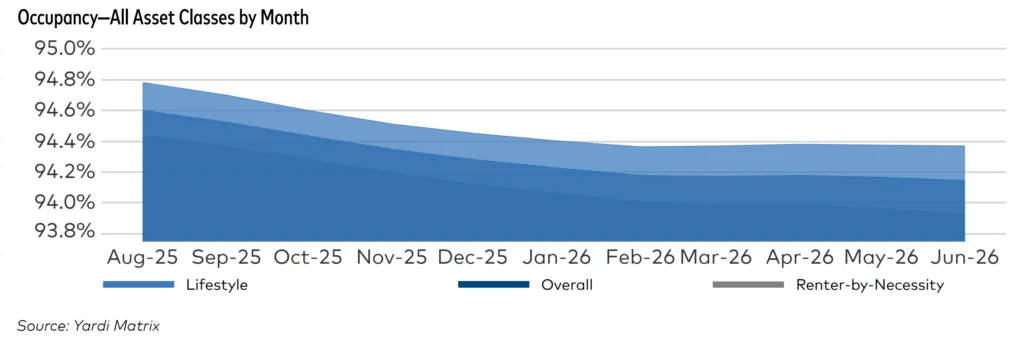
July’s $4 average rent increase is the largest for the month since 2015, excluding the 2021-22 boom. Nationally, year-to-date rents are up 1.3%, compared to a sluggish pace in the same window last year. Occupancy, however, slipped 60 basis points year-over-year to 94.1% in June, with markets such as Houston (91.6%), Austin (91.9%), and Dallas (92.2%) experiencing the lowest rates among major metros.
On a year-over-year basis, San Francisco led the pack with 5.3% rent growth, followed by New York City (5.2%), Kansas City (3.1%), Chicago (2.7%), and the Twin Cities (2.4%). Meanwhile, high-supply markets like Austin, Denver, and Phoenix logged declines ranging from -3.7% to -2.1%.
Regional Variance and Product Type Spread Narrow
The spread between outperforming and struggling regions appears to be narrowing, even as occupancy faces ongoing headwinds. The Midwest, led by Indianapolis, Chicago, and Cleveland, continues to deliver outsize gains, especially in the single-family build-to-rent (BTR) segment. July saw BTR advertised rents hit a record $2,240—up $5 on the month and 0.3% year-over-year.
Conversely, Texas saw pronounced softness, with San Antonio BTR rents down 5.2% year-over-year. Sun Belt metros that were hammered by new supply in 2024 and 2025, like Orlando and Nashville, are now among the leaders in monthly rent growth, suggesting that the worst dislocation from the supply glut may be past. In July, only six of the 30 top US metros saw rent declines month-over-month.
Why It Matters
The market’s momentum in July implies that robust household formation and sticky for-sale home prices are underpinning rental demand, even as vacancies tick up. Yardi Matrix data covering 140 markets shows that, while average annual multifamily rent growth remains well below the 3.4% ten-year average, pockets of strength have broadened in recent months. That improving breadth aligns with recent investor surveys showing confidence is returning as supply pressures gradually ease across many markets. For example, Midwest and gateway markets now dominate the rent growth leaderboard, with San Francisco posting an uptick in occupancy thanks to AI-fueled job creation.
Policy support could further change the equation. With the 21st Century ROAD to Housing Act now law, HUD is tasked with reducing environmental review timelines for infill apartments and piloting grant programs intended to spur housing supply. Notably, while severe restrictions on build-to-rent were stripped before passage, institutional buyers face new limits on scattered-site single-family acquisitions, nudging them toward BTR communities—a space already gaining ground nationally. The permanent renewal of Opportunity Zone tax incentives may also draw more capital into multifamily projects.
Yet, several headwinds remain. Persistently high inflation, elevated interest rates (with the 10-year Treasury yield at an 18-month high), and geopolitical jitters could suppress consumer confidence and delay a full recovery in occupancy. Continued construction cost inflation and high apartment completions—especially in Sun Belt metros—will likely keep rent growth modest. Still, the law’s supply-side measures and slowly waning deliveries should gradually reduce competitive pressure and help rebalance fundamentals heading into 2027.
What’s Next
Looking ahead, the rest of 2026 will test whether July’s strengthening rent growth trend can persist as seasonality returns and new lease-ups moderate. Yardi Matrix forecasts suggest year-end rent growth will remain soft in the worst-hit supply markets like Phoenix, Austin, and Denver, but should improve modestly in the Midwest and gateway cities.
Policy changes from the new housing law will take years to manifest in actual supply, though incentives could jumpstart planning in both infill and Opportunity Zone markets. Short-term, higher mortgage rates are likely to continue supporting rental demand by sidelining would-be homebuyers, but sluggish job growth and global macro risks pose downside for occupancy and rent growth through year-end.