






- Multifamily and single-family home prices rarely appreciate at the same rate, with results varying by metro.
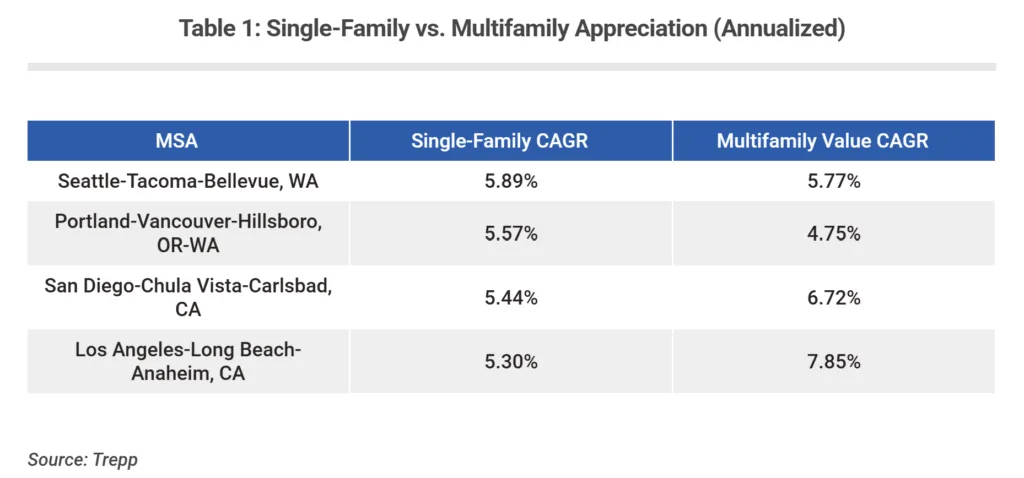
- In Seattle, appreciation rates for apartments and houses closely track, while in Los Angeles and San Diego, multifamily outperformed.
- Long-term value growth depends on local fundamentals beyond household demand, including rent trends, cap rates, and market constraints.
Comparing Decades of Value Growth
Multifamily asset values do not always track single-family home prices, according to Trepp’s latest analysis. The firm compared long-term growth across four major West Coast housing markets.
Trepp analyzed annualized compound growth rates in Seattle-Tacoma-Bellevue, Portland-Vancouver-Hillsboro, San Diego-Chula Vista-Carlsbad, and Los Angeles-Long Beach-Anaheim. Although these metros share strong housing demand, apartment and home values often moved differently.
The analysis used Freddie Mac’s House Price Index to track single-family homes over 40 years. Trepp measured multifamily values with decades of repeat-valuation appraisals. While the timelines differ slightly, the data offers a strong long-term comparison.
Get Smarter about what matters in CRE
Stay ahead of trends in commercial real estate with CRE Daily – the free newsletter delivering everything you need to start your day in just 5-minutes
The Details
Seattle delivered nearly identical appreciation for both property types. Single-family homes grew at a 5.89% CAGR, while multifamily assets posted 5.77%.
Portland favored single-family homes. Houses gained 5.57% annually, while apartments returned 4.75%.
Southern California told a different story. San Diego apartments beat single-family homes by 128 basis points. Los Angeles multifamily assets led by a much wider margin, growing 7.85% annually versus 5.30% for homes.
Trepp tracked multifamily values across roughly 30 years on average. Home prices covered 40 years. Although the periods do not fully match, they provide a reliable directional comparison.
Diverging Fundamentals in Key West Coast Metros
Seattle and Portland benefited from decades of hiring by Amazon, Microsoft, Intel, Nike, and Silicon Forest employers. Those jobs supported population growth, higher incomes, and stronger housing demand.
Recently, layoffs, consolidations, and smaller office footprints weakened that formula. Those trends softened office demand and pressured both apartment and home markets.
Southern California followed a different path. Tight housing supply, large renter populations, and strict development barriers lifted multifamily values well above single-family home appreciation.
Why It Matters
Many investors expect strong home price growth to translate into similar multifamily returns. Trepp’s findings challenge that assumption. Local market conditions remain the biggest driver.
Apartment values depend on rent growth, cap rates, operating costs, and development constraints. Recent pricing trends also show cap rate resets created much wider valuation gaps across apartment markets, reinforcing how local conditions shape returns. In Los Angeles, multifamily assets gained 7.85% annually over 30 years. That exceeded home appreciation by 255 basis points.
Portland showed the opposite pattern. Apartments returned 4.75% annually, trailing single-family homes. The results highlight the limits of relying only on housing demand when underwriting multifamily assets.
Supply-constrained rental markets can still deliver strong risk-adjusted returns, even when home prices grow more slowly. Investors should avoid treating one property sector as a predictor for another.
As economic uncertainty grows, local market drivers become more important. Trepp’s data shows multifamily investments can either outperform or lag single-family homes by wide margins.
What’s Next
Future growth could slow if layoffs, tax increases, or office downsizing weaken employment and migration across West Coast metros. Historical multifamily returns may depend more on renter demand, limited supply, and strong property management.
Investors should look beyond home price appreciation. They should monitor rent growth, risk spreads, and local policy changes. As urban markets evolve, apartment and home values could diverge even further. Strong local research will remain essential for CRE decisions.