



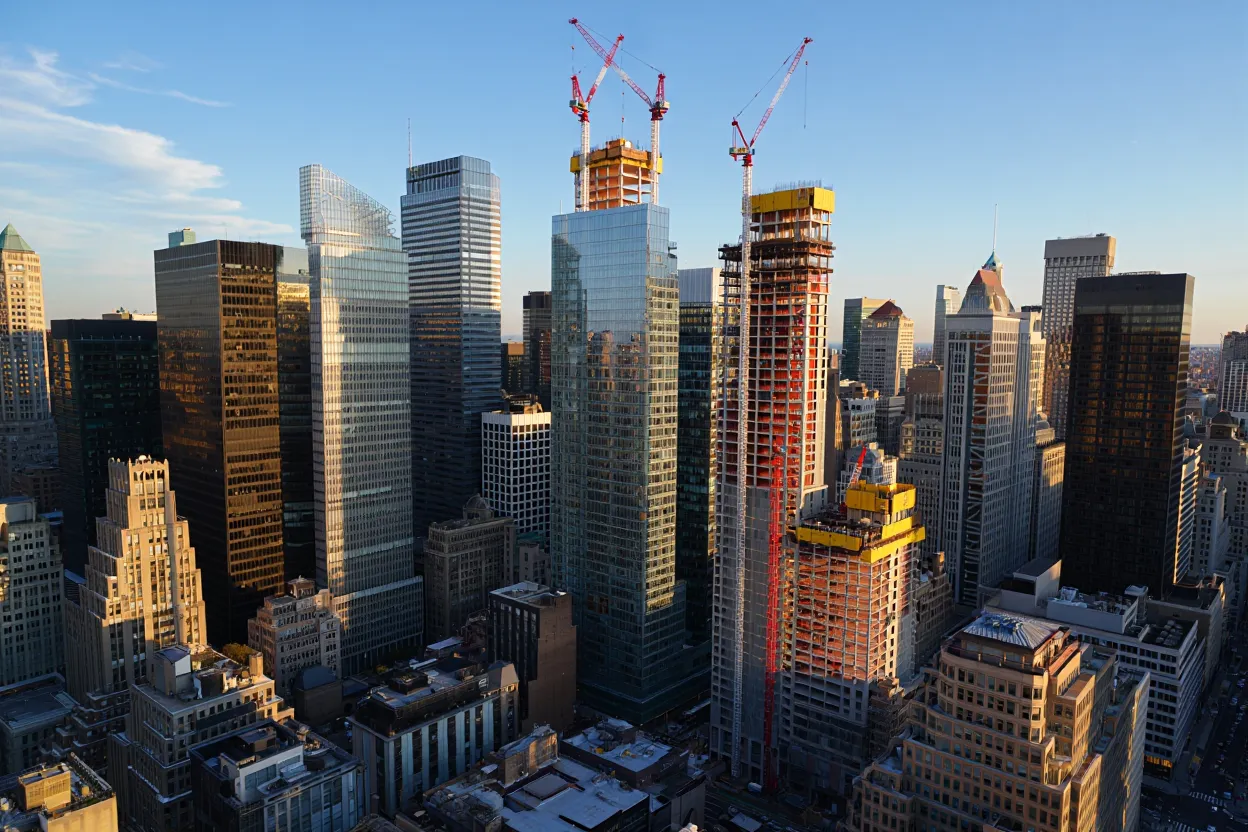
- Manhattan development sales reached $706.6M in Q2 2026, up 1,457% from the prior year per Avison Young.
- Office and multifamily/mixed-use also logged robust volume increases; retail underperformed in value but not transaction count.
- Rising activity points to renewed optimism, though most asset classes saw PSF pricing declines except development.
Investment Activity Returns to Manhattan
Manhattan’s commercial real estate market saw a dramatic swing in Q2 2026 as development and office transactions drove a sharp rise in total sales, according to a report from Avison Young cited by Globe St. The borough recorded 94 property sales totaling $3.41B—a 103% jump in dollar volume from the prior year, even as quarterly activity moderated. While sales activity remains uneven across asset classes, the remarkable surge in development transactions underscores fresh confidence among both buyers and sellers.
This surge stands out since, just a year earlier, Manhattan’s CRE environment was marked by muted development starts and investor caution. Development’s turnaround, coupled with gains in office and multifamily/mixed-use segments, now suggests a broader recovery underway in New York’s investment market.
Get Smarter About What Matters in New York
Subscribe to our free newsletter covering the biggest commercial real estate stories across the five boroughs — delivered in just 5 minutes.
The End of the Drought for Development Deals
After years of sluggish performance, Manhattan’s development sales exploded to $706.6M in Q2 2026, representing a 1,457% year-over-year increase. Avison Young flagged this volume as the strongest since before the pandemic.
The number of development transactions also jumped 333% versus last year, showing that it’s not just megadeals skewing the results—activity was spread across more projects and players. Prices for development land reflected rising demand, climbing 66% to $656 per buildable SF, whereas most other asset classes saw their PSF values slip.
The Details
Office tallied $1.51B in sales—up 68% from Q2 2025—and clinched the largest single asset deal: 575 Fifth Avenue traded for $378M. Multifamily and mixed-use volume hit $888M (a 219% gain), lifted by deals like 7 Dey Street’s $222.6M sale. By contrast, retail sales value slumped 48% to $164.5M, although the number of transactions nearly doubled to 23, indicating greater interest in smaller or repositioning plays.
Pricing dropped across most sectors: retail fell 43% to $1,079 PSF, office slipped 16% to $567 PSF, and multifamily/mixed-use softened by 3% to $770 PSF. The outlier was development, due to strong site bidding and a limited pipeline.
Expansion Beyond Trophy Assets
The pattern of transaction growth wasn’t limited to headline-grabbing towers. Avison Young highlighted rising sales of smaller mixed-use and retail properties. That broader activity comes as institutional investors return to office opportunities after years of caution.
The $450.8M deal for 405-415 Park Avenue anchored development. Retail’s largest sale, 1511 Third Avenue, closed at $46.1M. More retail and multifamily transactions suggest investors are looking beyond core properties. They may be targeting value in previously overlooked locations or asset types.
Why It Matters
The data point to a fundamental shift in Manhattan’s CRE investment environment. Annualized sales surging over 100%—and a 1,457% leap in development—suggest risk tolerance is returning, and that capital once sidelined by uncertainty is reentering the market. Principal Brandon Polakoff at Avison Young emphasized how price discovery and confidence in New York City’s long-term fundamentals are fueling this trend. Notably, average sale pricing slipped for offices and retail, which could attract buyers priced out earlier in the cycle. Development was the only segment with pricing gains, up 66% per buildable SF, underscoring fierce competition for scarce, buildable land.
While office led all sectors by total sales volume, the broader participation in secondary segments implies more wide-reaching investor conviction. The fact that retail transactions almost doubled year-over-year—even as average pricing cratered—reflects speculation that owner-users, niche players, and adaptive reuse strategies are driving activity, rather than a recovery in traditional retail leasing demand. As Manhattan’s CRE market continues to diversify, rising deal flows may test the staying power of recent pricing trends. Per Avison Young, the sector mix and risk spectrum for Manhattan deals in 2026 looks broader than any time since before COVID-19.
What’s Next
Looking ahead, Avison Young is tracking whether owner-use and adaptive reuse will continue to underpin retail and office investment. Observers are watching whether momentum extends beyond trophy properties—especially as more capital competes for limited core assets and as development pricing escalates. The impact of these trends on future pipeline activity, deal pricing, and the composition of Manhattan’s investment base will be crucial for the second half of 2026. With the strong start to the year, Manhattan could be on track for its highest development sales volume since 2019 if activity persists at this pace.