




- US small-cap CRE sales rose 9.3% YoY to $57.1B in H1 2026, led by industrial and retail sectors.
- Institutional capital increasingly targets deals under $25M, blurring traditional market lines and increasing competition.
- Industrial sets new records, retail overtakes other sectors in growth, but multifamily’s market share and pace are shrinking.
Recovery in Small-Property Deals Outpaces Expectations
Green Street’s latest Real Estate Alert Broker Rankings report signals a market-wide shift in US commercial real estate, especially for small-cap transactions between $5M and $25M. The report, published August 2026, details how industrial and retail are fueling a recovery, with H1 2026 sales totaling $57.1B—a 9.3% increase from 2025, per Green Street. This marks the second consecutive year of first-half growth, but activity remains about 10% below the 2022 high of $63.55B, highlighting a recovery with room to run.
Industrial and retail are driving most of the rebound. Demand for smaller, well-located assets is reshaping the landscape, while institutional buyers increasingly chase smaller deals. This challenges the old segmentation between private-capital and institutional activity, leading to more liquidity—and more competition—across the lower rungs of the transaction scale.
Get Smarter about what matters in CRE
Stay ahead of trends in commercial real estate with CRE Daily – the free newsletter delivering everything you need to start your day in just 5-minutes
Industrial and Retail Sectors Take the Lead
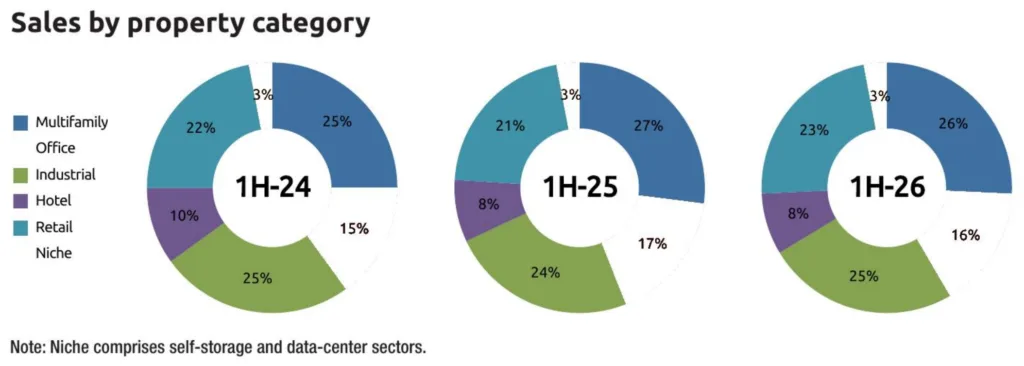
Industrial transaction volume surged 12.6% to a record $14.2B during the first half of 2026, Green Street reports. That edges out the 2022 peak by over 5%, and industrial’s share of small-cap deals now exceeds 24.9%, up sharply from 16.3% seen in 2019. Both Q1 and Q2 set new records, and strong appetite persists for urban infill and strategic industrial locations that are tough to replicate.
Retail outpaced even industrial by growth rate, jumping 17.7% to $12.91B—a new benchmark, according to Green Street. Retail’s market share hit 22.6%, the highest since Green Street started tracking this sector breakdown in 2019. Strip centers dominate, accounting for 65% of retail volume, with institutional capital returning to necessity-anchored and grocery positions. The report notes that strip-center foot traffic is robust, with higher-end malls in San Jose, Phoenix, and Orange County outperforming other mall formats, while many secondary malls lag behind pre-pandemic numbers.
Source: Green Street
The Institutional-Private Border Is Disappearing
One of the report’s major observations is the growing institutionalization of the small-deal market. Institutional investors who once rarely looked below $100M are routinely underwriting $50M deals. Meanwhile, buyers traditionally focused on $25M–$50M transactions are dropping down toward the $10M mark. Private capital, on the other hand, is getting more sophisticated—building up analytical teams, formalizing investment committees, and mimicking institutional portfolio strategies.
This convergence is eroding the traditional private-institutional dividing line at $25M. The effect is intensified competition for assets, greater liquidity, and upward pressure on pricing in the $5M–$25M range. According to the report, this trend is both cyclical—driven by a tight yield environment—and structural, as managers across the capital stack adjust to new market realities and operational standards.
Why It Matters
The latest transaction data from Green Street points to a commercial market that’s healthier but highly segmented. That improvement follows a 2% increase in CRE property prices during 2025, signaling broader stabilization across the market. Small-property liquidity is improving, especially as private investors behave more like institutions and global capital adapts to smaller deal sizes. Brokers handled roughly $35.0B of the $57.1B total in H1 2026, with CBRE leading all firms by brokering $7.04B, a 22% increase. Institutional buyers’ willingness to underwrite lower-value deals indicates both a search for yield and resilience across more asset classes, not just core.
Sector divergences are stark. Industrial and retail are clear winners, with record sales and increased market share—retail rising fastest at 17.7%. Multifamily remains the largest sector by total volume at $14.54B, but its slice of the small-deal market has shrunk from 31% during 2019–2021 to just 25.5% in H1 2026. Activity in conventional apartments is flat, while senior housing in that category posted a 38% jump to $1.98B. Office volume rose 6.2% year over year but now claims just 16.3% market share, well below its pre-pandemic position.
These dynamics highlight shifting risk and opportunity as market players accept today’s higher-yield environment, with fewer bets on rapid rent growth. The use of Delaware statutory trusts (DSTs) for 1031 exchanges is also accelerating. DST fundraising hit $8.41B in 2025 (up 49%), and Green Street expects up to $11B in 2026 as boomers seek passive income and estate planning solutions. This demographic wave has potential to unlock further supply, as Americans over 70 now control more than $55T in inheritable assets, per Green Street’s sources.
What’s Next
Green Street’s report suggests the small-cap transaction market faces macroeconomic, not capital, constraints in the second half of 2026. With the 10-year Treasury yield near 4.7%, investors are watching employment data and rates closely. Underwriting remains disciplined; buyers now demand that deals pencil out on today’s rents and returns, reflecting little tolerance for overoptimistic projections. If baby boomer owners continue to embrace DSTs or other passive strategies, additional inventory could come to market, supporting sustained transaction volume—at least as long as recession fears and yield spread volatility remain contained.