





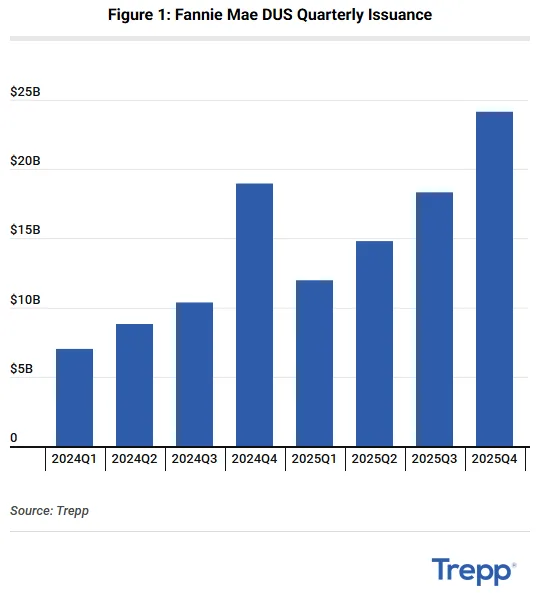
- Fannie Mae DUS origination volume jumped to $24.1B in Q4 2025, the highest since Q4 2020.
- Growth primarily driven by increased loan count, not larger loan sizes or looser standards.
- Underwriting metrics and interest-only structures remained stable despite the surge.
- Apartment properties dominated, with broad-based regional participation in higher issuance.
Sharp Uptick in DUS Volume
Trepp reports that Fannie Mae’s Delegated Underwriting and Servicing program had its strongest quarter since 2020. Origination activity reached $24.1B in Q4 2025. That total rose by roughly one-third from the previous quarter. It also came in well above Q4 2024. The program has now posted three straight quarters of growth. The surge came mainly from higher loan volume. Lenders closed more deals, not larger ones.
Steady Underwriting Fundamentals
Despite robust issuance growth, DUS underwriting criteria showed little change. Average loan size was mostly flat versus a year earlier. Loan-to-values ticked up only modestly, while debt service coverage ratios and debt yields remained within recent ranges. The dominance of interest-only loan structures persisted, showing lenders scaled up origination without loosening credit or altering loan mechanics. This aligns with broader signals that commercial mortgage activity is beginning to find a floor after a prolonged slowdown, even as certain sectors remain uneven. The preference for five-year term loans increased toward year-end, indicating interest in shorter maturities.
Get Smarter about what matters in CRE
Stay ahead of trends in commercial real estate with CRE Daily – the free newsletter delivering everything you need to start your day in just 5-minutes
Multifamily and Regional Expansion
The DUS activity boost in Q4 was concentrated in core apartment and cooperative property loans, with these segments accounting for nearly all dollar growth. Specialized property types such as manufactured housing and affordable housing grew only modestly and did not impact the overall mix. Regionally, origination increased across all major US areas, with notable gains in the South Atlantic, Pacific, and Middle Atlantic states. Growth patterns suggest momentum is shifting into regions that lagged in prior quarters, rather than accelerating only in traditionally active markets.
What’s Ahead
The Q4 2025 DUS results suggest borrower demand and lender capacity are aligned, fueling broad-based momentum for Fannie Mae’s multifamily financing. The absence of material underwriting erosion positions the DUS program for continued stability as the market enters 2026.