






- A Dallas Fed working paper estimates unauthorized immigration drove 30% of US home price growth from 2021 to 2024.
- The research links a 7M-person immigration surge to both labor market gains and housing demand spikes, especially where supply lagged.
- This analysis represents the first empirical estimate quantifying immigration’s recent impact on rents and home prices at the MSA level.
Immigration’s Role in Housing Market Turbulence
The Dallas Federal Reserve released a working paper that directly connects the surge in unauthorized immigration under the Biden administration to a sizable portion of recent home price appreciation. According to Just the News, the authors found that the arrival of about 7 million unauthorized immigrants from early 2021 to early 2024 created a demand shock in already tight US housing markets, driving major increases in both home prices and rents.
Per the paper, upward pressures were concentrated in metropolitan statistical areas (MSAs) that already faced housing supply constraints. The researchers applied a new statistical approach that combined immigration court records with government administrative data to map local market effects at a granular level—a first for this type of analysis.
Get Smarter about what matters in CRE
Stay ahead of trends in commercial real estate with CRE Daily – the free newsletter delivering everything you need to start your day in just 5-minutes
Quantifying the Demand Shock
The working paper estimates total weighted-mean increases in home prices and rents during the 2021–2024 timeframe were 22.4% and 22.6%, respectively. The authors attribute roughly 30% of the home price surge and 20% of the rent increase directly to the wave of unauthorized immigration. With new housing production failing to keep up with new arrivals, existing homes absorbed most of the demand.
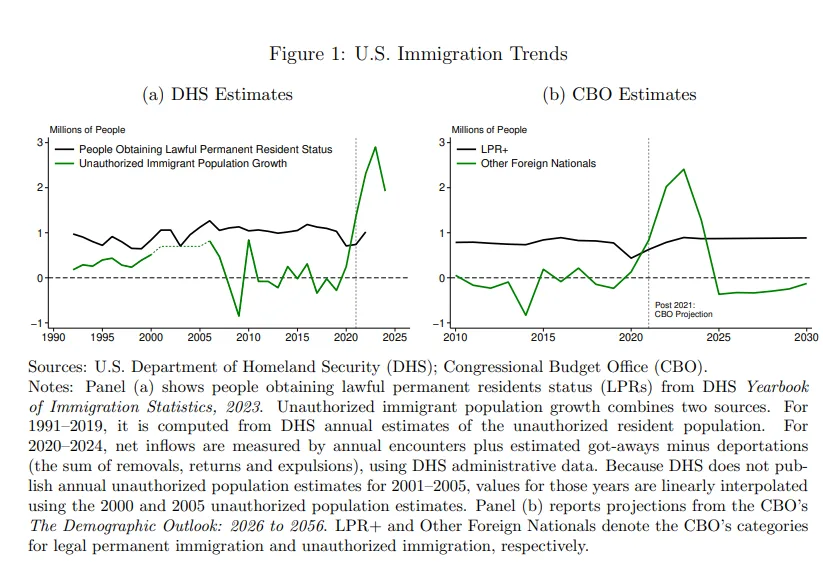
Despite the rapid influx, the researchers found little evidence that new homebuilding ramped up in response. Instead, the report identifies a classic demand shock, with local housing markets unable to adjust supply quickly enough to offset the impact. The paper emphasizes these findings are preliminary and subject to further professional review.
MSA-Level Analysis Offers Fresh Perspective
This paper represents the first systematic empirical effort to tie a specific immigration episode to housing market outcomes at the local level. Prior research often focused on broader macro trends or struggled to isolate unauthorized immigration’s unique impact. Here, by tracking where new arrivals settled and linking this to local pricing pressure, the authors suggest causation—at least for this period.
Other studies, like Moody’s 2024 Housing Analysis, have noted regional disparities in home price appreciation, with fast-growth Sun Belt metros disproportionately affected by migration patterns. But the Dallas Fed study provides a quantitative attribution, filling a persistent data gap for policymakers and investors.
Why It Matters
For CRE professionals, the Dallas Fed’s findings underscore the sensitivity of both home and rental pricing to sudden inflows of new residents, particularly in supply-constrained cities. According to the report, immigration alone accounted for about a third of home price inflation—significantly more than could be explained by interest rate policy, construction costs, or other common culprits over this period.
Markets that experienced the highest price jumps, such as Phoenix, Dallas, and Miami, were popular landing points for new arrivals, amplifying baseline demographic and supply/demand pressures. The study also highlights the limited elasticity of the homebuilding sector, which failed to ramp up even as the demand surge became clear. That dynamic, per the Urban Institute’s 2023 estimate of longstanding housing shortages, suggests CRE developers and investors need to monitor population flows closely—even when job growth is driving positive metrics elsewhere in the market.
While the paper stops short of making policy prescriptions, its quantified approach offers a new tool for understanding the localized effects of large-scale migration. For cities with known shortages or strained permitting pipelines, similar demand shocks could continue to drive pricing volatility and outpace incomes.
What’s Next
The Dallas Fed authors stress that these results are preliminary and invite professional commentary. Further analysis and peer review are likely, and other institutions may soon follow with their own methodologies to validate or challenge the findings. CRE analysts, developers, and multifamily operators watching for persistent pricing volatility—or opportunities in high-growth, supply-constrained metros—should keep an eye on follow-up studies.
Meanwhile, the connection between population growth, supply lags, and accelerating price appreciation could inform everything from investment strategy to local housing policy through 2026 and beyond, as post-pandemic migration patterns continue to shift.