




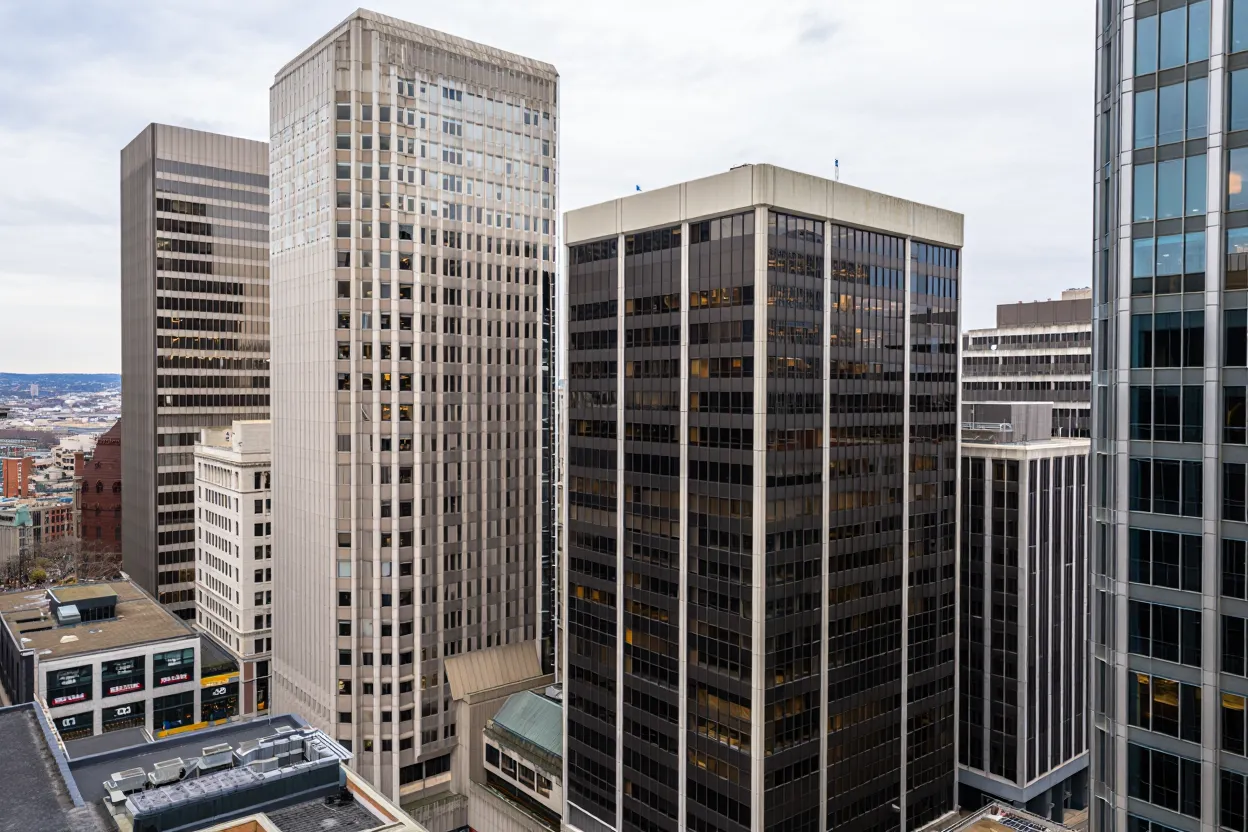



- Brookfield has slashed its D.C.-area office footprint, offloading over 2M SF and several trophy assets since 2020.
- The firm claims strategic portfolio management, but experts cite market decline, shrinking demand, and a push into data centers as key drivers.
- With asset values dropping up to 50%, smaller and private buyers are increasingly willing to step into the distressed D.C. office market.
From Trophy Investments to Strategic Exits
Brookfield has rapidly exited a significant chunk of its Washington, D.C.-area office portfolio since the onset of the pandemic. As detailed in Bisnow, the Canadian giant has sold more than 2M SF of local office space, dropping from 32 D.C. properties in 2019 to just 20 in 2026, while reducing its on-the-ground staff by 70%. Notably, Brookfield has divested both stabilized assets and distressed ones, with five Montgomery County buildings going to foreclosure last fall and a Bethesda tower purchased for $150M in 2011 selling for just $20M last month. These moves conclude two decades of major institutional involvement in D.C. office and highlight a dramatic strategic pivot.
This transformation comes amid severe market stress. According to CoStar, US office vacancy rates are projected to stagnate through 2026, after already climbing to record levels. The turmoil is compounded in D.C. by a federal workforce reduction—238,000 fewer jobs in 2025 per Pew Research Center—and government efforts to offload surplus office buildings. These factors have undermined a market Brookfield once touted for its stable, creditworthy tenants and steady growth.
Get Smarter about what matters in CRE
Stay ahead of trends in commercial real estate with CRE Daily – the free newsletter delivering everything you need to start your day in just 5-minutes
The End of D.C.’s “Prime” Office Era
Washington, D.C. was once among the world’s most sought-after office markets. Today, it reflects the sector’s post-pandemic challenges. Brookfield entered the market in 2004 by buying the 364K SF Edison Place for $167.1M. It sold the property in 2025 for $175M.
The sale showed a paper gain but an inflation-adjusted loss exceeding $100M. Brookfield expanded again in 2018 with its $11.4B acquisition of The Yards waterfront project. However, it began selling assets just six years later. Parcel Q’s rezoning from office to residential reflects both a tactical move and changing market conditions. Alongside discounted trophy tower sales, these deals mark the end of D.C.’s low-risk office era.
The Details
Brookfield has sold assets through planned sales and lender takeovers. In May, it sold the 388K SF 3 Bethesda Metro Center for $20M. The price marked an 87% drop from its $150M purchase in 2011.
In February, a downtown glass tower sold for $163M, far below pre-pandemic values. Brookfield also lost several properties to foreclosure, including six Montgomery County offices in October. Lenders took ownership of five buildings. The company says it is recycling capital through disciplined portfolio management. It has also shifted local property management to a CBRE partnership.
Meanwhile, Brookfield is marketing Parcel Q at The Yards. The site now supports residential development after a May 2026 zoning change. The company continues prioritizing logistics, retail, and digital infrastructure.
D.C.’s Office Market Reset Attracts New Buyers
Office values have fallen about 50% from their peak, according to Bisnow. That decline has changed the market’s risk and reward. Institutional investors like Brookfield are shifting capital into data centers and digital infrastructure. Its $100B AI infrastructure program, launched in November 2025, highlights that strategy.
At the same time, smaller investment firms, family offices, and entrepreneurs are buying discounted assets. In-Rel Properties acquired Bethesda Metro Center for just $51 PSF. Many buyers are upgrading older buildings with modern amenities. Others, including FarmViewVentures, expect distressed assets to recover as tenant demand evolves.
Why It Matters
D.C.’s office reset extends beyond one city. It reflects a broader shift in office ownership across government-focused markets. Brookfield’s exit shows that long-standing assumptions about core office markets no longer hold. D.C. also faces a shrinking federal workforce, adding pressure beyond national office trends.
Meanwhile, Brookfield continues shifting capital toward data centers and digital infrastructure. The move reflects structural demand changes, not just portfolio adjustments. CoStar expects US office vacancies to remain elevated through 2026, keeping pressure on rents and values. As institutions step back, local investors can reposition assets more quickly.
Smaller investors now have opportunities to convert offices into housing, upgrade amenities, or create speculative suites. That momentum matches a growing wave of office-to-residential projects gaining financing across Washington as developers pursue adaptive reuse. Large institutions increasingly favor diversification over concentrated office exposure. As values reset, private investors will likely shape D.C.’s office market for years ahead.
What’s Next
Brookfield will likely stay active in the region with a different investment focus. Its $100B digital infrastructure strategy points toward data centers, logistics, and mixed-use projects instead of traditional offices.
The D.C. office market will likely attract smaller, entrepreneurial buyers. Distressed acquisitions, conversions, and property upgrades should drive activity over the next year. Brokers also expect more Class B-to-Class A conversions and continued ownership changes as institutions rebalance their portfolios.