





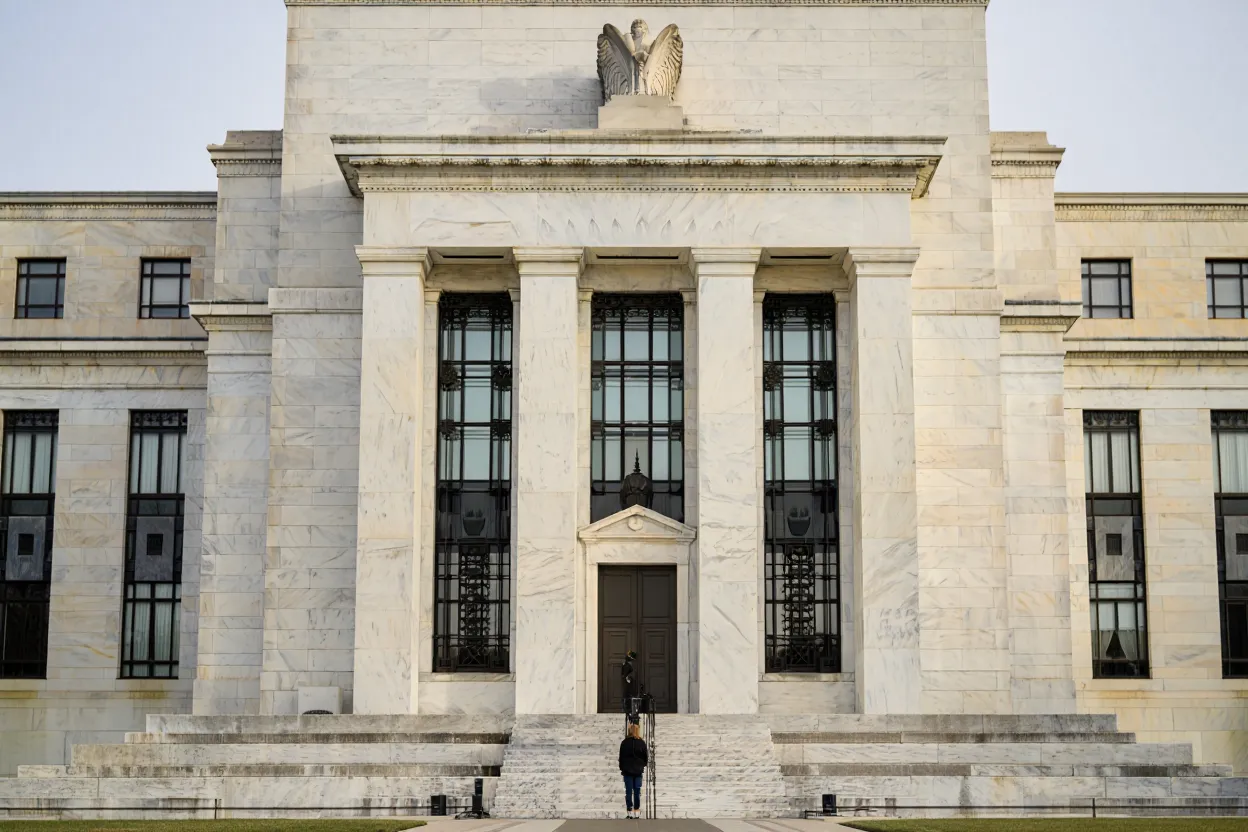



- Alan Greenspan, who led the US Federal Reserve from 1987 to 2006, died at age 100, per NBC News.
- His policies oversaw major economic growth and crises, influencing both the 1990s boom and later criticism post-2008 crash.
- Greenspan’s legacy remains controversial, with his decisions still shaping monetary policy debates and CRE risk models.
From ‘Maestro’ to Lightning Rod
Alan Greenspan’s nearly two-decade tenure atop the Federal Reserve made him one of the most influential—and polarizing—figures in modern US economic history. Reuters reports that Greenspan died Monday at 100 from complications of Parkinson’s Disease, citing his wife, Andrea Mitchell. Originator of the so-called ‘Fed speak’ and the second-longest-serving chair after William McChesney Martin, Greenspan oversaw the central bank through a pivotal period spanning the October 1987 market crash, the 1990s expansion, and the early 2000s asset run-ups.
Greenspan’s influence outlived his term, with both praise and blame for subsequent busts. His reign included the second-longest US economic expansion—March 1991 through March 2001—and his steady response to Black Monday set an early tone for activist central banking. But the unresolved debate over his deregulatory stance and policies during the run-up to the 2007-2009 crisis continues to inform analyses in CRE risk and banking circles.
Get Smarter about what matters in CRE
Stay ahead of trends in commercial real estate with CRE Daily – the free newsletter delivering everything you need to start your day in just 5-minutes
The Details
President Ronald Reagan appointed Greenspan to the Fed in 1987. Presidents George H.W. Bush, Bill Clinton, and George W. Bush reappointed him.
He guided major shifts in monetary policy and markets. He often consulted White House and Treasury officials. Still, he remained independent and hard to read. In 1996, he warned of “irrational exuberance” in stock markets. After the 1987 crash, he quickly injected liquidity. Many credit that move with stabilizing markets.
Greenspan also guided the economy through the 1990–91 recession. He managed the Asian and Russian crises, the dot-com crash, and the post-9/11 period. He relied on data but also trusted judgment. He viewed the mid-1990s productivity surge as noninflationary. Fed officials still cite that view today.
Monetary Expansion and Its Critics
The Greenspan era brought strong growth through much of the 1990s. The S&P 500 returned more than 15% annually, according to Bloomberg. Debates over monetary policy remain divisive, with recent disagreements among policymakers raising questions about future rate moves.
However, critics questioned his policies. They argue low rates and weak regulation fueled the housing bubble. They also blame those policies for worsening the global financial crisis. In 2008, Greenspan admitted he misjudged banks’ ability to self-regulate. He said he felt “shocked disbelief” at their behavior.
Later Fed chairs embraced transparency. They adopted inflation targets and held regular press conferences. That differed sharply from Greenspan’s opaque style. Some also felt his backing of President George W. Bush’s 2001 tax cuts weakened central bank independence.
Why It Matters
Greenspan shaped a major era for US markets and real estate capital. His hands-off approach supported financial innovation. It helped drive CMBS growth and new risk models. However, it also exposed markets as underwriting weakened.
Regulations such as Dodd-Frank and Basel III followed the 2008 crisis. Many link those reforms to risks that emerged under Greenspan.
He allowed the economy to run hot in the mid-1990s. That decision extended growth and fueled CRE development. At the same time, his deregulatory approach influenced lending standards that markets still confront.
Market participants still study Greenspan’s decisions. Federal Reserve Chair Jerome Powell has cited his handling of productivity shocks. Powell argues policy sometimes requires judgment beyond economic models.
Some praise Greenspan as a master policymaker. Others blame him for enabling later crises. His legacy reminds CRE professionals that monetary policy shapes debt, equity, and development cycles. As investors face new rate decisions, his record offers both lessons and warnings.
What’s Next
The Federal Reserve’s ongoing challenge is to balance stability and innovation while learning from both Greenspan’s successes and missteps. Current macro uncertainty—persistent inflation, shifting rate expectations, and financial sector stress—has Fed watchers debating how much risk-taking central banks should tolerate. Greenspan’s calibrated blend of intuition and data is now juxtaposed against a more formulaic, transparent regime. For the CRE community, the lessons of his tenure—a willingness to act boldly during turmoil, the consequences of deregulation, and the complexities of forecasting—are sure to shape deal structuring and investment strategy for years to come.